2 The Income Barrier to Tertiary Education Rising Incomes, De-commodification, and the Decline of Access Inequality in Brazil
Abstract:
Influential theories of educational inequality in social stratification explain distributional change through enrollment expansion either by the saturation of upper-stratum participation or by competition dynamics governing selective access. We argue that the premises required for either mechanism to operate are absent in Brazil: during its second expansion cycle (1990s to the present), enrollment grew in parallel across income strata in a predominantly private, non-selective system. Yet income-based inequality in access fell dramatically. We propose an alternative framework drawing on welfare-state theory and the political economy of education conciliated with the micro-mechanisms of educational inequality proposed in the social stratification literature. Continuation decisions are conditioned by a cost-benefit calculus anchored in household income constrains, educational costs and returns. Unless de-commodification policies are in place, access inequality is governed by the barriers that family income must clear. Those barriers fell through rising real incomes and falling inequality that reduced the cost of continued study especially for the poor, and through (mostly) redistributive subsidy and affirmative action policies that reduced income depencence in tertiary education access for targeted groups. The prior expansion of free secondary education, itself a necessary but not sufficient precondition explicable through an analogous cost-barrier and de-commodification logic, underpins both channels. Drawing on harmonized household surveys (1992–2025) and proceeding by inference to the best explanation, this paper provides a political economy account that restores institutions, redistribution, and state regulation to explanations of educational inequality from which they have been systematically absent.
2.1 Introduction
In Brazil, access to most tertiary education — often conceived as the outcome of competition for scarce seats — requires neither academic performance nor success in selective entrance examinations. Admission depends above all on the ability to pay tuition. Competitive selection is concentrated in a narrower segment of tuition-free public institutions and in a subset of high-prestige private programs. Within that segment, selective entrance examinations determine who gains access, and performance on those examinations is itself strongly stratified by income (Senkevics et al., 2024; Senkevics et al., 2022). It would come as no surprise, then, that a system in which access is effectively mediated by ability to pay exhibits pronounced income-based inequality. Yet, over the past three decades, even as private-sector participation expanded substantially, access inequality fell sharply and the share of students from lower-income backgrounds increased. What explains the variation? We argue that trends in income barriers to enrollment, shaped by both market dynamics and de‑commodifying public policies, best account for this trajectory.
The case poses a straightforward challenge to dominant theories of educational inequality, which explain the distributional consequences of expansion in one of two ways. Since the late 1990s, Brazil has undergone what is commonly described as a second cycle of tertiary expansion (Senkevics, 2021): enrollments increased from approximately 1.6 million in 1995 to roughly 10 million in 2024. The saturation account, formalized as the maximally maintained inequality hypothesis (MMI), holds that inequality in access declines only when enrollment among upper socioeconomic strata approaches saturation; until then, growth is absorbed by the privileged and inequality remains constant or increases (Raftery & Hout, 1993). The competition account instead argues that inequality varies with the intensity of competition for places: when supply outruns demand, institutions relax selection criteria and inequality declines; when demand outruns supply, selection thresholds rise and privileged groups, who can purchase preparation and credentials, extend their advantage (Alon, 2009). The Brazilian literature has often found support for these theories when interpreting the national trajectory (Brito, 2017; Salata, 2018; Salata et al., 2025). We argue, however, that the premises on which both mechanisms rest are absent in the Brazilian case. Upper- and middle-stratum enrollment remained far from saturation throughout the period, and the enrollment rates of different income strata grew in parallel — the poorest deciles began gaining ground long before the middle of the distribution had saturated, which the saturation logic cannot accommodate. And competition, the engine of the second account, does not allocate most Brazilian seats at all: roughly three quarters of enrollment is in private institutions that admit anyone who can pay, and a further share of public seats is allocated through affirmative action criteria rather than open competitive examination.1
If neither saturation nor competition can carry the explanation, what does? This paper proposes an account centered on what we call the income barrier, drawing its theoretical vocabulary from welfare-state theory and the political economy of education rather than from the sociology of educational transitions (Esping-Andersen, 1990; Garritzmann, 2016). In a system where most access is bought, the probability of enrollment for a young person from a given household depends on whether family income can clear the barriers that stand between eligibility and a seat: completing secondary education, forgoing earnings, and — for the majority who enter through the market — paying tuition. Access inequality declines when those barriers fall for the lower reaches of the income distribution, and the Brazilian trajectory records two channels through which they fell, conditioned by the removal of a prior barrier. Through the affordability channel, sustained real income growth at the bottom of the distribution (driven by minimum-wage policy, formalization, and the broader decline of income inequality) met tuition prices that fell steeply relative to the incomes of the poor, so that a substantial share of lower-income families became able to purchase private tertiary education without any subsidy at all. Crucially, this affordability channel is not exogenous to state action: following the distinction between market and disposable income, the state’s general redistributive framework — minimum-wage policy, pension indexing, cash transfers — shapes the disposable income households bring to the tuition barrier, so the channel is itself a political product (Section 2.3.2 develops the distinction). Through the de-commodification channel, a sequence of targeted policies — ProUni scholarships, subsidized FIES loans, the Lei de Cotas, REUNI’s expansion of tuition-free federal capacity — reduced the price of access to zero or near-zero for targeted populations, with strongly redistributive effects whose systemic reach was nonetheless limited by the sheer size of the private market. And both channels operated on a population that only became eligible in the relevant period: the universalization of free, mandatory public secondary education (accomplished across the Cardoso and Workers’ Party administrations) removed the barrier that had previously excluded the poor from the pool of potential entrants altogether. The framework is offered, throughout, as a theory of the change of an outcome — an account of why the income-dependence of access moved as it did — rather than as a general model of intergenerational mobility: its terms are the barriers and their movements, chosen because they are measurable across three decades and manipulable by policy, not the destinations of class trajectories.
The evidence for this account is direct. The share of young adults in households able to clear a fixed real-income threshold rose from 45.9% in 1992 to 77.5% in 2024, while the same tuition bill, measured in units of household income, fell to roughly a third of its 2002 level for the bottom two deciles against two-thirds for the top decile — the affordability channel compressing fastest exactly where the barrier had bound tightest. Targeted instruments reinforced the movement: full ProUni scholarships alone raised the probability of enrollment by approximately 37 percentage points among eligible students. Access inequality fell accordingly through the 2000s and into the mid-2010s, stagnated as real-income growth slowed and de-commodifying instruments were retrenched after 2015, and resumed its decline after 2021 as the affordability channel reopened.
To develop this argument, we draw on harmonized household survey microdata (PNAD and PNAD Contínua) from 1992 to 2025, summarizing income-based access inequality as a concentration index — a Gini-like scalar measuring the degree to which enrollment is concentrated among higher income ranks — and we synthesize the quasi-experimental evidence that the economics of education has accumulated on the causal effects of individual policy instruments. The measurement choice is itself part of the argument: a theory of income barriers requires an instrument that registers movement across the whole income distribution, not the odds ratio between two fixed poles of a class schema, which by construction ignores the middle of the distribution — a middle composed, in Brazil, of people whose incomes resemble those of the poor far more than those of the rich.
This article brings together contributions usually confined within disciplinary silos. The theoretical contribution is to incorporate redistribution and policy design into explanations of educational inequality through the income-barrier framework, connecting the educational stratification debate to welfare-state theory and to the literature on the decline of Brazilian income inequality. The methodological contribution is to adapt the concentration index to measure inequality in access to tertiary education, departing from conventional logit-based approaches and their focus on class-origin effects. The empirical contribution is a systematic longitudinal measurement of income-based access inequality across three decades, read jointly with the causal evidence base.
The contribution is best situated through the methodological distinction between population-oriented and case-oriented causality (Mahoney, 2008, 2021): the former asks for the mean effect of a variable across a large sample of units, the latter asks what accounts for a particular outcome in a particular case — here, the trajectory of access inequality in Brazil across three decades. This chapter pursues the second kind of question: it does not estimate the average effect of a single policy, but adjudicates between rival explanations for why that trajectory took the shape it did, eliminating the premises of the saturation and competition accounts and showing that the income-barrier framework survives contact with the same evidence. Under the inference-to-the-best-explanation standard that Spirling & Stewart (2025) argue governs almost all empirical social science, and that Fairfield & Charman (2022) formalize for qualitative inquiry, evaluating the observable implications of rival explanations is not a weaker substitute for causal identification but an equally constitutive part of the same inferential task — one this chapter undertakes at the level the identification literature does not, the system as a whole rather than one instrument at a time.
The many recent quasi-experimental studies of Brazilian higher-education policies belong, in this sense, to the same research agenda: each estimates the population-level effect of one instrument, and together they supply much of the evidence read below as the de-commodification channel’s causal record (Section VII) — the kind of accumulating, credible evidence base that Callis et al. (2022) argue design-based research builds precisely so that theory can integrate it — while the case-oriented question of why the aggregate trajectory took the shape it did remains this chapter’s own. Part III of this dissertation extends the same case-oriented standard formally, through the Bayesian process-tracing framework of Fairfield & Charman (2022), whose machinery requires rival hypotheses to be stated as mutually exclusive alternatives and weighed against the same body of evidence; the informal adjudication practiced here imposes no such requirement — the candidate accounts are not logically exclusive, and the argument proceeds by showing that the premises the rivals need are absent, rather than by computing their relative posterior standing — but it shares the same rejection of a single frequentist, effect-estimation template as the sole legitimate form of causal inference in political economy (Brady & Collier, 2010; Mahoney, 2010).
The remainder of the paper proceeds as follows. Section Section 2.2 establishes that the premises of the saturation and competition accounts fail in Brazil, and examines the measurement conventions that allowed them to persist. Section Section 2.3 develops the income-barrier framework and its observable implications. Section Section 2.4 presents the data and the concentration-index measurement strategy, and documents the trajectory to be explained. Section Section 2.5 presents the evidence for each mechanism: the affordability channel, the eligibility precondition, and the de-commodification channel. Section Section 2.6 synthesizes the findings and discusses scope conditions; Section Section 2.7 concludes.
2.2 Why the Premises of the Dominant Accounts Fail
2.2.1 Saturation without Saturation
The maximally maintained inequality hypothesis deserves more careful reading than it usually receives. Raftery and Hout’s original argument was not that policy is irrelevant to educational inequality; it was that a specific policy — the abolition of secondary-school fees in Ireland — proved insufficient because the binding constraint for poor families was not the fee but the opportunity cost of forgone earnings. Students and families, in their account, weigh the full costs of continued schooling against its expected returns; inequality declines when that calculus changes for the poor, and the removal of one cost component may leave the calculus essentially untouched. This microfoundation — enrollment as a cost-benefit decision under an income constraint — is one we retain. What we reject is the macro-level prediction grafted onto it: that class differences in transition rates remain stable until the privileged approach universal participation, so that equalization arrives only as a saturation effect.
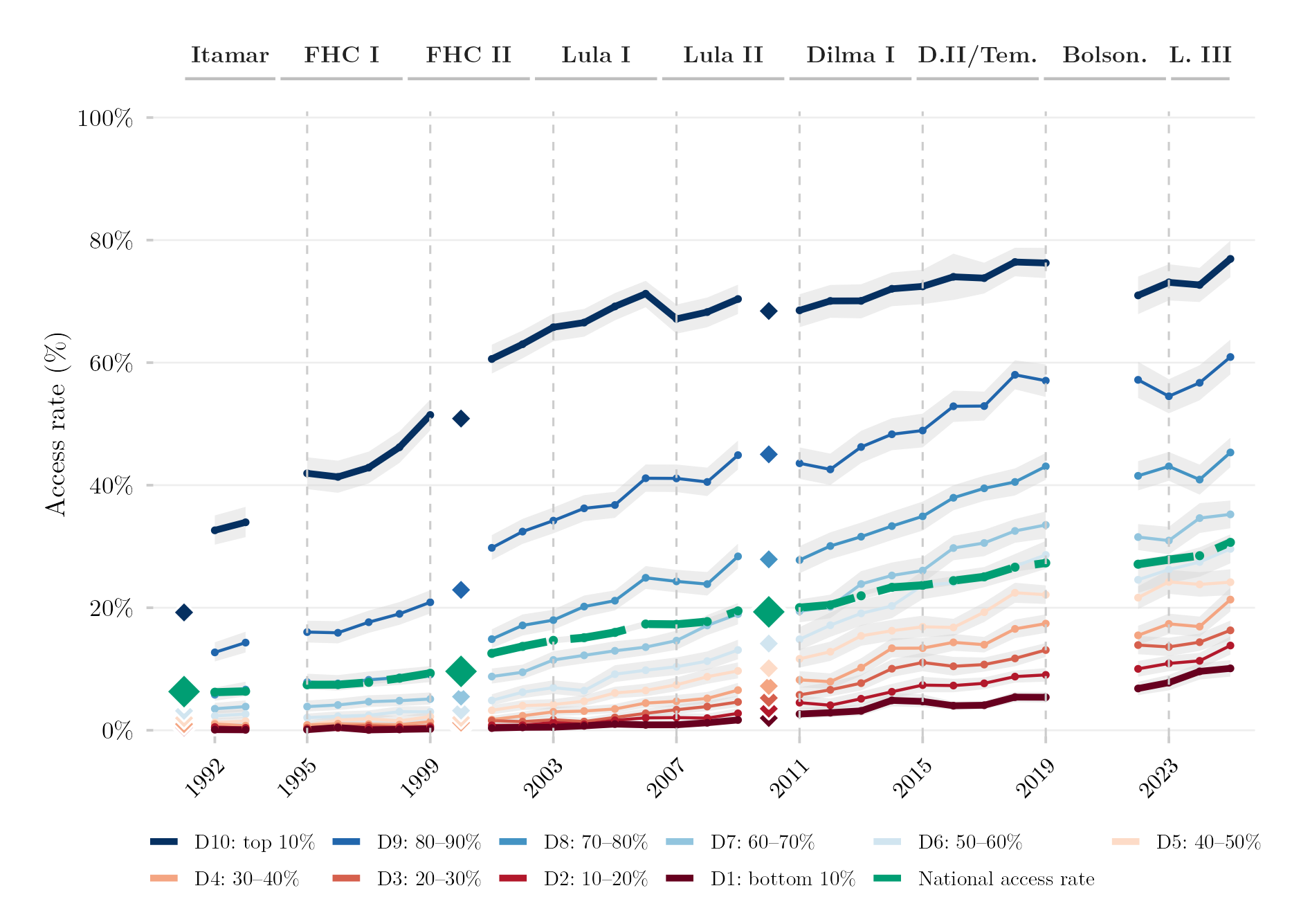
The prediction fails observationally in Brazil, and it fails in a way that no auxiliary assumption rescues. Upper-decile enrollment rates remained far below any plausible saturation threshold throughout the second expansion cycle (Figure 2.1). More tellingly, the growth of participation was parallel rather than sequential: the enrollment rates of the poorest deciles began rising before the middle deciles had saturated — indeed, while the middle of the distribution was itself still expanding vigorously. The saturation logic requires an orderly queue, in which each stratum’s gains await the exhaustion of demand above it; the Brazilian data show all strata advancing simultaneously, at rates that vary by period in ways the queue metaphor cannot generate. A hypothesis whose mechanism is the sequential filling of strata has little to say about a system in which the strata fill in parallel.
2.2.2 Competition without Competition
The competition account faces a more elementary difficulty: the mechanism it presupposes does not allocate most Brazilian seats. Alon’s framework turns on how institutions adjust selection criteria as the balance between applicants and places shifts, and on the superior capacity of privileged families to purchase advantage — test preparation, extracurricular credentials, elite secondary schooling — when selection thresholds rise. Where admission is genuinely competitive, this is a powerful lens. But roughly three quarters of Brazilian tertiary enrollment is in private institutions that operate on an open-access, pay-to-enter basis: whoever can pay the monthly tuition bill is admitted, and the effective selection device is the family budget, not an examination. A further segment of public seats — half of federal admissions since the Lei de Cotas — is allocated through affirmative action criteria that restrict competition to candidates from public secondary schools, with income and racial sub-quotas; within those protected pools the better-resourced still tend to fare better, but the pools themselves are defined precisely to exclude the privileged from the contest. What remains is a minority segment — the non-quota places of selective public institutions and a subset of high-prestige private programs — where competitive dynamics of the kind Alon theorizes plausibly operate. Even there, however, the mechanism lacks the systemic stakes the theory requires, because exclusion from the selective segment is not exclusion from tertiary education: the rejected candidate is redirected toward the market route — a low-priced private program, a scholarship, a subsidized loan — rather than out of the system altogether. A theory in which the distributive engine is a contest whose losers forgo access does not describe a system in which losing the contest costs, at most, institutional prestige. That segment matters greatly for elite reproduction and for horizontal stratification, but it cannot govern the system-level trajectory of access inequality, both because it contains too small a share of the seats and because its losers remain inside the system. A further, less noticed difficulty is that the account’s key independent variable — demand — is rarely measured with any care; enrollment-to-application ratios conflate demand with discouragement, and the counterfactual pool of would-be applicants in a system where most cannot pay is unobservable by construction.
None of this retires the stratification tradition wholesale, and the scope of the claim should be stated precisely. Its theories retain their purchase on questions this paper does not pose: who wins the contest for the selective segment, and how advantage is reconstituted horizontally across institutions, courses, and modalities of different prestige once entry to the system has been gained. The claim defended here is deliberately narrower — that the mechanisms of saturation and competition do not govern the explanandum of this paper, which is the income-dependence of access to the system as a whole.
2.2.3 What the Logit Tradition Measures, and What It Misses
The persistence of these accounts in the Brazilian literature owes something to the measurement conventions through which the trajectory has been studied. The dominant approach — exemplified by the Shavit-Blossfeld lineage and its sophisticated Brazilian practitioners (Salata, 2018; Salata et al., 2025) — models enrollment as a binary outcome in logistic regression with social class of origin as the central predictor, and reports inequality as ratios between predefined strata: odds ratios in the classic studies and, in recent work, adjusted relative risks computed from marginal probabilities, a choice that addresses the well-known difficulties of comparing logistic coefficients across years (Salata et al., 2025). This aims to measure (com todas as limitações de dados observacionais) the net effect of class origin, and the Brazilian studies in this tradition document the trajectory with care and increasing temporal coverage. But a ratio between two fixed poles of a categorical distribution — whatever the metric in which it is expressed — is silent about everything between the poles. When the middle of the distribution — which in Brazil is composed of households whose incomes sit far closer to the poor than to the rich — enters tertiary education in large numbers, income-based access inequality has genuinely declined, yet a top-versus-bottom ratio may register little movement. Comparisons confined to the extremes thereby overstate the stability of inequality and understate precisely the kind of distributional change that a mass expansion produces. The point is not that the logit tradition is wrong on its own terms; it is that its terms — class-origin effects net of distributional shape — are not the terms in which a theory of income barriers, or for that matter a policymaker, poses the question.
A second convention deserves comment, with due respect for the design choices that motivate it: the decomposition of access into sequential transitions, with inequality estimated conditionally on completing the prior stage (Mare, 1981). As description, the decomposition is genuinely informative — the recent Brazilian studies use it to show that much of the democratization of unconditional access runs through the convergence of secondary completion (Salata et al., 2025). As a device for isolating a specifically tertiary barrier, however, it faces two difficulties that the framework developed below helps make visible. The first is that household income plausibly operates on both sides of the conditioning: the same budget that pays a tuition bill also sustains an adolescent through secondary school, so that conditioning on secondary completion removes part of the very mechanism whose effect one hopes to observe. The second is that selection into the conditional pool changes over time: when secondary completion was a minority outcome in the bottom half of the income distribution, the poor students who reached the tertiary threshold were a highly selected group in respects no survey observes; as completion universalized, that selectivity dissolved — and trends in conditional transition inequality therefore mix changes in the barriers with changes in the composition of those facing them, a difficulty the transition-model literature has recognized since its founding statements (Cameron & Heckman, 1998; Mare, 1981). Neither difficulty is fatal for description, and both are acknowledged in the tradition’s more candid moments; they do, however, counsel caution in reading the conditional series as a measure of the tertiary barrier alone. For a theory in which income operates along the entire trajectory, the unconditional income-dependence of access is not a contaminated proxy for something purer — it is the quantity of theoretical interest.
The difficulty runs deeper than the choice of inequality measure, because the other half of the conventional design — the measurement of expansion itself — is compromised in ways the field has only recently confronted. Jackson (2021) demonstrates that the enrollment rate, the standard operationalization of educational supply throughout this literature, is statistically endogenous to the very odds ratio used to measure inequality of opportunity: expressed in the parameters of the underlying loglinear model, the enrollment rate is partly a function of the association term that the odds ratio reports, so that decades of studies have correlated a measure of expansion with a measure of inequality that is already contained within it. Her structural objection cuts deeper still. The theories reviewed above treat the supply of places as exogenous — expansion happens, and its distributive “effects” are then read off the data — when educational institutions in fact decide jointly how many places to supply and under what rules those places will be allocated; every new place arrives attached to an allocation rule, and it is the allocation rules under expansion, not expansion itself, that carry the distributive consequences (Jackson, 2021). Because the decision to expand and the rules attached to the new places share common causes, any observed association between enrollment growth and inequality is uninformative about the causal claim the expansion theories make. Whether growth equalizes therefore depends on decisions that the saturation and competition accounts leave entirely untheorized — and the Brazilian case, where the dominant allocation rule is simply the price of tuition, makes the omission unusually visible.
In Brazil, moreover, the measurement problem Jackson identifies takes an acute form. Enrollment is routinely read as a measure of the supply of places — the ratio of entrants to secondary graduates serves, in recent studies, as an index of the balance between supply and demand (Salata et al., 2025) — when enrollment records only the equilibrium of the two. The private sector has long operated with substantial idle capacity, authorizing far more places than it fills; ProUni itself was designed around those unfilled seats (the vagas ociosas), a fact the same studies register in passing. A segment able to absorb, at short notice, essentially anyone prepared to pay is not a segment in which the scarcity of seats can be the binding constraint — and an enrollment series, however long, cannot by itself distinguish a supply constraint from a budget constraint. This is not a fault of any particular study; it is a limitation of the object itself, and one more reason to build the explanation on the variables that do bind: prices, incomes, and the rules attached to subsidized places.
The productive question, we suggest, is not whether inequality is maximally maintained but which allocation regime would permit it to be. Saturation dynamics presuppose a regime in which places are rationed and queued; competition dynamics presuppose a regime in which places are contested; the Brazilian regime prices most places, subsidizes some under targeted rules, and reserves competitive examination for a minority segment. A theory of its inequality trajectory must therefore be a theory of prices, incomes, and subsidies — which is to say, a theory of the allocation rules Jackson’s critique demands. That is the theory the next section develops.
2.3 The Income-Barrier Framework
2.3.1 Enrollment as a Decision under an Income Constraint
We take from Raftery and Hout what is most defensible in their account: prospective students and their families weigh the costs of continued schooling against its expected returns. In the Brazilian tertiary system, the terms of that calculus are set by three institutional facts. First, the expected returns are exceptionally high: the wage premium for tertiary education in Brazil is among the highest recorded in OECD comparative data, so that for anyone who can clear the entry barriers the investment calculus is strongly favorable. Second, for the roughly three quarters of seats in the private sector, the decisive cost is tuition, paid monthly out of current household income, alongside the opportunity cost of forgone earnings. Third, eligibility to attempt entry at all requires completed secondary education. The probability of access for a young person from a household at a given income rank is therefore governed by whether that income can clear the barriers that apply on the route actually available: for the minority route through tuition-free public institutions, the barrier is competitive examination performance (itself income-stratified through secondary-school quality); for the majority route through the market, the barrier is the tuition bill relative to the household budget; and for either route, secondary completion is the precondition. Tuition costs matter for inequality, it should be stressed, conditionally: they bind for those who seek entry outside the public sector and outside any de-commodifying policy — which is to say, for most entrants in most years of the period under study.
2.3.2 Two Channels and a Precondition
From this microfoundation, the trajectory of access inequality is governed by the evolution of the barriers, and the framework identifies three mechanisms through which they fell. The first is the affordability channel: anything that raises real household income at the bottom of the distribution, or lowers the price of tuition relative to that income, moves the barrier down the income distribution and admits strata that were previously priced out — with no policy targeting whatsoever. Brazil’s 2000s combined both movements: sustained real minimum-wage increases, formalization, and falling income inequality raised the purchasing power of the bottom deciles, while tuition prices fell dramatically relative to the minimum wage. An important share of lower-income entrants during the period bought private tertiary education at market prices, without ProUni, without FIES — though, lacking any cushion, they remained the entrants most exposed to dropout when incomes faltered.
This channel is not exogenous to state action, and it is worth being precise about why. Following Lupu & Pontusson (2023), market income — generated by employment and market returns — is distinct from disposable income, the resources actually available to households after taxes and transfers. In a highly unequal context like Brazil’s, the state’s general redistributive framework (minimum-wage increases, pension indexing, cash transfers) plays a decisive role in shaping household disposable income at the bottom and middle of the distribution. The state therefore conditions educational inequality not only through targeted education policies but also, and perhaps more fundamentally, through the general fiscal and regulatory redistributive machinery that elevates household disposable income to meet market tuition barriers — which is why the affordability channel, notwithstanding its name, is a political product rather than a market background condition.
The second is the de-commodification channel: policies that sever the link between household income and access for defined populations (Esping-Andersen, 1990; Garritzmann, 2016). ProUni set the price of private seats to zero for eligible low-income students; FIES deferred it; the Lei de Cotas reserved half of federal seats for public-school graduates with income and racial sub-quotas; REUNI expanded tuition-free federal capacity into regions the existing system did not reach. These instruments are, by design, strongly redistributive — they direct resources toward students whom the affordability channel reaches last or not at all — but their systemic reach is bounded by scale: the private market is so large that the aggregate inequality of the system is heavily shaped by market dynamics even when the de-commodified segment is highly equalizing.
The third mechanism is the removal of a prior barrier: the universalization of secondary education. A tertiary income barrier is only visible to those who reach it. Through the 1990s, most poor Brazilians never did: secondary completion was a minority outcome in the bottom half of the income distribution, so the tertiary calculus — however favorable — was simply never theirs to make. The expansion and effective universalization of free, mandatory public secondary schooling, sustained across the Cardoso and Workers’ Party administrations and financed by the state down to school meals, removed the income barrier at the preceding transition and thereby created, for the first time, a mass population of poor secondary graduates eligible to attempt tertiary entry. This mechanism is a necessary condition rather than a sufficient one: it does not by itself produce tertiary equalization, but no tertiary equalization was possible without it. Real incomes were already growing in the 1990s; what the 1990s lacked was the eligible population (still gated at the secondary level), the de-commodifying instruments (not yet created), and affordable tuition (private prices were high relative to the incomes of the poor, and the public sector was small and fiercely competitive). It is the barrier structure that distinguishes the periods, not the presence or absence of growth.
2.3.3 The Epistemic Status of the Mechanisms
The three mechanisms do not enter the argument with the same epistemic standing, and it serves the argument to say so plainly. The de-commodification channel rests on the most established footing: the concept from which it takes its name is among the oldest and most theorized in the political economy of welfare (Esping-Andersen, 1990; Polanyi, 2001), its extension to education and student finance has been developed systematically in comparative scholarship (Busemeyer, 2014; Garritzmann, 2016), and the Brazilian instruments through which it operated have each been evaluated with credible quasi-experimental designs that find the redistributive effects the theory predicts (Barahona et al., 2025a; Machado et al., 2025; Mello, 2022). The eligibility precondition stands on a different logical plane: as a necessary rather than sufficient condition, it cannot function as an explanation on its own — no one enters tertiary education without completing secondary school — and its explanatory role consists in gating when the other two mechanisms could begin to operate at all. The set-theoretic logic of necessary conditions (Mahoney, 2021) gives this claim its proper form, and with the form comes a discipline: a necessary condition explains only when it is important rather than trivial, since a condition that nearly every case satisfies discriminates among none of them. Secondary completion is necessary in the important sense — its membership varied enormously across income strata and over time, and it was moved by deliberate policy — so the opening of this gate distinguishes the periods of the trajectory in a way no constant background condition could. The same asymmetric logic characterizes the income barrier itself: disposable income sufficient to cover tuition and costs of living operates as an enabling condition (\(Income \ge Barrier\)) — beneath the threshold, enrollment through the affordability channel is not less likely but unavailable; above it, enrollment becomes possible without becoming guaranteed, the remaining variation belonging to secondary completion, information, and the academic and cultural mediations the stratification literature has always emphasized. Claims of this form are asymmetric by construction and are evaluated here as such, rather than being forced into the mold of a symmetric average effect — a point about the logical form of these two claims, not a reservation about the instrument-level estimates marshalled below, which answer population-oriented questions on which the framework itself relies. What must be resisted is the temptation to treat it as exogenous background, a demographic tide against which the interesting variables are then assessed: the universalization of free public secondary education was itself a deliberate, contested, and expensive act of state-building, sustained across administrations of opposing partisan orientation, and any account that brackets it as context rather than analyzing it as policy — a bracketing that even the most careful recent stratification scholarship on the Brazilian case adopts (Salata et al., 2025) — sets aside precisely the political variable that this paper argues carries much of the explanation.
The affordability channel has a different history within this project, and the difference is worth disclosing in the spirit of keeping the generation of explanations distinct from their testing (Spirling & Stewart, 2025). The hypothesis with which this research began was that de-commodification would carry the explanation: the decline in access inequality was expected to map onto the introduction and scaling of the targeted instruments, with income growth as background. What the harmonized series revealed resisted that reading — the magnitude of the fall in tuition relative to the minimum wage, and the substantial share of lower-income students entering private institutions at full price, without scholarship or subsidized credit, pointed to a mechanism operating through the market with no policy targeting whatsoever. The affordability channel is therefore advanced here as a proposal generated by the data rather than a hypothesis the project set out to confirm: a mechanism the observational record makes difficult to ignore, whose theorization remains thinner than the de-commodification channel’s, and whose sharper tests (elasticities of enrollment with respect to the tuition-to-income ratio by decile, and the period after 2021 as an out-of-sample check) constitute the natural next step of the research agenda this paper opens. Registering that difference in epistemic status does not weaken the framework; it specifies where the framework consolidates established theory and where it proposes new theory to be tested.
2.3.4 Observable Implications
The value of a framework, under a standard of inference that adjudicates rival explanations against evidence (Spirling & Stewart, 2025), lies in the implications that discriminate: observations expected under the income-barrier framework and unexpected, or difficult to accommodate, under the accounts examined above. Four organize the empirical sections. First, enrollment growth across income strata should be parallel rather than sequential — the barrier framework expects every stratum to advance whenever the barriers binding it move, while the saturation account requires an orderly queue in which the gains of lower strata await the exhaustion of demand above them. Second, the de-commodified segment should exhibit dramatically lower income concentration than the market segment at any point in time; this sectoral contrast follows directly from a theory in which the price of access does the distributive work, and neither the saturation nor the competition account generates any prediction about it at all, since neither assigns a distributive role to the price regime that separates the sectors. Third, the composition of growth should matter as much as its volume: growth through cheap, non-targeted vehicles (distance learning after 2017) lowers the market barrier through price and should draw in middle and lower-middle deciles without the targeted redistribution of the de-commodification channel, whereas for the expansion accounts growth is growth, and the vehicle through which it occurs should be distributively irrelevant. Fourth, the framework commits itself beyond the period on which it was formed: renewed real minimum-wage growth after 2021, meeting a supply side whose prices the distance-learning transformation had pushed down, should reopen the affordability channel and resume the decline in concentration even with the de-commodification channel still retrenched — a configuration under which any account in which only targeted policy, or only saturation, equalizes would predict continued stagnation. A corollary closes the set: expansion that leaves the barrier structure untouched should not equalize at all, however vigorous — which is what the 1990s, growth at prices the poor could not pay for a population mostly not yet eligible, are in the record to show. Sections V through VII take these implications to the data.
2.4 Data and Measurement
2.4.1 The Concentration Index as a “Gini of Access”
The measurement approach adopted here departs from both major literatures bearing on access inequality. The stratification tradition, as discussed, reports odds ratios between class strata from logistic models — a ratio between two fixed poles that cannot summarize the full distributional shape, cannot be plotted as a single scalar across three decades, and cannot register the entry of the middle of the distribution. The comparative political economy tradition theorizes de-commodification directly — its central question is precisely whether access depends on ability to pay — but its empirical leverage comes from between-country variation in tuition regimes and student support across OECD systems (Ansell, 2010; Busemeyer, 2014; Garritzmann, 2016); the within-country longitudinal trajectory of income-based access inequality is not its object of measurement.
We therefore measure access inequality with a concentration index adapted from the formalization developed by Wagstaff et al. (1991) and Wagstaff (2011) in health economics. Using harmonized PNAD and PNAD Contínua microdata from 1992 to 2025, we compute, for each survey year, the degree to which tertiary enrollment among 18-to-24-year-olds is concentrated among higher ranks of the per-capita household income distribution. The index is bounded, taking the value zero when enrollment is independent of income rank and rising toward one as enrollment concentrates among the richest. The intellectual inspiration is not health economics but the income-inequality literature and its use of the Gini coefficient: just as the Gini collapses the Lorenz curve into a single scalar of concentration, the index employed here functions as a Gini of tertiary access — a summary of how unequally enrollment chances are distributed across the full income distribution at a point in time, designed to be tracked longitudinally and read against policy and macroeconomic history. This is precisely the quantity a theory of income barriers is about: not the net effect of class origin, but the income-dependence of access. The approach should be distinguished from the superficially similar “education Gini” of Thomas et al. (2001) and Thomas et al. (2003), which measures how unequally years of schooling are distributed across the adult population regardless of income — an attainment-stock measure, not a measure of the covariation between enrollment chances and income rank.
The choice also embodies a methodological commitment worth making explicit: to bring the measurement of educational inequality closer to the measurement of income inequality — consistent scalars, tracked over time, sensitive to the whole distribution — and away from teleological readings in which inequality is always and everywhere maintained. A rank-based index can rise as well as fall, and in the Brazilian series it does both; it preserves the contingency of distributive outcomes that the persistent-inequality tradition tends to define away. Under the terms proposed by De Kadt & Grzymala-Busse (2025), such descriptive mapping is not a lesser form of inquiry, but a theory-led exercise that satisfies the criteria of clarity, comparability, and completeness. By showing that expansion was parallel rather than sequential and that the vast majority of seats are private and non-competitive, this descriptive reconstruction directly evaluates the empirical validity of the premises underlying saturation (MMI) and competition accounts. In this sense, good description of the income barrier is a necessary intermediate step for the evaluation of causal claims, providing the system-level evidence that case-oriented process tracing demands.
[PROPOSTA 2026-07-06 — parágrafos novos para debate; ver relatório do chat para a justificativa e para a pendência sobre a 4.2 mencionada ali.] The measurement draws on two IBGE household surveys with materially different designs, harmonized into a single series rather than treated as interchangeable. PNAD Anual, fielded every year from 1992 to 2015 except the two Census years, used a simpler stratified sampling design; PNAD Contínua, the continuous quarterly survey that succeeded it, follows a complex multi-stage design (primary sampling units nested within strata) that supports exact design-based standard errors rather than the Kish-approximation intervals used for its predecessor. Because the two surveys’ fieldwork overlaps for several years between 2012 and 2015, each figure draws every year’s estimate from a single source rather than pooling both, and the resulting splice is checked against a benchmark external to both surveys: the 1991, 2000, and 2010 Demographic Censuses, against which the harmonized decile-level series agrees within roughly two percentage points, outside one documented exception concerning the rural North before the transition (detailed in Appendix B).
Two further features of the series are visible in the figures themselves and worth stating plainly rather than leaving implicit. First, the lines are interrupted, not interpolated, in years without a comparable survey: 2000 and 2010, when the Census substitutes for PNAD Anual, and 2020–2021, when the pandemic-era PNAD Contínua moved to a retroweighted telephone design whose household-income module is not comparable to the rest of the series. Second, because the source switches from PNAD Anual to PNAD Contínua partway through the period covered, a reader should not mistake that survey transition for a substantive break in the trend it measures; where an argument in this article turns on the shape of the trajectory near that transition, as in the stagnation phase identified in Section 2.4.2 below, we flag the coincidence explicitly rather than let it pass unremarked. The complete harmonization protocol — every coding decision, sample restriction, and cross-survey variable crosswalk — is documented in Appendix B, to which the reader is referred for anything beyond what bears directly on the argument.
2.4.2 The Trajectory to Be Explained
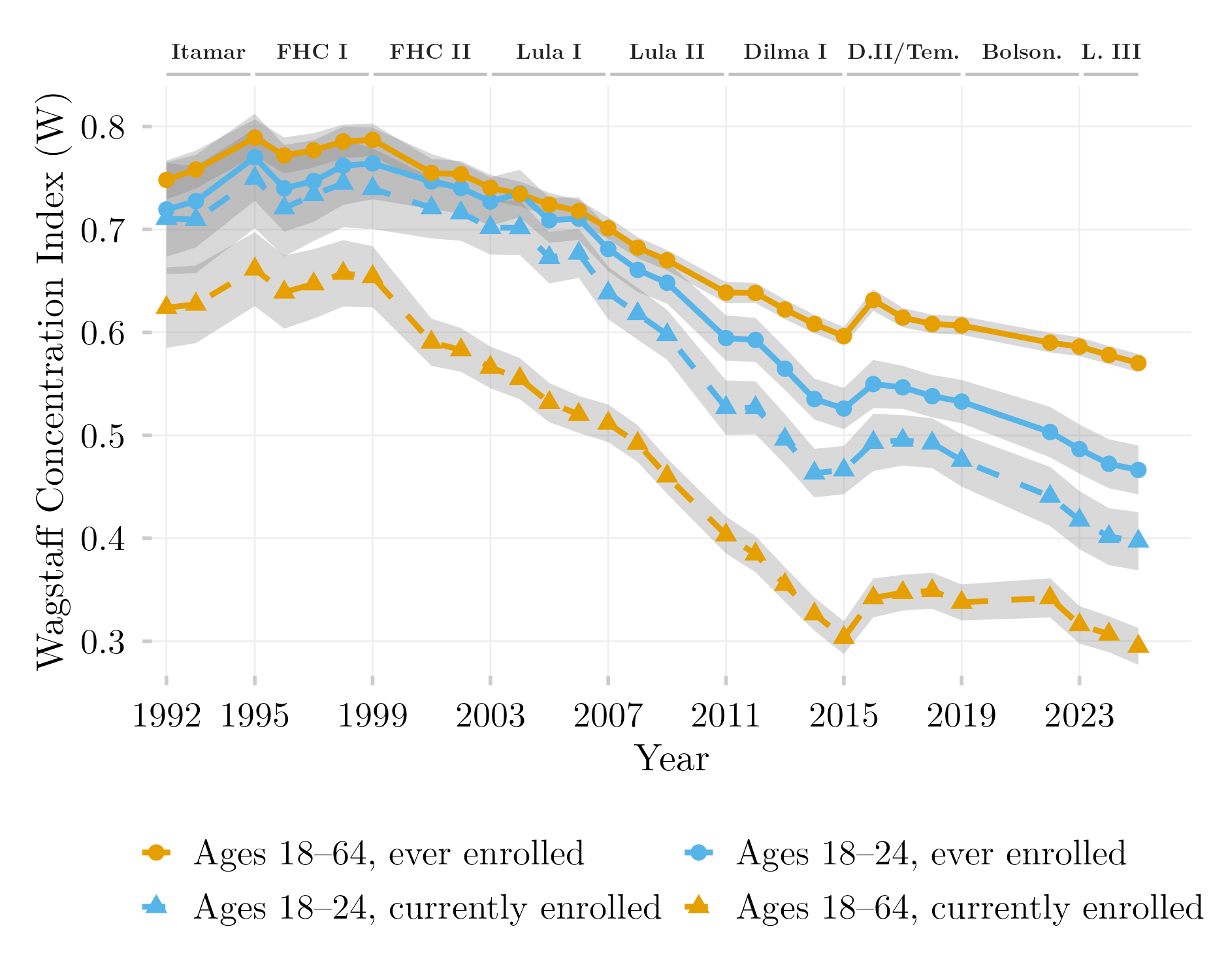
Figure 2.2 plots the concentration index for the full period and defines the explanandum. Three phases organize the series. Inequality remained at its historical plateau through the 1990s and early 2000s, even as the system grew rapidly through private expansion; it then fell steeply and continuously from the mid-2000s to roughly 2015; it stagnated in the second half of the 2010s, as enrollment growth continued through other vehicles; and it has resumed its decline after 2021. The flatness of the first phase is statistically strict, not an impression of the eye: no year’s index falls significantly below the 1992 baseline (W = 0.72 for access among 18-to-24-year-olds) until 2008 for access and 2007 for current enrollment — 2009 and 2008, respectively, under the more conservative criterion of non-overlapping 95% confidence intervals — and the point estimates of the late 1990s sit above the baseline, not below it. Any adequate explanation must account for all four features — the flat phase under growth, the steep fall, the stagnation under continued growth, and the recent resumption — and the sections that follow argue that the barrier framework does so while the saturation and competition accounts cannot accommodate even the first.
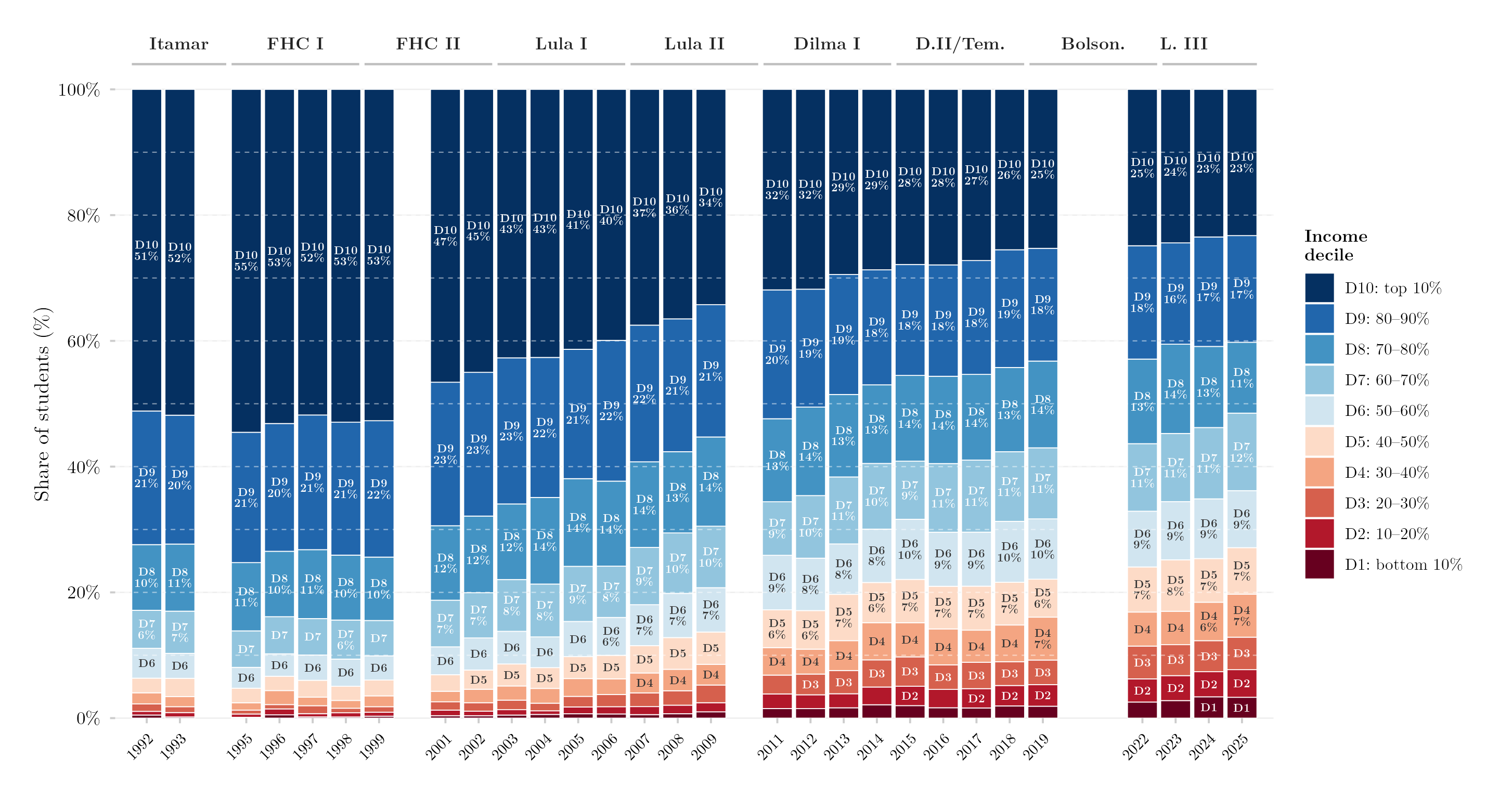
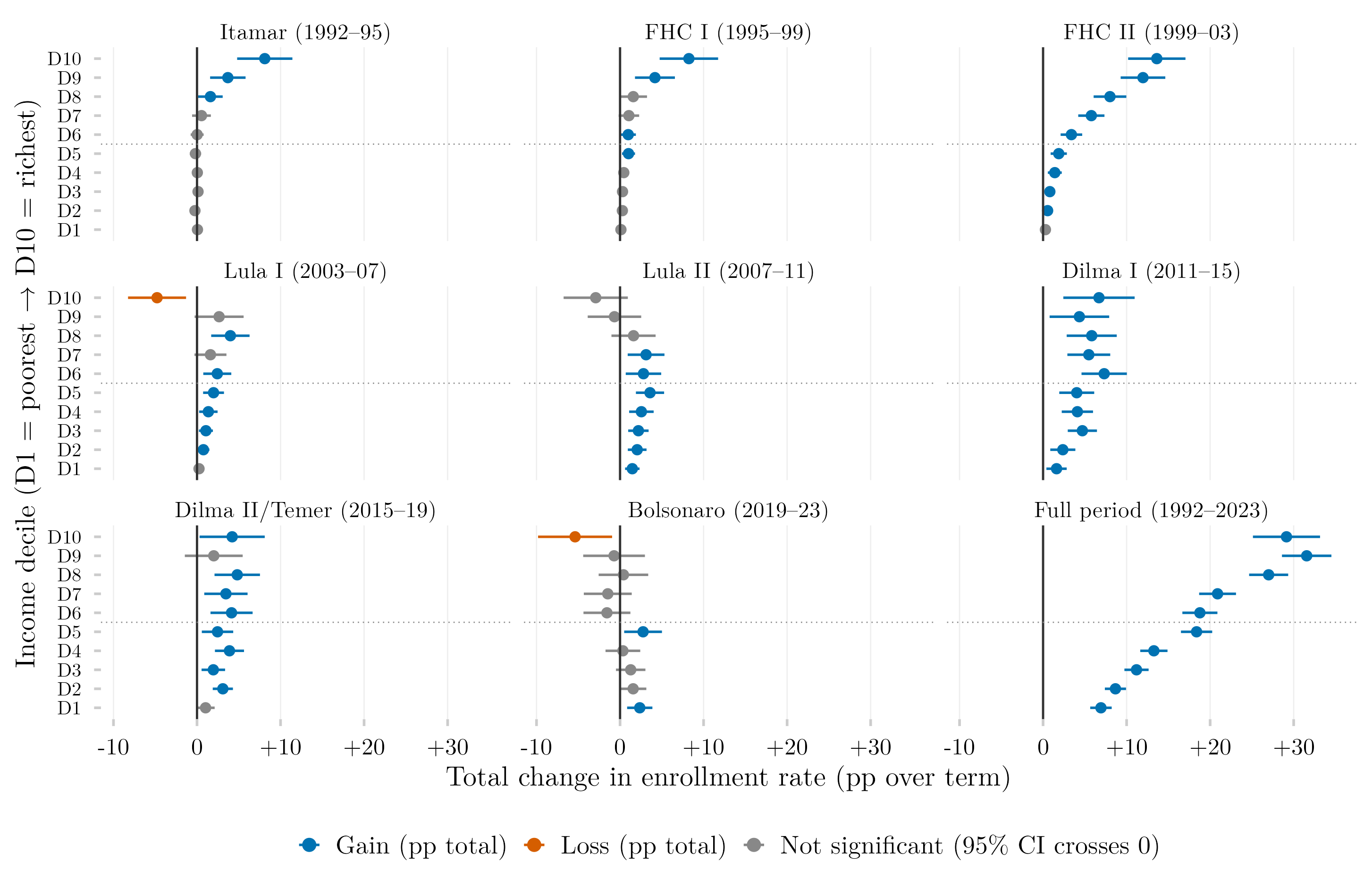
The decile-level and administration-level views (Figure 2.3; Figure 2.4) add distributional texture to the scalar series. The income composition of the student body shifts visibly toward the lower deciles from the mid-2000s; the administration-level panels reveal that during the Cardoso terms (1995–2003), expansion was heavily concentrated in the top deciles, with the top two gaining substantial percentage points in current enrollment, while the bottom half of the income distribution saw little to no gains. In contrast, during the Lula (2003–2011) and first Dilma (2011–2015) terms, the pattern changed, becoming much more distributed across income deciles. Over the full 1992–2023 period the ninth and tenth deciles expanded the most in percentage-point terms, but the ordering reverses on the scale that matters for access: the top decile roughly doubled its rate, from 24.6% to 53.8%, while the bottom decile’s rose from near zero to 7.0%, and the multiple of increase falls monotonically from the bottom of the distribution to the top.
2.5 Empirical Evidence: Re-evaluating the Three Channels
2.5.1 The Affordability Channel
The affordability channel requires two things to be documented: that the real incomes of the lower deciles rose substantially, and that the price of tuition fell relative to those incomes. Both movements are large, and their conjunction in the 2000s and early 2010s is the quiet macroeconomic foundation of the access trajectory.
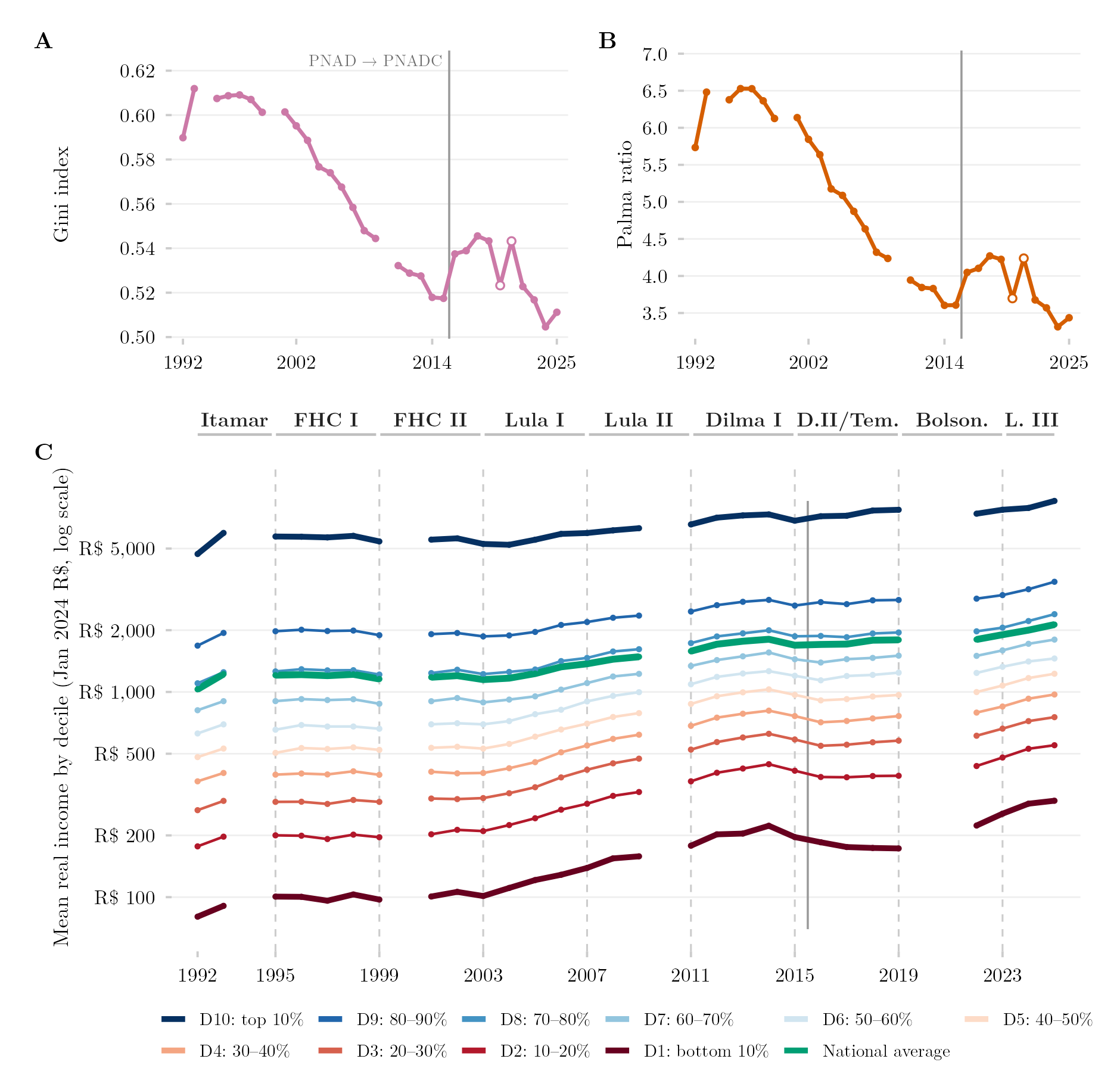
Figure 2.5 establishes the magnitude of the movement on the income side, and it is worth pausing on how large it is. The Gini index of real per-capita income stood at 0.590 in 1992 and peaked at 0.612 in 1993; by 2024 it had fallen to 0.505, its lowest recorded value, a decline of 17.5% from the peak. The Palma ratio, which compares the income share of the richest tenth to that of the poorest four deciles, fell further still over the same span, from 6.48 to 3.31 — the top decile went from commanding six and a half times the income of the bottom 40% to commanding a little over three. These are the official figures: computed on the universe that retains households reporting no income, they track IBGE’s published series to within a ten-thousandth, so the trajectory here is not an artefact of the working sample used elsewhere in the chapter.
Panel C converts that scalar movement into the quantity the framework actually needs, which is not inequality as such but the income available to each stratum. Between 2002 and 2025 the mean real income of the bottom decile grew to 2.8 times its starting level, against 1.5 for the top decile and 1.8 for the country as a whole; the ordering of growth rates is monotonic from the bottom of the distribution to the top. On the logarithmic axis this appears as a narrowing of the fan, which is the same fact the Gini and the Palma ratio report in scalar form — the three panels describe one movement, not three. That narrowing is what the barrier framework requires: a household in the second decile in 2015 faced the same tuition bill as a household in the second decile in 2002, but faced it with substantially more income.
Two features of the series qualify the reading, and both cut against overstating the case. The decline is not monotonic: inequality rose between 2015 and 2019, and roughly a third of the 2015–2016 step, in both the Gini and the Palma ratio, is the change of survey rather than a change in the world. And the series turns again at the end, with the Gini rising from its 2024 minimum of 0.505 to 0.511 in 2025 and the Palma ratio from 3.31 to 3.44. One year is not a trend, and the level remains the second-lowest on record, but the affordability channel is not a ratchet, and the framework predicts that access inequality should respond to reversals as well as to improvements.
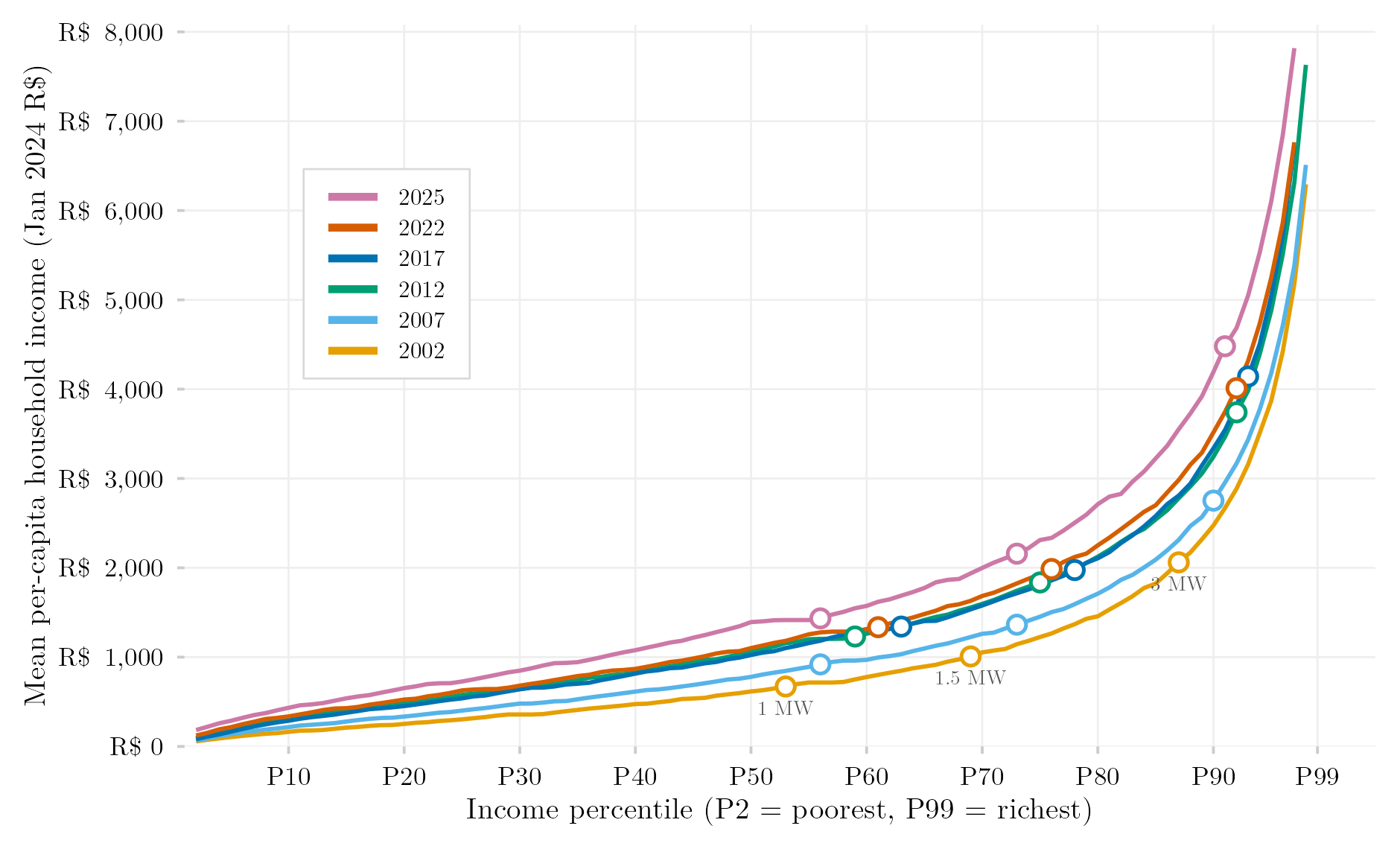
Figure 2.6 resolves the same movement at finer grain. Real per-capita household income rose across the entire distribution between 2002 and 2014, with proportional gains largest in the lower and middle centiles — the well-documented decline of Brazilian income inequality during the commodity-boom decade. The markers locating the minimum-wage multiples make the compositional point directly: the share of the population living in households above the income thresholds that define practical purchasing power for a private tuition bill (or eligibility ceilings for means-tested programs) expanded substantially over the period, as Figure 2.7 shows directly.
NÃO ACHO QUE ESSA IMAGEM VALE A PENA, REPENSAR
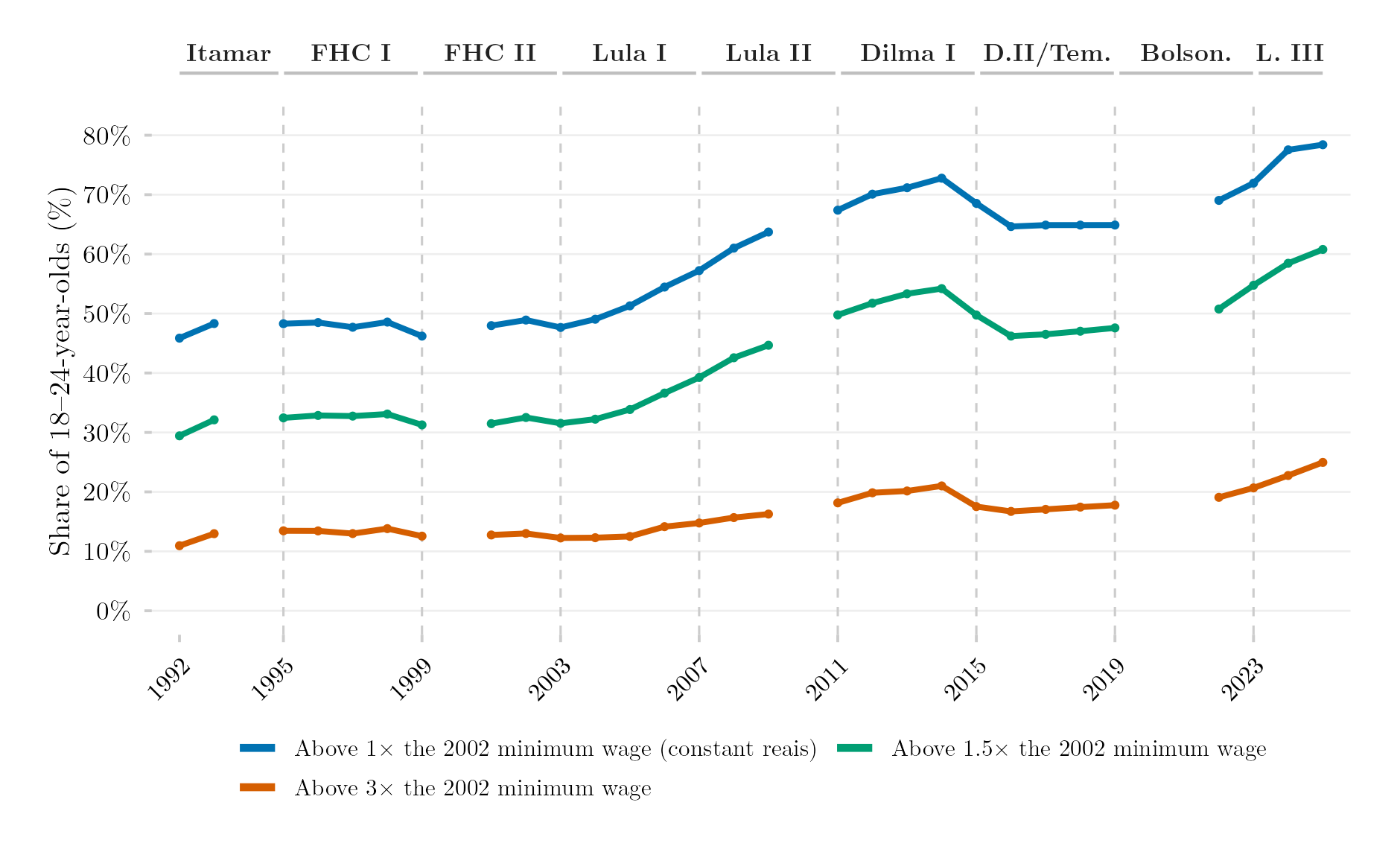
The stock of families able to clear that threshold grew steadily: the share of 18–24-year-olds in households above the January-2002 real minimum wage rose from 45.9% in 1992 to 78.4% in 2025, and above 1.5 times that wage from 29.4% to 60.8% — precisely the pool of families for whom a private tuition bill, or a means-tested ceiling of 1.5 or 3 minimum wages per capita, shifted from unreachable to attainable. This is the affordability channel read as a stock rather than a flow — the population that could, in principle, meet the barrier — and it grew before, during, and after the steepest phase of the decline in access inequality, consistent with a channel that operated continuously rather than in a single policy window. (Figures 230, 231, and 234 — the growth-incidence curve of income by subperiod, indexed real income by decile, and the correlation between the macro series and the concentration index — remain candidates for a future revision; see 9-vers/plan/2026-07-04_Plano_Testes_Quantitativos.md, item 4b, for the full inventory of pending affordability-channel tests, including the ones aimed directly at Salata et al.’s 2025 reading of the same trajectory.)
[COMPLETAR — números específicos dos limiares após inserção da figura 233.]
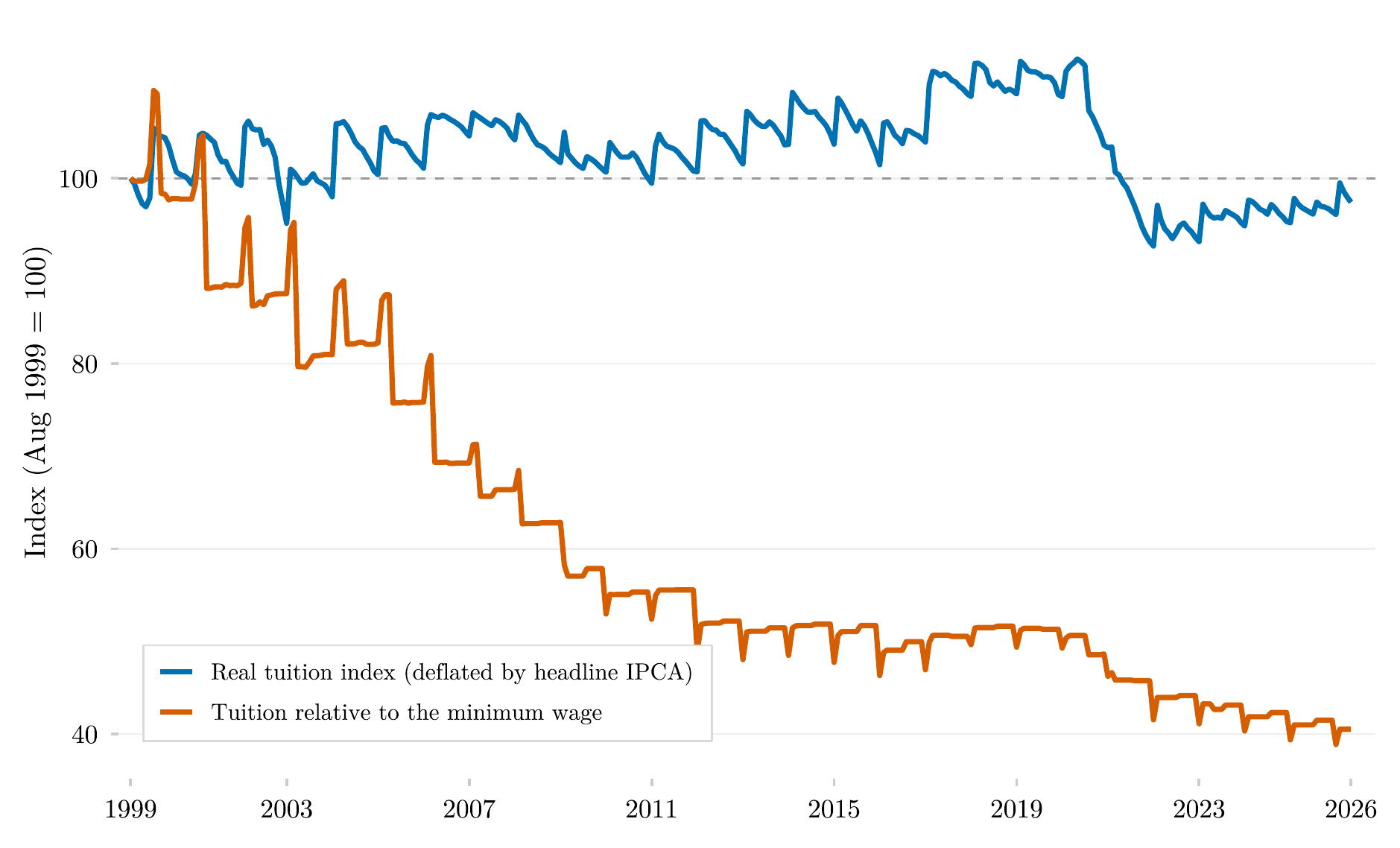
Figure 2.8 shows the price side, and its two series tell usefully different stories. Measured against overall consumer prices, tuition readjustments roughly tracked inflation for two decades: private higher education did not become cheaper in real terms. Measured against the minimum wage — the more relevant benchmark for the budget of a household in the bottom half of the distribution — the same tuition bill fell by roughly 60 percent, with nearly all of the decline concentrated in 2001–2012, the years of sustained real minimum-wage increases. The affordability of private tertiary education for the poor was transformed not by falling prices but by rising wage floors; and the index, computed over a fixed panel of institutions, does not even register the additional compositional cheapening that came later through the migration of enrollment toward low-priced distance-learning programs. This is the affordability channel in a single figure: the barrier fell because the denominator rose.
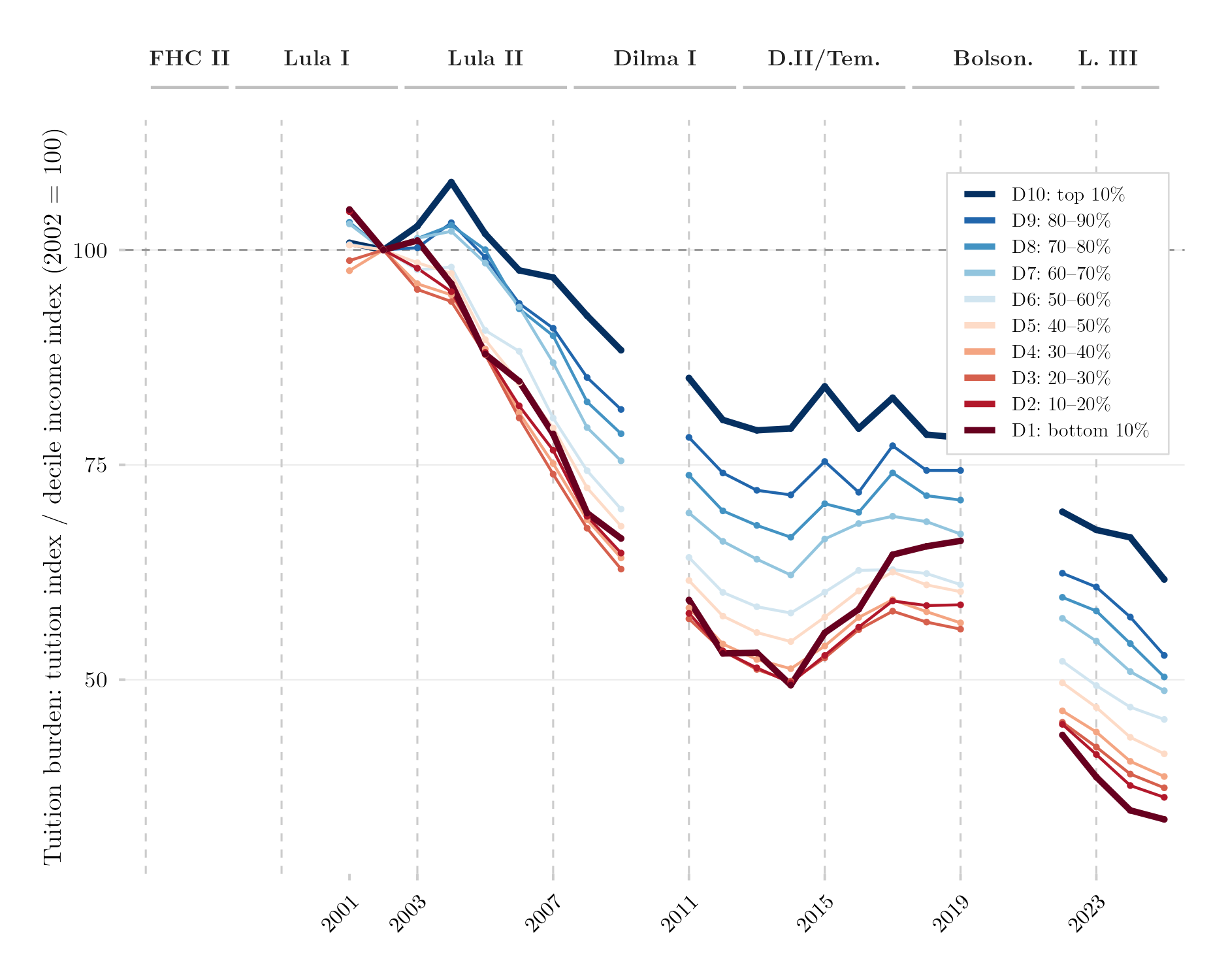
Figure 2.9 joins numerator and denominator directly, and the asymmetry is the whole affordability-channel argument in one image: the same tuition bill, expressed in units of each decile’s own income, fell to 33.7% of its 2002 level for the bottom decile by 2025, and to 36.3% for the second decile, while for the top decile it fell only to 61.7% — a bill that barely moved for the rich became, for the poor, a fraction of what it had been. The proposal this figure supports is that this asymmetric compression is itself a mechanism worth taking seriously, not merely a background condition; the case for treating it as such, rather than as an artifact of the two series’ separate trends, is developed above, in the discussion of the epistemic status of the affordability channel (Section III).
The direct behavioral trace of the channel is compositional: throughout the equalizing phase, a substantial share of lower-income students enrolled in private institutions at full price, without ProUni scholarships or FIES contracts. While precise individual-level matching of income to financial aid requires supplementary survey modules, aggregate bounds drawn from the Higher Education Census (CENSUP) establish the magnitude of this phenomenon: even at the peak of federal financing in 2018, nearly 53% of all private sector enrollments involved no federal scholarship or student loan. Given the known income distribution of private sector students in the PNAD, even under the most conservative assumption—that all federal aid was perfectly targeted to the poorest students—a substantial residual of students from the bottom half of the income distribution must have been paying full tuition. These full-price entrants from the bottom deciles are invisible to any account in which only policy moves the poor into higher education, and they are the population most exposed to dropout when household income falters — a vulnerability to which we return in Section VIII. They are also precisely the kind of discriminating observation on which the adjudication of Section III turns: under the saturation account they should not have entered before the strata above them approached saturation, under the competition account they should not have entered without prevailing in a contest, and under a purely policy-centered account they should not have entered at all — yet the compositional record shows that they did.
The aggregate ceiling on de-commodification makes the same point from the supply side, and it is lower and flatter than the policy record suggests (Figure 2.10). Counting every seat that carries no price at all — the free public network plus ProUni scholarships — the de-commodified share of Brazilian tertiary enrollment moved between 29% and 32% for a decade, ending at 24.4% in 2023, below where it began in 2009. What rose and then fell over that decade was FIES, which is not a waived price but a deferred one: at the 2015 peak, 46.6% of all enrollment was subsidised in some form, but 16.7 of those points were loans, and the no-price share underneath them was 29.9%, essentially indistinguishable from its 2009 value. The great financing expansion of the 2010s did not de-commodify the system; it lent students the money to keep paying it, and when the lending stopped the share of enrollment carrying neither price nor debt was lower than before the programs began.
That ceiling is what makes the compositional residual unavoidable rather than merely probable. The de-commodified share never exceeded a third of enrollment, while the bottom half of the income distribution supplied a growing fraction of the entrants documented above; even granting the most favourable assumption available — that every scholarship and every loan went to a student from the bottom half, which no evaluation of either program supports — the arithmetic leaves a substantial body of low-income students paying full private tuition throughout the equalizing phase. The precise size of that body cannot be recovered from these sources: the Census records institutions and instruments, the household surveys record incomes, and no Brazilian instrument matches individual income to individual financial aid across this period. What the sources do establish is the sign and the order of magnitude, and both cut against any account in which the poor entered tertiary education only through the door that policy opened for them.
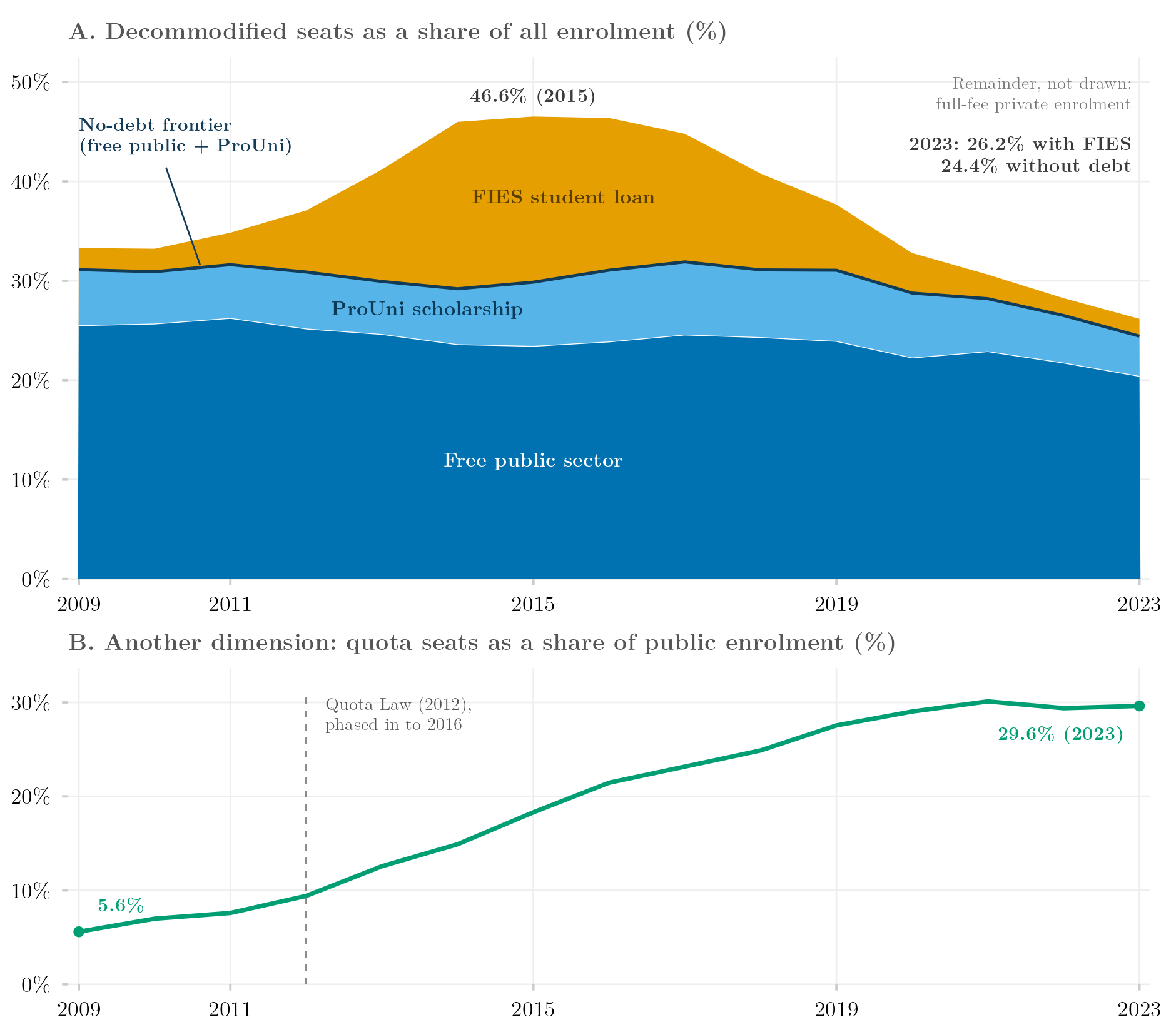
Reserved seats moved in the opposite direction and on their own axis (Panel B). Quota places rose from 5.6% of public enrollment in 2009 to 29.6% in 2023, with the inflection immediately after the 2012 Quota Law and a plateau once the phase-in completed. This is redistribution of who occupies a free place rather than of what a place costs, which is why it is not additive with Panel A — and why the two panels together state the chapter’s distinction compactly: over this period Brazil redistributed access to the de-commodified seats it already had far more than it expanded their number.
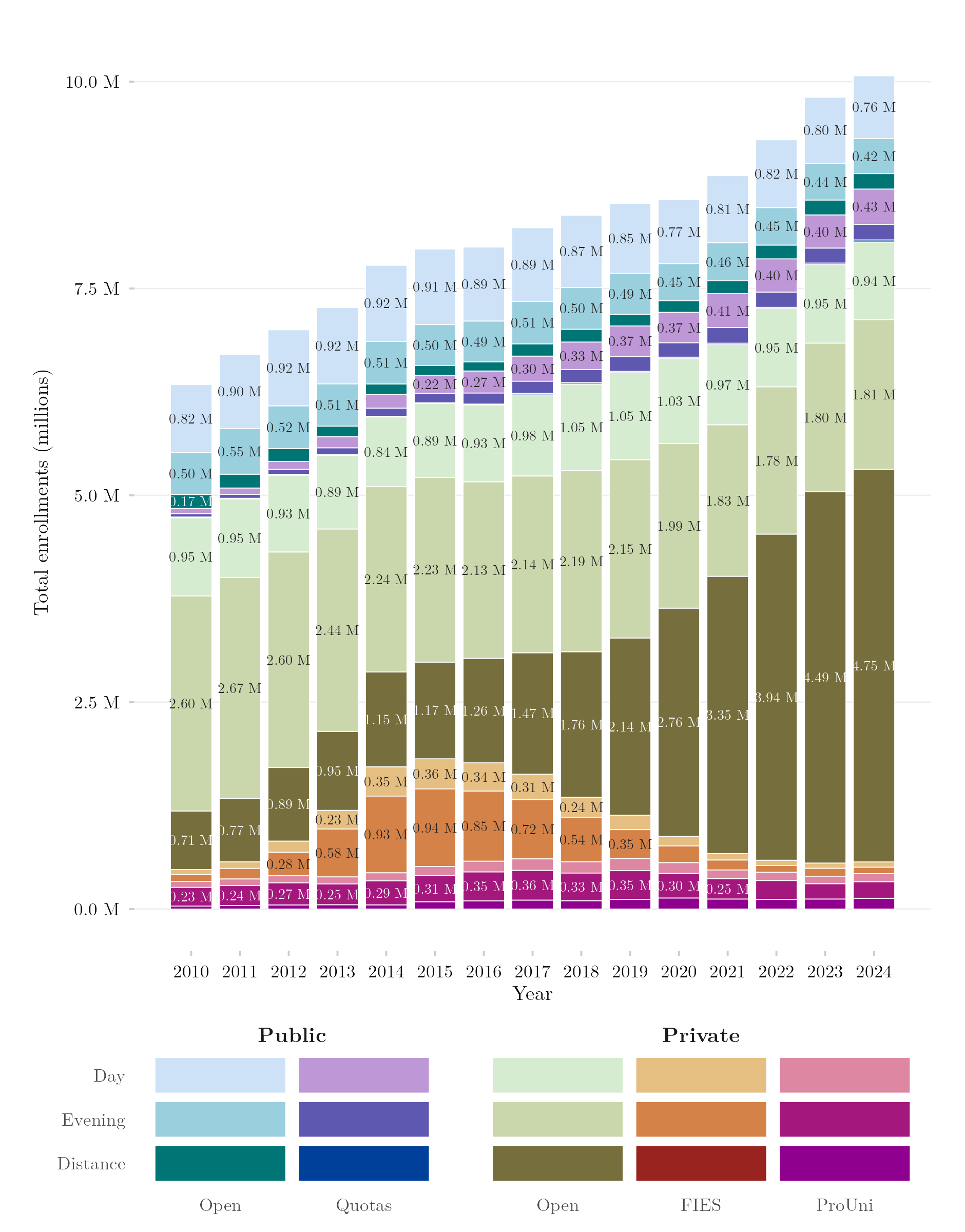
Disaggregating the same system by the route through which each seat was reached and by the time of day at which it was occupied (Figure 2.12) exposes the substitution that the aggregate shares conceal. Private distance enrollment rose from 0.71 million in 2010 to 4.75 million in 2024, and almost all of that growth is concentrated after 2014 — precisely the years in which FIES contracts collapsed, from 0.94 million at their 2015 peak to 0.14 million. Private evening enrollment, the traditional destination of the working student, sat almost immobile near 2 million across the entire period, so the growth did not come from the classroom at all. The system did not contract when subsidised credit was withdrawn; enrollment migrated to the cheapest modality on offer. This is the affordability channel visible in administrative data rather than inferred from prices and incomes: what sustained entry after 2015 was not a policy that lowered the price for the student but a product sold at a price the student could already meet.
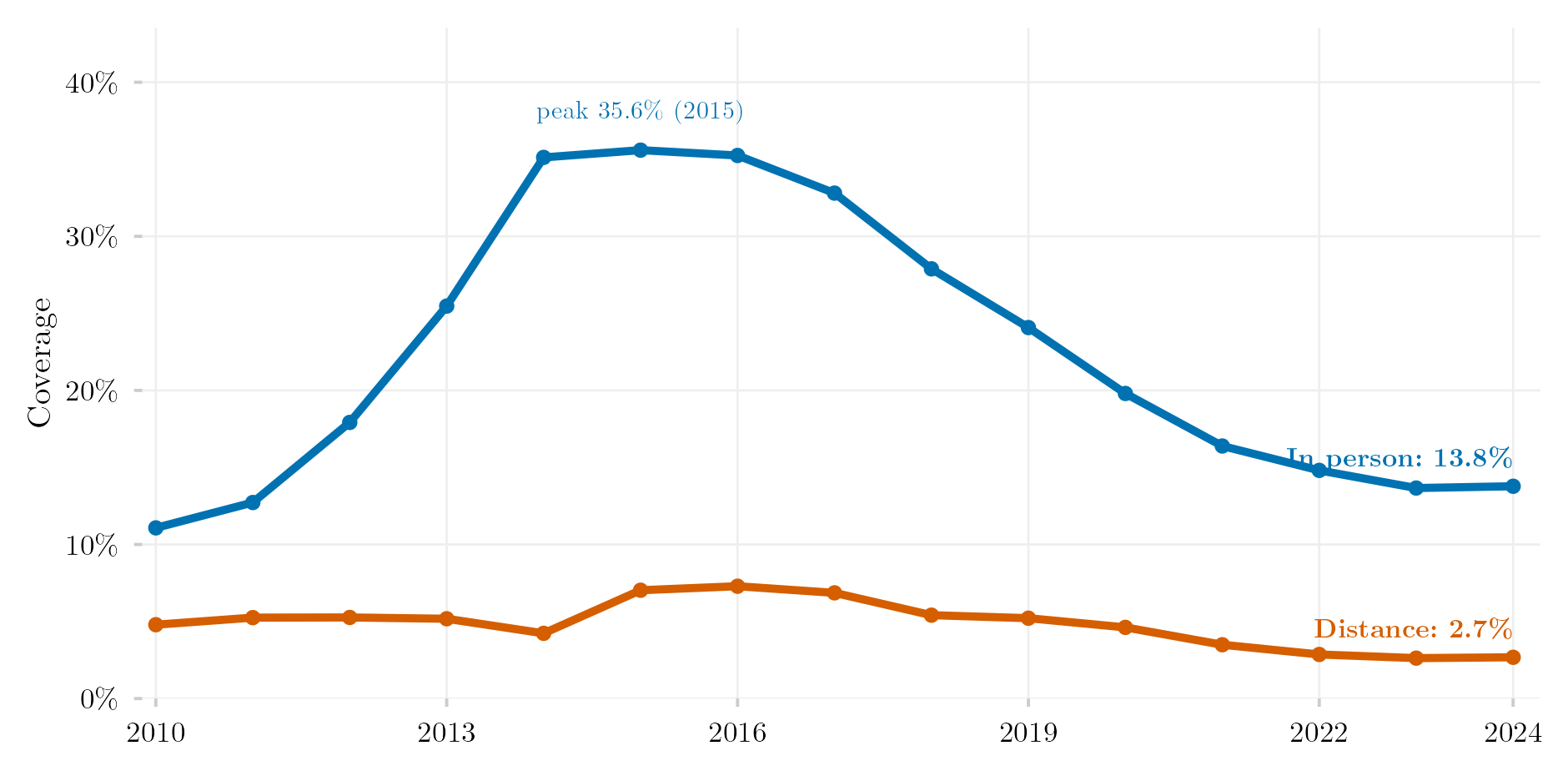
The scale of that migration is what makes the point structural rather than incidental. Distance study went from 15.7% of private enrollment in 2010 to 60.5% in 2024, while ProUni enrollment within it stayed between 116,000 and 137,000 from 2019 onward — flat in absolute terms as the modality it sits in more than doubled. Expressed as coverage rather than as volume (Figure 2.11), the contrast is sharper still: the share of in-person private enrollment holding a ProUni scholarship or a FIES contract rose to 35.6% in 2015 and fell to 13.8% by 2024, while in distance study it never exceeded 7.3% and ended at 2.7%. The instruments of de-commodification were not dismantled over these years; they were outgrown by a form of provision they had never reached.
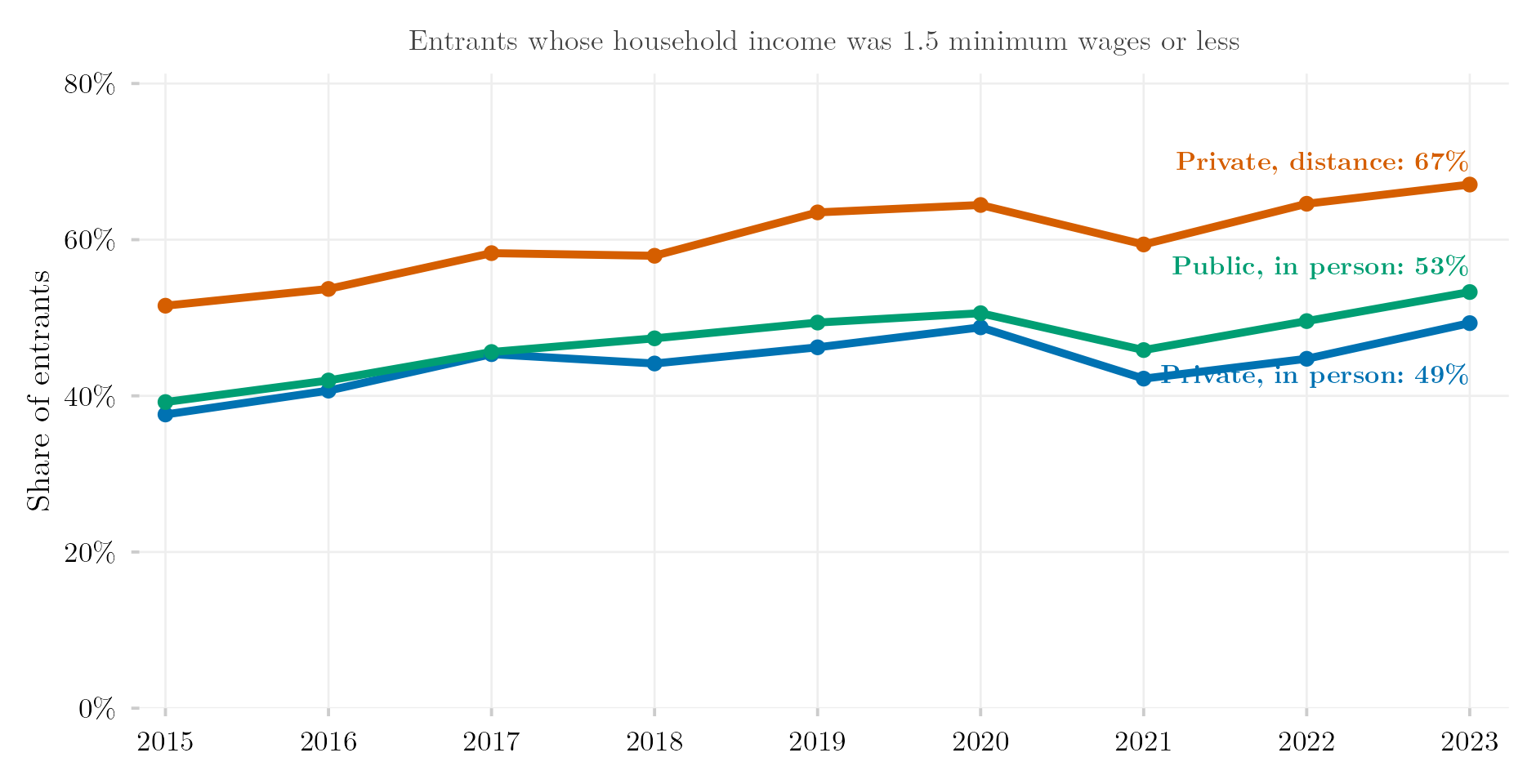
Linking those entrants to their own examination records closes the argument from the demand side, and it is the first evidence in this chapter about the income of the students entering by each door rather than about the price of the door itself (Figure 2.13). Among entrants matched to their ENEM record, the share coming from households living on 1.5 minimum wages or less is consistently and substantially higher in distance study than in either in-person sector: 67% against 49% in private in-person study and 53% in the public network by 2023, a gap of roughly eighteen percentage points that holds in every year observed and widens over the period. The cheap door is not merely cheap; it is the door the poor use. That the public network — free at the point of use, and the object of the reserved-seat policy — admits a less poor intake than private distance study is the sharpest single expression of what the de-commodification channel did not accomplish: it redistributed access to seats that remained scarce, while the growth in seats happened somewhere its instruments never went.
Reading the same records against the pool they were drawn from sharpens the point and disposes of the obvious objection to it (Figure 2.14). Since only those who sat the examination can be observed, and the examination is required for admission to the public network but not for distance study, the comparison of levels between destinations is contaminated by who chooses to sit it at all. Comparing each destination to the entire body of that year’s examinees removes the contamination, because the question becomes conditional: given the same pool of candidates, whom does each destination recruit from it? Among all 2023 examinees, 55.0% came from households living on 1.5 minimum wages or less. Private distance study drew 67.1% of its entrants from that group, twelve points above the pool. Private in-person study drew 49.3%, nearly six points below it. And the public network drew 53.3% — below the pool, not above it.
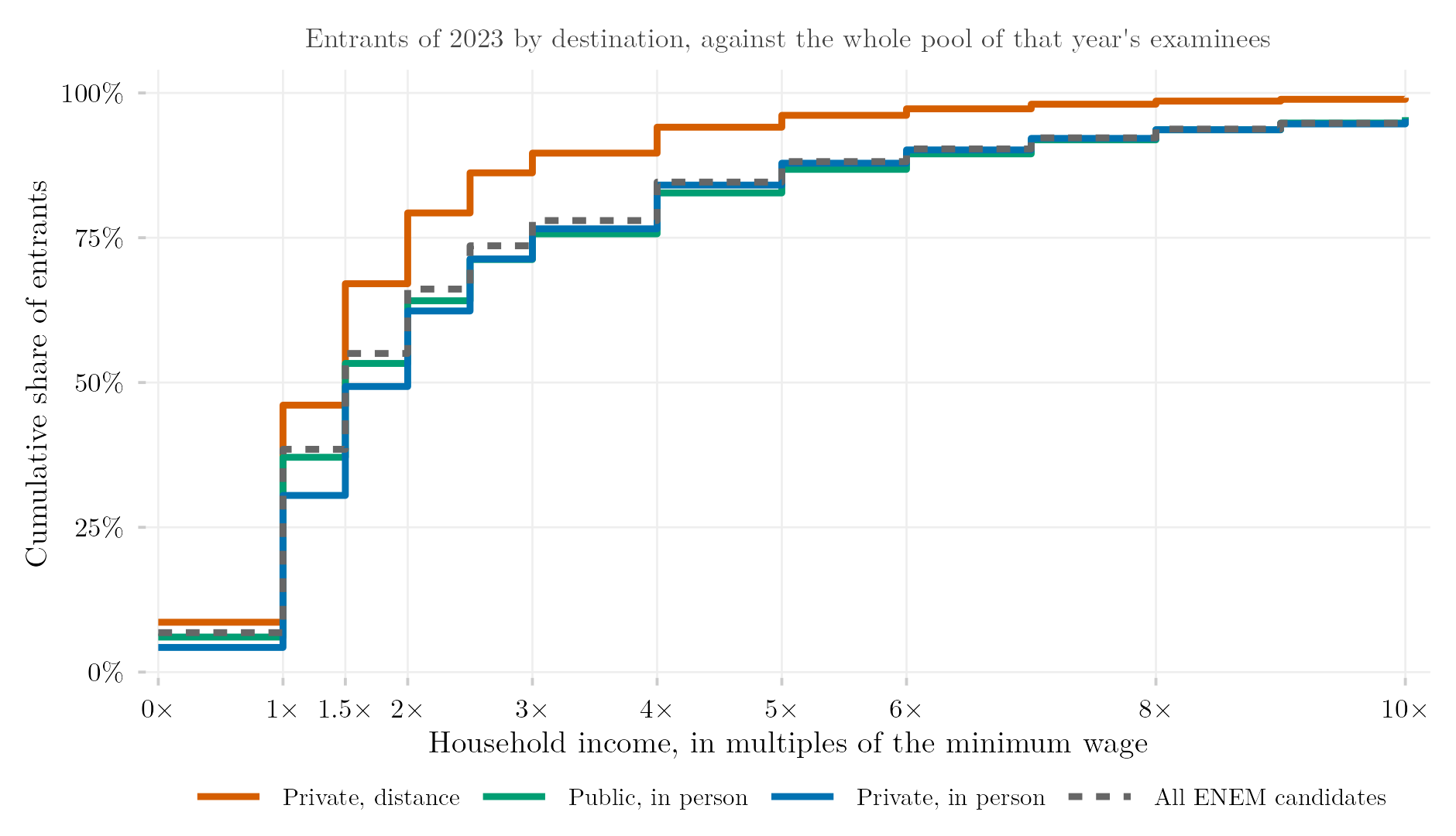
[Parágrafo abaixo está errado ignorar] That last figure is the one that costs the de-commodification account most. A free seat, allocated under a reservation policy written expressly to widen the social base of the public network, produced an intake no poorer than the applicant pool it selected from — while a priced seat, sold by a commercial provider with no targeting instrument attached to it, produced an intake substantially poorer. The comparison does not show that quotas failed at what they were designed to do; reserved seats redistribute among applicants to a network whose size the policy did not change, and the pool of examinees is itself already selected. What it shows is the limit of allocating a fixed quantity: the public network in 2023 admitted about 1.16 million entrants against a private sector admitting some eight million, and no rule for distributing the smaller number could offset the composition of the larger one. The affordability channel moved more poor students into tertiary education over these years than the de-commodification channel did, not because it was better designed, but because it operated on the margin that was growing.
That reading also disciplines the claim of the previous figure. The de-commodified share fell after 2017 partly because the denominator grew, and this figure shows what the denominator was growing into: not new public places, nor new scholarships, but distance seats sold at private prices low enough to clear the incomes that a decade of growth had raised. De-commodification and affordability are separable in principle and were substitutes in practice over these years, which is exactly why the chapter treats them as two channels rather than one.
2.5.2 The Eligibility Precondition
No one enrolls in tertiary education without completing secondary school, and for most of Brazilian history that observation sufficed to keep the poor out of the tertiary calculus altogether. The transformation of secondary education from a minority credential into a near-universal one is therefore not background to the access trajectory but a constitutive part of it. The expansion was overwhelmingly public: enrollment growth ran through the state networks, tuition-free, under a legal mandate progressively hardened (obligatory schooling to age 17 after the 2009 constitutional amendment), and materially supported down to school meals and transport. It spanned political cycles — initiated and consolidated under Cardoso, sustained and completed under the Workers’ Party governments — which is itself analytically convenient, since it decouples the precondition from any single partisan project. State provision, it should be added, was not the only force at work: the same growth in household incomes that the affordability channel describes also eased the opportunity costs of keeping an adolescent in school, so that the barrier framework applies at the secondary stage as much as at the tertiary one — one more reason, alongside those given in Section II, for reading the trajectory unconditionally rather than transition by transition. By the late 2000s, for the first time, the majority of 18-year-olds in the bottom half of the income distribution held the credential that makes tertiary entry possible (Figure 2.15).
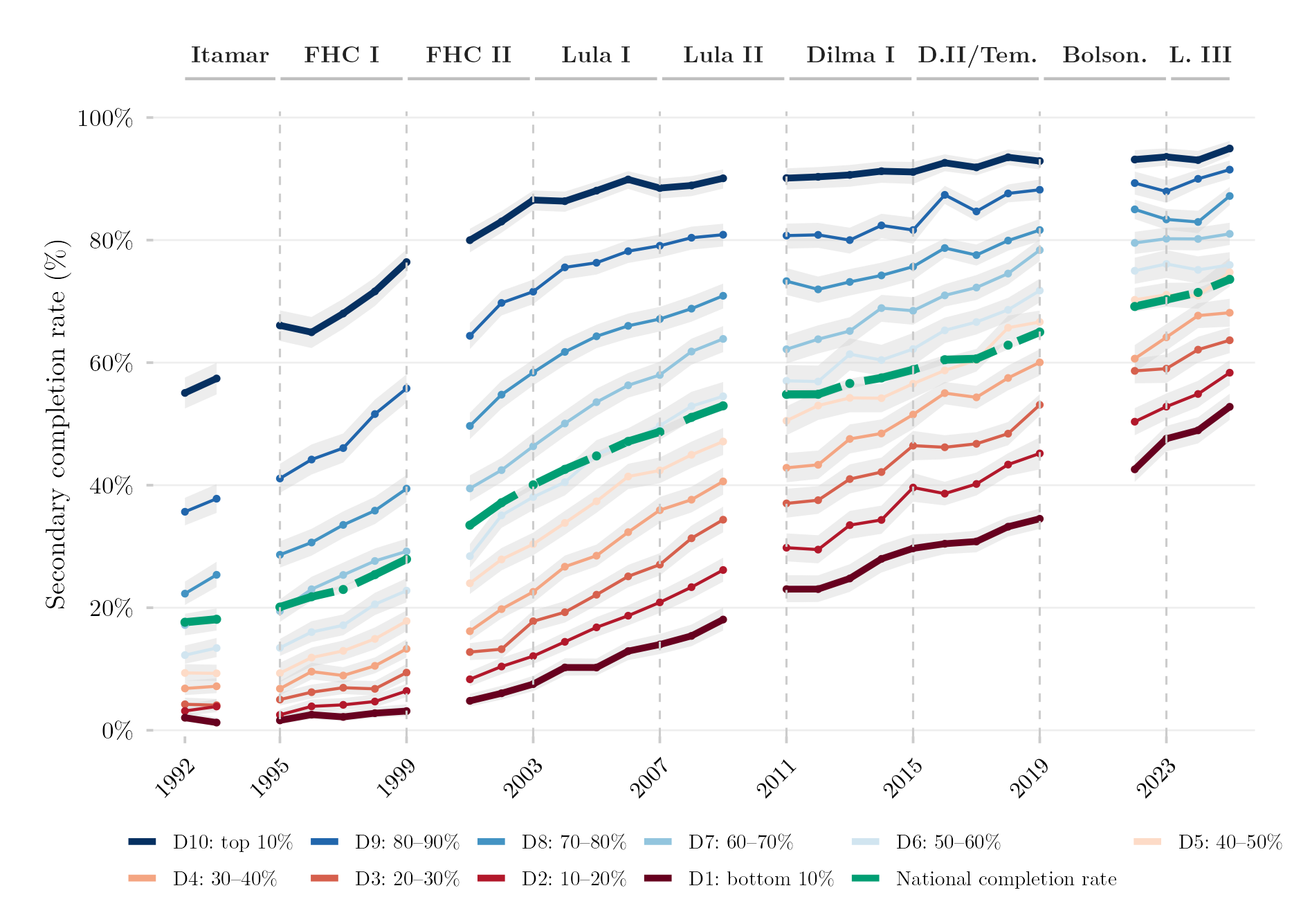
The historical sequence of this removal matters for the interpretation of everything else. Real incomes were already growing in the second half of the 1990s; private tertiary capacity was already expanding. What the 1990s lacked was a mass population of poor secondary graduates: the barrier at the preceding transition still filtered the poor out before the tertiary income barrier could even apply to them. As secondary completion universalized through the 2000s, each cohort delivered a larger pool of eligible lower-income candidates to the tertiary threshold — precisely as rising incomes and falling relative tuition were lowering that threshold, and as the new policy instruments began waiving it for targeted groups. The conjunction was historical, not logical: nothing guaranteed that the eligibility pool, the affordability channel, and the de-commodification channel would open together. That they did is what gives the 2005–2015 phase its exceptional steepness, and treating any one of the three as the explanation misreads a conjuncture as a mechanism. The conjunctural structure of the claim is itself a point of method — a necessary condition operating jointly with companions that are only sufficient together is the signature of case-oriented explanation, and precisely what a general law of expansion has no grammar for. The most recent work in the stratification tradition offers, in this respect, an instructive convergence: decomposing access into its sequential stages, Salata and colleagues find that the aggregate improvement owes more to convergence in secondary completion than to any transformation at the tertiary transition itself [CITAR — Salata/Bringhenti/Miranda, RSSM 2026, DOI 10.1016/j.rssm.2026.101167]. The finding corroborates the precondition mechanism from within the rival tradition’s own decomposition — although their design treats the universalization of secondary education as an exogenous trend to be conditioned on rather than as the deliberate act of state-building described above, and thereby leaves the most consequential part of its own finding outside the reach of political explanation.
2.5.3 The De-commodification Channel: Sectoral Contrast and Policy Instruments
The Sectoral Contrast.
Before turning to instrument-specific causal estimates, the observational record offers one comparison that displays the effect of de-commodification with unusual directness: the contrast between the tuition-free public network and the tuition-charging private network at a given point in time. If access inequality is produced chiefly by the income barrier, then the segment of the system where the price is zero should exhibit far lower income concentration than the segment where access is bought — and it does, dramatically.
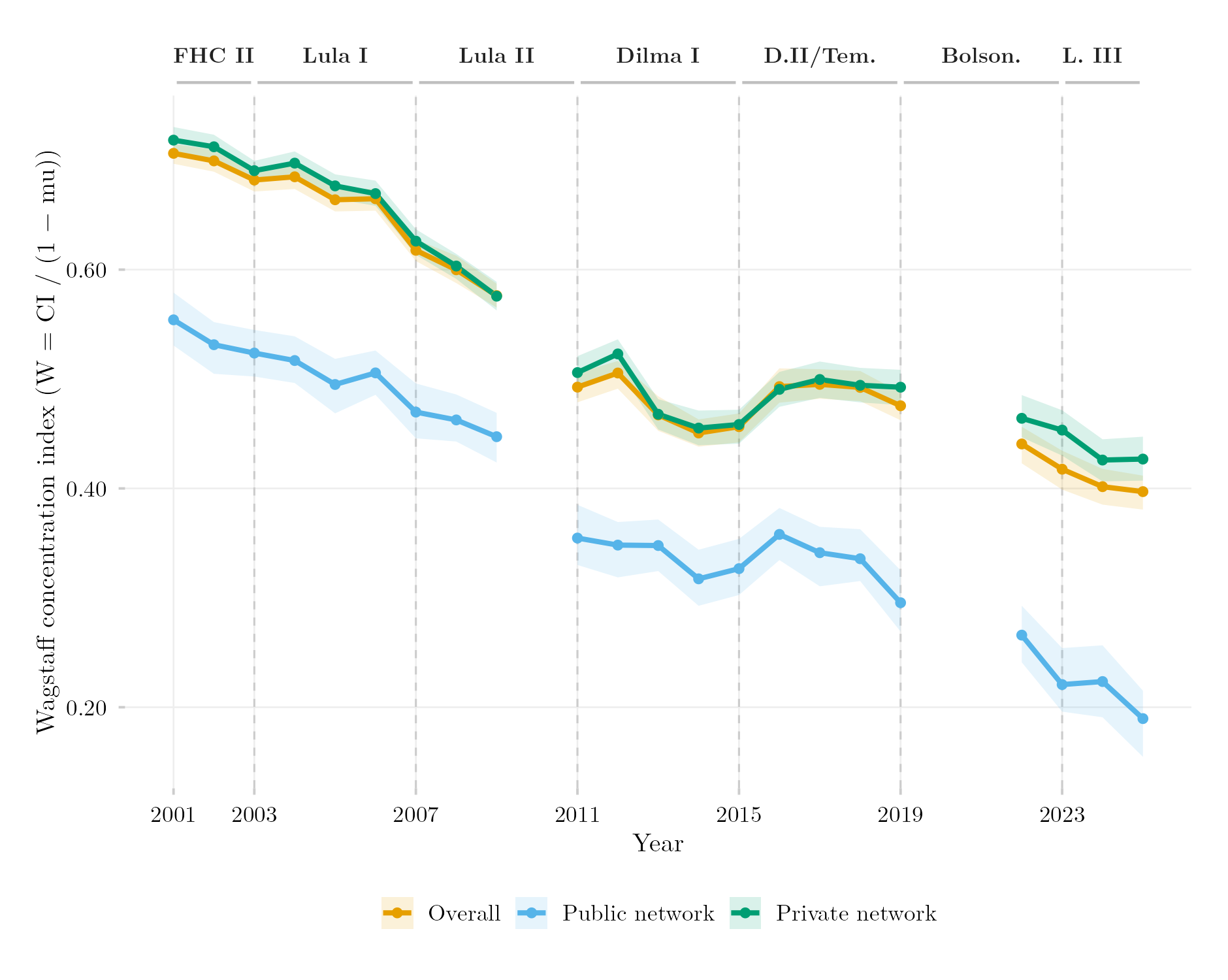
The sectoral time series (Figure 2.16) shows the de-commodified public network sitting far closer to income-independence than the tuition-charging private network, and shows that the gap is persistent, not an artifact of any single year. The comparison is not a clean natural experiment — the networks differ in selectivity, geography, and course composition, and public-network prevalence is far lower — but its magnitude is difficult to explain on any account in which the price of access is not doing the distributive work. Where the state removed the price, access approaches income-independence; where the market prices access, concentration among the rich is severe. The system-level index of Figure 2.2 is, in effect, a size-weighted blend of these two regimes — which is why the sheer scale of the private sector bounds what the de-commodification channel alone can accomplish, however redistributive its instruments.
Two Literatures.
The social stratification literature and the economics of education have developed, over the past two decades, parallel and largely non-intersecting bodies of evidence on the distributive consequences of Brazilian higher-education policy. The sociological tradition (Carvalhaes et al., 2023; Salata et al., 2025; Senkevics et al., 2024; Senkevics et al., 2022) has documented the trajectory of access inequality with increasing resolution; the economics tradition has estimated the causal effects of specific instruments with increasingly credible identification. The gap between them is not one of quality but of explanatory posture: the economists estimate the effects of causes — one instrument, one design, one population at a time — while the sociologists describe the effect to be explained without a theory of its causes that survives contact with the system’s institutional structure. Writing from inside the design-based tradition itself, Callis et al. (2022) name the missing step: credibly identified estimates are “stubborn facts” that accumulate into knowledge about mechanisms and generalizability only when theory integrates them across studies — comparing related designs, unbundling composite treatments, reading the same instrument against different outcomes — a labor the estimates cannot perform for themselves. The synthesis below undertakes that step, reading the instrument-level causal evidence as the de-commodification channel of the barrier framework: each estimate documents one mechanism by which policy removed, for a defined population, the income barrier that the market otherwise enforces.
ProUni.
The ProUni program, which provides full and partial scholarships to low-income students in private institutions through corporate tax exemptions and began operating in 2005, became the primary instrument of private-sector access de-commodification during the Lula years. Leal & Choi (2022, CITAR — verificar chave e fonte) estimate, using a difference-in-differences design exploiting variation in scholarship availability across programs and institutions, that full ProUni scholarships increased the probability of enrolling in higher education by approximately 37 percentage points among eligible students, with effects concentrated among women and non-white applicants — the populations with the highest income-conditional access gap at baseline. The magnitude is consistent with the view that the cost barrier to private-sector enrollment was the binding constraint for the target population. For the trajectory, the implication is direct: the program’s scale (approximately 200,000 new scholarships per year at its peak) and the concentration of its benefits in the lower deciles make it a first-order contributor to the compositional shift of 2005–2010 — a targeted waiver of the market barrier at exactly the income ranks where the barrier bound most tightly.
FIES.
The student-loan program FIES — substantially reformed and expanded beginning in 2010, reaching over 700,000 annual new contracts at its peak in 2014 before contracting sharply after 2015 — presents a more complex distributional picture. De Mello & Duarte (2020, CITAR — Economía; verificar chave) show that the availability of subsidized student credit induced tuition increases in the private sector, consistent with the prediction that supply-inelastic institutions capture part of the demand-side subsidy. Barahona et al. (2025a, pp. CITAR — NBER WP 33833) refine this picture using the 2015 reform as a natural experiment, finding that income-based targeting reduces tuition by approximately 0.8% while merit-based targeting raises it by 2.2%, through differential effects on the price elasticity of demand across income groups. For the trajectory, the implication is twofold: the 2010–2014 expansion lowered the income barrier for hundreds of thousands of students at the margin of affordability (with part of the subsidy captured by tuition inflation), and the abrupt contraction of 2015–2016 — from over 700,000 new annual contracts to under 100,000 — restored the barrier for precisely that marginal population, which is where the framework locates the onset of the stagnation phase.
Lei de Cotas and SISU.
The most extensively studied policy instrument in the quasi-experimental literature is the conjunction of the Lei de Cotas (12.711/2012) and the SISU centralized admissions system. Mello (2022, pp. CITAR — AEJ: Economic Policy 14(3)), using the staggered rollout of SISU across federal institutions and the associated expansion of income and racial quotas to 50% of places, shows that the combination of admissions centralization and quota expansion produced net gains in enrollment for students from public secondary schools — the population most strongly correlated with lower income strata — while protecting them from the crowding-out dynamics that centralization alone generates by intensifying competition among qualified lower-SES candidates. Mello (2023, CITAR — Journal of Public Economics) documents a further general-equilibrium effect: the Lei de Cotas induced a 31% increase in the propensity of students near federal universities to attend public rather than private secondary schools, amplifying the direct access effect through changes in pre-tertiary trajectories. Machado et al. (2025, pp. CITAR — JLE 43(2), Machado/Reyes/Riehl) provide the labor-market closure: marginally admitted quota beneficiaries at UERJ experienced a 14% increase in early-career earnings relative to the counterfactual, establishing that the access gains from redistributive targeting translate into economic returns rather than being neutralized by credential devaluation. For the trajectory, the quota system operates on the minority segment of the system where competition does allocate seats: it is the instrument that de-commodifies the competitive barrier rather than the price barrier, reserving half of the zero-price seats for populations whose examination performance the income gradient would otherwise exclude. Its implementation after 2012 coincides with the steepest stretch of the decline, and it is the one major instrument that survived the post-2015 fiscal retrenchment intact. One null result belongs in this record, reported because an adjudicative standard is only as credible as its willingness to show where the evidence does not move (Spirling & Stewart, 2025): when the public network’s enrollment is ranked against the general 18–24 income distribution, its concentration curve is essentially unchanged before and after 2012. The null is informative about the measure as much as about the policy — a lens calibrated to the whole population cannot register a recomposition occurring within a network whose share of total enrollment barely moved — and it disciplines the aggregate claim accordingly: the quota system’s demonstrated redistribution operates on who occupies the public network’s seats, and its imprint on the system-level index is bounded by that network’s minority scale.
REUNI and Geographic Expansion.
The REUNI program, which financed the expansion of federal universities with an explicit emphasis on geographic reach into underserved regions, provides a more diffuse causal target. The available evidence [CITAR — evento estudado por arXiv 2011.03120; verificar disponibilidade e chave] shows that the opening of new federal campuses in municipalities without prior tertiary access increases the academic performance incentives of secondary students in their catchment areas — an effect operating on the pipeline of lower-income students who can compete for public places rather than directly on enrollment rates. What is clear from the descriptive record is that REUNI substantially increased the number of tuition-free places in regions where the income composition of the potential student population was lower than in the metropolitan centers where public capacity was historically concentrated: a supply-side de-commodification through the geographic redistribution of zero-price seats, whose national-level magnitude remains uncertain but whose direction is unambiguous.
2.5.4 EaD: The Affordability Channel by Other Means
The post-2015 boom in distance learning is the instructive contrast case, and the barrier framework reads it differently than a pure de-commodification account would. Barahona et al. (2025b, pp. CITAR — NBER WP 34522, R & R QJE) estimate, using regional variation in EaD penetration in a structural model of higher-education demand, that online programs expand access for older and non-traditional students while partially diverting younger students away from higher-quality in-person programs. EaD expansion is not de-commodification: it is means-blind, untargeted, and fully commodified. But it is also radically cheaper — its tuition sits far below the in-person private average — and cheapness is itself a movement of the market barrier. The framework therefore predicts for the EaD era neither the strong equalization of the targeted-instrument phase nor a simple reproduction of the old income gradient, but something intermediate: continued absorption of middle and lower-middle deciles through low prices, without the targeted redistribution that had previously pulled in the bottom of the distribution, and with quality and completion differentials layered on top as a new axis of horizontal stratification. The stagnation of the concentration index after 2015 — followed by a resumed decline after 2021 as real minimum-wage growth returned and ultra-cheap EaD supply matured — is consistent with that intermediate reading, and hard to reconcile with any account in which enrollment growth as such does the equalizing.
2.6 Synthesis and Scope Conditions
2.6.1 Reading the Trajectory through the Framework
The four features of the trajectory identified in Section IV now have an account. The flat phase of the 1990s combined vigorous system growth with an untouched barrier structure: the poor were mostly not yet eligible (the secondary gate was still closed), no de-commodifying instruments existed, public capacity was small and fiercely competitive, and private tuition was high relative to the incomes of the bottom half. Expansion under those conditions enlarged the system for those who could already clear its barriers — which is exactly what the decile series show, and what no saturation or competition mechanism is needed to explain. The steep decline of 2005–2015 reflects the historical conjunction of all three mechanisms: a newly eligible mass of poor secondary graduates met tuition that had fallen dramatically relative to the minimum wage, a de-commodification channel that waived the price for targeted groups (ProUni from 2005, FIES at scale from 2010, cotas from 2012, REUNI’s zero-price seats from 2007), and household incomes growing fastest at the bottom. The stagnation after 2015 is not a single event but a policy package: the fiscal contraction that cut FIES came joined to the regulatory liberalization that made ultra-cheap EaD the new growth vehicle — the Temer government sought to cut spending, not to halt expansion, and the composition of growth shifted accordingly from targeted de-commodification to untargeted cheapness. And the resumption of decline after 2021 is what the framework expects when the affordability channel reopens: renewed real minimum-wage growth meeting a supply side whose prices had been pushed down by the EaD transformation.
The final phase repays a closer look, because it separates into two movements that the aggregate index runs together. Between 2019 and 2022 the only decile whose access rate changes detectably is the tenth, which falls by 6.9 points; every other decile moves within sampling error. Between 2022 and 2024 the pattern reverses ends: the top decile is flat while the bottom decile gains 3.6 points and the fifth gains 3.0, both distinguishable from zero. The compression of 2019–2022 was thus produced at the top, in a period of pandemic disruption and stagnant enrollment, whereas the resumption after 2022 is driven from below. That distinction matters for the framework, because the two movements have different causes: a fall at the top compresses the distribution without anyone new entering, while a rise at the bottom is entry, and only the second is what a reopening affordability channel predicts.
Read alongside the supply side, the phase is also the cleanest separation of the two channels the record affords. Access inequality continued to fall after 2022 while de-commodification was retreating: the share of enrollment carrying neither price nor debt reached its trough of the series in 2023 (Figure 2.10), as FIES wound down and public enrollment stayed flat against a growing total. Entry from the bottom therefore cannot be attributed to instruments that were contracting; what remained available to the poorest deciles was a price low enough to meet, in a supply increasingly composed of distance provision, against household incomes rising again with the minimum wage. The two channels, which moved together through the 2005–2015 decline and are for that reason hard to distinguish there, move in opposite directions here — which is the strongest reason the chapter has for treating them as two mechanisms rather than one.
This reading has to be squared with Salata et al. (2025), whose conditional series shows the income effect on the transition to tertiary education stable or slightly rising through 2022, where the series used here shows inequality falling. The divergence is real but not contradictory, because the two quantities are different. The measure used here is unconditional: the share of all 18–24-year-olds in each income decile who have reached tertiary education, computed across the whole distribution. Salata and colleagues estimate a conditional quantity, the association between income and the probability of continuing among those who have completed secondary school, summarized between two poles. The bridge between them is the eligibility precondition documented above: secondary completion expanded fastest in the bottom deciles, so the pool of eligible poor grew both larger and more negatively selected on the unmeasured attributes that predict continuation. A conditional association can hold constant, or tighten, precisely because the composition of the conditioning set has changed — while the unconditional share of poor young people reaching tertiary education rises. Neither series is wrong; they answer different questions, and the barrier framework is a claim about the second. Whether the conditional association would also have loosened under a counterfactual in which eligibility had not expanded is not something either series can settle.
[COMPLETAR — decompor a fase pós-2019 entre presencial e EaD. Bloqueado por fonte, não por análise: o INEP deixou de publicar o microdado de aluno depois de 2019, e a decomposição depende de acesso ao CENSUP via SEDAP+ (solicitado). Ver 4-DA-Code/2026-08_SEDAP/.]
Read as an adjudication, the four features allow the candidate explanations to be weighed against one another. The saturation account does not accommodate the first two — a flat phase under vigorous growth, followed by a decline driven by strata advancing in parallel — because its mechanism generates equalization only from the top down, and only under a saturation that never arrived. The competition account has little purchase on a system in which losing the contest for selective places redirects the loser to a priced alternative rather than out of the system, and it generates no prediction for the sectoral contrast or the compositional shifts that structure the record. The income-barrier framework is consistent with all four features and, among the explanations considered here, it is the one whose mechanisms are built from the institutional facts — prices, subsidies, eligibility — that demonstrably allocate the seats. That is the sense, precise rather than rhetorical, in which it is offered as the best explanation available, on the evidence assembled here, of the Brazilian trajectory.
The counterfactual discipline of the framework should be stated plainly. It does not claim that income growth alone would have produced the observed equalization (the 1990s show otherwise: growth without eligibility and without affordable prices equalized nothing), nor that policy alone would have (the instruments never covered more than a fraction of a private market whose scale bounds their systemic reach), nor that secondary universalization alone could have (eligibility without affordability is a right without a purchase). The explanation is conjunctural, and the framework’s contribution is to specify the barriers whose joint movement the conjuncture required — which is also what makes it falsifiable going forward: a renewed FIES expansion without income growth, or income growth against rising relative tuition, would move the index in directions the framework predicts and the expansion accounts do not.
2.6.2 Scope Conditions
The framework travels, but not everywhere. It presupposes, first, a system that is predominantly commodified: where most access is bought, the income barrier is the master variable, and both of its channels (market and state) have distributive traction. In systems that are already tuition-free and centrally rationed, access inequality is governed by the competitive barrier alone, and frameworks centered on selection — including, in their proper domain, saturation and competition accounts — regain their purchase. Second, it presupposes the absence of rigid institutional tracking between secondary and tertiary levels: Brazilian secondary education is formally comprehensive, so that secondary completion translates into tertiary eligibility without the early sorting that, in tracked systems, relocates the decisive inequality to age ten or fourteen. Third, it presupposes returns high enough to make the cost-benefit calculus favorable whenever the barrier is cleared; Brazil’s tertiary wage premium, among the highest in comparative data, guarantees that demand exists all along the income distribution the moment the barrier moves. Where these conditions hold jointly — as they do, in varying degrees, in Chile, Colombia, Peru, and much of the developing world’s mass private higher education — the framework predicts that neither enrollment growth nor income growth alone equalizes access, and that the distributive action is in the joint movement of incomes, prices, eligibility, and targeted de-commodification. Where they fail, its predictions weaken in specifiable ways, which is what scope conditions are for.
2.6.3 What the Index Does and Does Not Measure
Arguing that de-commodification policies reduce the income-dependence of access can sound tautological; it is worth being precise about why it is not, and about what our measure leaves out. The claim is not definitional but distributional: instruments that waive the price for targeted groups could in principle be captured by the near-poor, offset by tuition inflation (as FIES partially was), or swamped by market dynamics — whether they in fact shifted the income composition of the student body is an empirical question, and one the literature has answered mostly without posing it theoretically. As for the measure: a rank-based concentration index summarizes vertical inequality in one transition and is silent about the horizontal inequalities layered upon it — the concentration of the poor in lower-prestige institutions, less selective courses, and distance-learning formats (Carvalhaes & Ribeiro, 2019), and their higher exposure to dropout, particularly among the full-price entrants of the affordability channel. Those inequalities are real, consequential, and partly produced by the same commodified structure this paper analyzes. But their existence does not diminish the finding that a transition of first-order economic consequence became substantially less income-dependent; treating every equalization as merely the relocation of inequality to the next threshold is the teleological reflex this paper has argued against, and it sits oddly in a literature whose practitioners have themselves often worked, inside the Brazilian state, on the very policies whose distributive effects the reflex defines away. The index is also mechanically sensitive to expansion — as prevalence rises, extreme concentration becomes arithmetically harder to sustain — but the Brazilian series itself shows this is a tendency, not a law: the index was flat through the expanding 1990s and rose in subperiods. It preserves contingency, which is the property a measure of distributive outcomes should have.
2.7 Conclusion
This paper began from an empirical puzzle for the dominant theories of educational inequality: in Brazil, the mechanisms those theories rely upon — saturation queues and competitive selection — do not describe how most seats are allocated, and the premises they require are absent. It proposed instead that access inequality in a commodified system is governed by the barriers family income must clear, and it documented mechanisms that can arguably better explain how those barriers fell: through a affordability channel in which rising real incomes at the bottom met tuition prices that collapsed relative to the wage floor; through a de-commodification channel of targeted instruments whose redistribution the quasi-experimental literature has now documented instrument by instrument; and upon the precondition of a universalized public secondary system that made the poor eligible to face the tertiary barrier at all. The mode of inference practiced here is adjudication between rival explanations, and the paper has treated that as a standard to be met rather than a limitation to be confessed: the prevailing explanations cannot be right, because the premises their mechanisms require are demonstrably absent; the income-barrier framework generates discriminating implications — parallel growth across strata, the sectoral contrast, the compositional reading of growth, the resumption after 2021 — that the evidence bears out and that the rival accounts, as formulated, do not accommodate; and the reorientation turns a scattered collection of instrument-level causal estimates — the effects of causes — into the beginnings of an answer to the question the system-level trajectory actually poses, the causes of the effects. The framework yields empirical implications specific enough to be tested, refined, or overturned by designs more demanding than the descriptive and synthetic evidence marshalled here — a task most pressing for the affordability channel, the mechanism this project did not set out to find and now considers indispensable: counterfactual decompositions of the index by instrument, elasticities of enrollment with respect to the tuition-to-income ratio by decile, and the post-2021 period as an out-of-sample test in which the affordability channel operates while the de-commodification channel remains retrenched. That agenda is where this argument goes next; what the present analysis establishes is that it is the right agenda — that the politics of prices, incomes, and subsidies, not the demography of saturation or the arms race of selection, is where the explanation of Brazil’s equalization lives.
The MMI hypothesis was formulated for Ireland and found its most sympathetic evidence in the British Isles; subsequent comparative work has falsified it in a range of national cases (Hout & DiPrete, 2006). The Brazilian literature has nonetheless often imported it uncritically, alongside cognate formulations from the same theoretical lineage such as effectively maintained inequality (Lucas, 2001).↩︎