Introduction
…they never wavered in their insistence that while markets made great servants, they also made terrible masters.
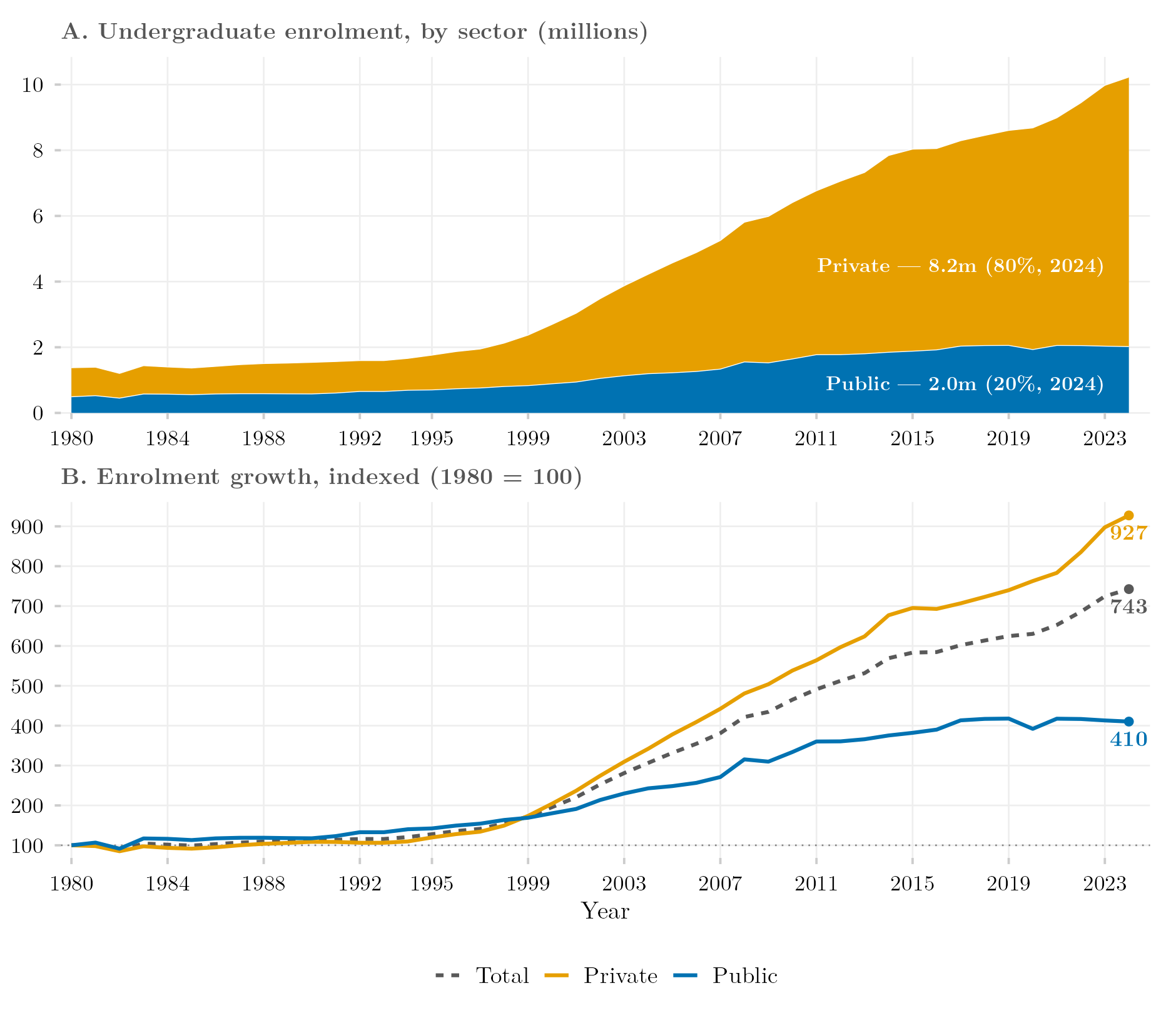
Income-related inequality in access to tertiary education1 in Brazil is at its lowest levels ever recorded. Over the past three decades, income inequality in access to tertiary education declined sharply. The system that produced this outcome is not an obvious candidate for achieving a more egalitarian distribution of access, a pattern traditionally associated with public-led, highly subsidized, and de-stratified education systems, of which the Nordic countries are a canonical example. Most of the Brazilian system, however, is private, where admission to many institutions requires neither high academic performance nor competitive examinations, but primarily the ability to pay tuition. In the early 1990s, the system was highly restricted even by regional standards, ranking among the proportionally smallest in Latin America. As it expanded — growing from 1.6 million to over 10 million enrolled students between 1994 and 2024, as shown in Figure 1 — the private sector expanded enormously and consolidated into corporate conglomerates, giving rise to some of the largest for-profit tertiary education companies in the world, a process widely characterized in the academic literature as state-sponsored privatization and financialization. Enrollment multiplied roughly sevenfold after 1992, breaking almost two decades of stagnation that marked the 1980s, so that by 2024 four out of five students were enrolled in private institutions, three out of five in legally for-profit entities, and half in distance-learning programs. Under different political conditions — and within a predominantly private educational framework — this expansion trajectory could easily have proven deeply regressive, selling more places at market prices to those already capable of paying while leaving lower-income groups excluded. How can this reduction in income-related access inequality be explained, and what were the political cleavages on tertiary education policy that shaped inequality of access? These two interconnected research questions guide this dissertation.
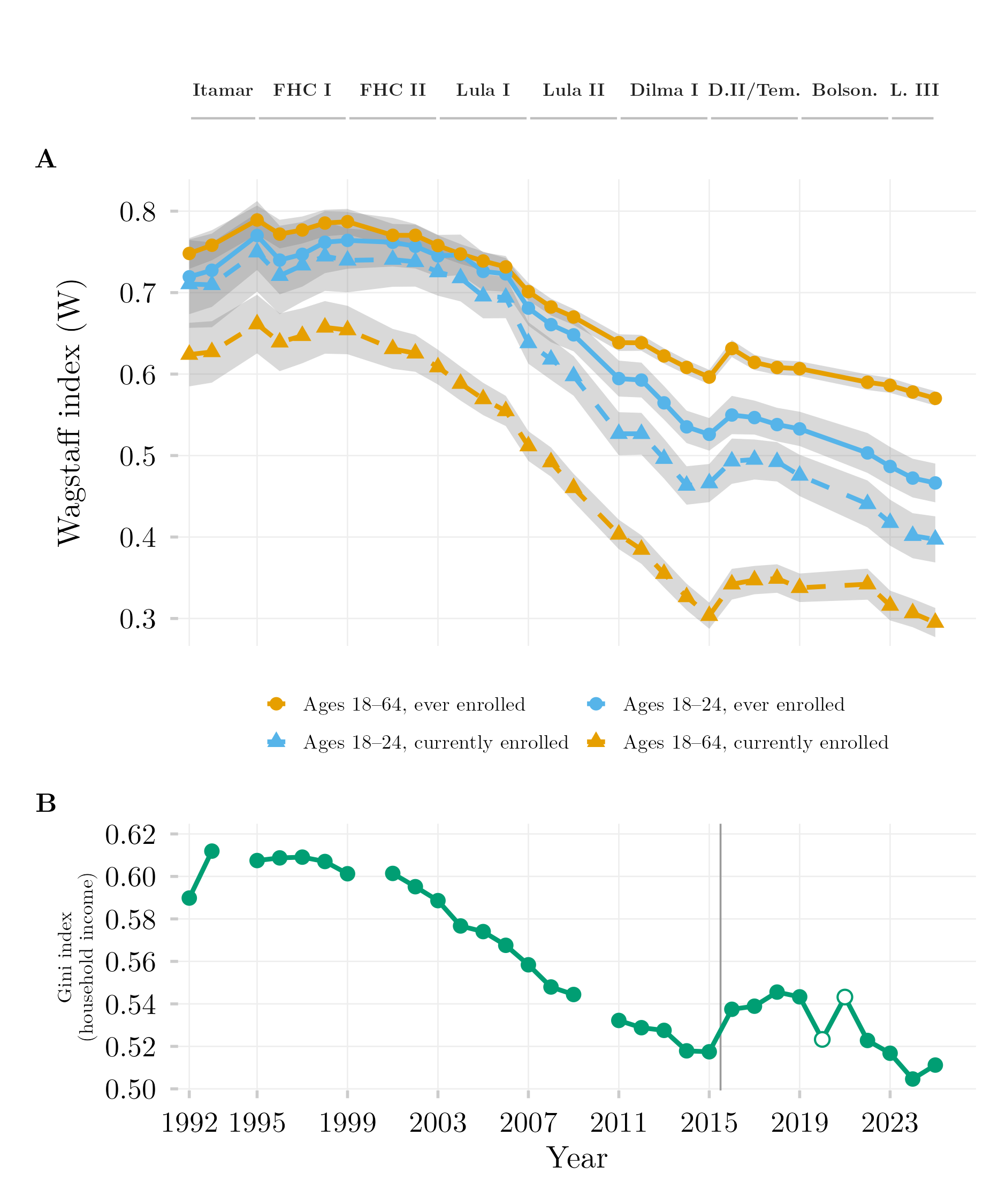
Brazil, once a prominent laggard in educational attainment, became a reference case for affirmative action programs and means-tested subsidies that helped alter the income composition of entrants at participating institutions. Alongside these policy shifts, economic growth and redistribution drove a continuous rise in real per capita income from 2003 to 2014 before stagnating or declining, thereby lowering the financial burden of pursuing further education. We argue that these are relevant mechanisms accounting for the shifts in inequality observed over the 1992–2025 period. The trajectory of this inequality, visible in Figure 2 and derived from the harmonized household survey series, provides the primary empirical description of the phenomenon to be explained. The Wagstaff concentration index (\(W\)) summarizes how entry into tertiary education is distributed across the household income distribution. Much like the Gini coefficient (shown in Panel B, directly below the Wagstaff index), it measures inequality by evaluating a binary outcome ordered by an external socioeconomic rank: \(W = 0\) when the probability of being enrolled or having accessed tertiary education does not vary by income, and \(W > 0\) when entry is concentrated among wealthier households, reaching \(W = 1\) if entry were perfectly concentrated among the richest. Crucially, its value is independent of overall enrollment volume — a system can double its intake and leave \(W\) untouched, provided new entrants reproduce the income profile of existing cohorts. This scale-independence makes the metric particularly well-suited to the puzzle at hand, as Brazil’s intake grew roughly sevenfold over the period. The Wagstaff normalization is what ensures longitudinal comparability: for a binary outcome, the bounds of the standard concentration index shrink as the mean (\(\mu\)) changes, so dividing by \((1 - \mu)\) restores comparability between years with different enrollment levels. Figure 2 plots four such series by crossing two dimensions: color distinguishes the age bracket used as the denominator (18 to 24, the typical age of first entry, versus the broader working-age population of 18 to 64), while line style and markers distinguish the outcome measured — whether an individual has ever accessed tertiary education (solid lines with circles) or is currently enrolled (dashed lines with triangles). The dominant approach in the stratification research, including the one on the Brazilian case (Brito, 2017; Salata, 2018; Salata et al., 2025), models educational transitions through logistic regression, reporting odds ratios or relative risks. The comparison is based on two selected categories — be they the richest income quintile against the poorest or the top occupational class against the lower-prestige class — and does not consider the changes in between. This comparison between the extremes of the distribution is blind to transformations in the middle of the income distribution — composed of families whose income sits far closer to the base than to the top.
In explaining inequality in access to tertiary education, the social stratification literature posits two primary mechanisms through which enrollment expansion might lead to equalization: either the saturation of upper-class enrollment (Raftery & Hout, 1993; Shavit & Blossfeld, 1993) or reduced competition for available slots (Alon, 2009). These explanations, however, face methodological problems regarding measurements of expansion that are endogenous to inequality metrics (Jackson, 2021), and the Brazilian trajectory directly challenges both mechanisms. Expansion was not inherently redistributive when the cycle began: inequality did not fall during the enrollment boom of the 1990s, nor did it decline monotonically thereafter. The saturation logic does not apply to any part of the period, as wealthier strata were not near saturation when equalization occurred, while the competition logic is equally weak in a system where public-sector places are reserved through quotas and private admission is largely non-selective. The scholarship on horizontal stratification, such as Lucas (2001), emphasizes that as entry barriers ease, prestigious fields become primary sites for reproducing inequality. Yet horizontal stratification remains analytically distinct from access barriers: while studies such as Carvalhaes & Ribeiro (2019) and Rodrigues (2023) document horizontal segregation in Brazil, Salata et al. (2025) demonstrates that the initial transition into higher education still accounts for a substantial share of overall inequities. While horizontal stratification is undoubtedly a relevant dimension of educational inequality, we argue that the decline in access inequality captured by the Wagstaff concentration index cannot be dismissed as merely cosmetic. In fact, changes in access have been so substantive that even traditionally segregated, elite public institutions have begun to register measurable declines in horizontal inequality (Brito, 2026).
The literature’s closest approach to this answer came from within stratification research. Breaking the long-standing consensus of persistent inequality (Shavit & Blossfeld, 1993), Breen et al. (2009) showed that class inequalities in educational attainment declined across cohorts born through the first two-thirds of the twentieth century in eight European countries. The explanations they proposed for this decline centered on falling direct costs as fees were abolished and school supply expanded, real family income growth exceeding basic subsistence needs, receding pressure on working-class children to enter the labor market early, and welfare state expansion that narrowed class disparities in the capacity to bear educational costs — most visibly where income equalization was strongest, as in Sweden. Yet in their account, these factors appear as general background features of post-war development rather than as politically variable conditions in their own right: the ambition of Breen et al. (2009) remained, in the authors’ own words, “primarily empirical, descriptive, and methodological” (2009, p. 1515). Their concluding call to shift the field’s focus “from the explanation of stability to the explanation of change” — attentive to cross-national and temporal differences in the magnitude and timing of decline — left open the precise question our framework addresses: why income related educational inequality changes and how policy choice shapes it. In doing so, we mobilize their insights to test them as an explanation for the Brazilian case, proposing that the political economy of education is central to answering that question
Our answer to that first question shifts the focus from enrollment volume to how household income shapes who can afford access to tertiary education. We follow the premise that access inequality is governed by a cost-benefit calculus anchored in household income constraints, educational costs, and returns, following the cost-benefit logic that underpins Raftery & Hout (1993)’s model, further developed by Breen & Goldthorpe (1997), but transposing it to income inequality rather than the class logic it was developed for. This framework directs attention to two channels and to a necessary precondition. The first is the growth in real incomes and the broader improvement in living conditions. As Breen et al. (2009) and Breen (2010) suggest for Europe, these changes may reduce the relative cost of continued study for less privileged households — not only tuition and the earnings forgone by reducing paid work, but also the time constraint created by reconciling employment with evening classes, commuting, and study. The relevant barrier is not simply whether students work many hours: paid work may be indispensable for financing their enrollment, yet its temporal demands compete with the activities through which they can remain enrolled and learn. Higher real incomes can ease this trade-off by reducing the pressure to allocate scarce time to paid work rather than study. The second is the education-policy channel, operating through subsidies and affirmative-action policies such as ProUni scholarships, FIES loans, and racial and socioeconomic quotas, which can reduce the income-dependence of access and incorporate targeted groups. Theoretically, this is a case of how de-commodification (Esping-Andersen, 1990; Garritzmann, 2016)2 can affect educational inequalities, since public policies can reduce the dependency on household income to access a given essential service, such as education. The necessary but insufficient precondition is the prior expansion of secondary education: the progressive expansion of free public provision made a larger cohort of low-income graduates eligible to attempt entry, while the 1988 Constitution provided for the progressive extension of compulsory and free upper-secondary education and Constitutional Amendment 59/2009 made education compulsory from ages four to 17.
All those channels and the precondition are regulated by political disputes. They are a political economy problem, mediated by a series of complex political processes that are of interest to the comparative political economy of education literature. That literature posits that education policy is fundamentally a tool of targeted redistribution, developing general theories that aim to account for the expansion and financing of education. Ansell (2008, 2010) argues that the gross enrollment rate and the income-dependency around access serve as the primary cleavage between left- and right-wing parties, posing it as a trilemma problem where tertiary education systems may possess at most two of three properties: large, subsidized, and cheap. Therefore, states must trade off between enrollment growth, public subsidization, and overall public cost. One expectation of that theory was that as the educational system expanded to benefit a poorer electorate — and thus became less unequal — right-wing parties would eventually oppose the continued expansion of tertiary education enrollment. Against that expectation, we argue that in the Brazilian case and beyond, expansion was not a partisan cleavage, even though right- and left-wing governments alternated at different moments when enrollment rates crossed distinct thresholds that partisan theory predicts would generate conflicting policy stances. Contradicting these expectations, every government of the past thirty years, from 1995 onwards, regardless of partisan orientation, pursued or maintained policies that allowed for continued growth in tertiary education enrollment. The political cleavage was, however, on who would pay for tertiary education, with right-wing governments restricting public spending and enacting regulatory shifts in tertiary education that facilitated cheap private expansion (and later distance learning, or EAD) without redistributive targeting. That does not mean there was a simple cleavage of right versus left being pro-public or pro-private, as part of the literature argues. The private sector also grew continuously across all administrations; what varied was not whether it expanded, but the presence of distributively targeted instruments — since left-leaning administrations specifically targeted subsidies, credit income caps, and affirmative action rules toward lower-income groups, whereas right-leaning administrations relied on untargeted regulatory shifts that lowered entry costs for opening new enrollment slots without redistributive criteria.
To explain specific policies, however, one cannot rely solely on a partisan story of the political cleavage on education policy. Contrary to strong versions of partisan-theory expectations, the de-commodification instruments were not a simple product of partisan preferences: the actors who shaped their design and distributive targeting most decisively include non-partisan ones — social movements that pushed redistribution further than any governing coalition would have proposed on its own; the for-profit sector that lobbied to dilute targeting and convert credit into demand subsidies; and the fiscal and institutional constraints that made private provision structurally indispensable. Nor was the affordability channel a market outcome: real-income growth at the bottom resulted from deliberate welfare-state policies — minimum-wage valorization, income transfers, pension indexation (Arretche, 2018; Kerstenetzky, 2019). The answer to the first question thus opens the second: once the fall in inequality is traced to politically variable parameters — incomes, prices, subsidies — the question of who varied them, in what design, and against what resistance can no longer be treated as background. How income-dependence in access was politically shaped across both channels — through which actors, coalitions, and constraints the terms of access were changed over three decades — forms the core of the second research question this dissertation addresses.
The dissertation addresses its two research questions through two complementary empirical strategies that share a common mode of inference — inference to the best explanation (IBE). Part II develops a descriptive analysis of the trajectory of access inequality using harmonized household survey data from the PNAD and PNADC covering 1992 to 2025. It adjudicates among rival explanations — saturation, competition, and the articulation of household income, educational policy, and eligibility — by examining their observable implications. The chapter does not estimate the causal effect of those channels on aggregate inequality; it uses quasi-experimental estimates of specific policies from the economics of education as external evidence about the effects of the instruments themselves. Part III implements the abductive standard through IBE process tracing to evaluate competing hypotheses about the political origins of reform. Its evidence base combines legislative records and official Ministry of Education documents with a corpus of Folha de S.Paulo press coverage.
Read against Figure 2, the trajectory unfolds in four distinct phases. The plateau at high levels during the 1990s and early 2000s shows that vigorous expansion that tripled enrollment during that period did not come with a reduction in inequality in the composition of who accessed tertiary education. The sharp decline in access inequality between 2005 and 2015 coincided with rising real household incomes at the bottom, tuition prices falling relative to them, a growing cohort of low-income secondary graduates, and the introduction and scaling of policies that reduced the immediate income-dependence of access. The stagnation between 2015 and 2022 coincided with continued enrollment growth through distance education, the restructuring or erosion of key policy instruments, and stalled real income growth. Finally, the resumption of decline after 2022 is consistent with the reopening of the income channel as median income began to rise again.
Three findings emerge from the analysis, each a better explanation than the current literature proposes. First, the partisan cleavage that matters runs along the cost of tertiary education rather than expansion, as former theories argued. Contrary to trilemma theories predicting right-wing resistance to expansion, right-leaning governments in Brazil favored enrollment growth but restricted public spending, prioritizing fiscally cheap expansion by enabling private-sector and distance-learning growth through untargeted regulatory shifts while reducing costs to the government. PT governments (2003–2016) distinguished themselves not by expanding enrollment more — as all administrations expanded — but by reducing the income-dependence of access through distributively targeted instruments such as ProUni (2005), REUNI (2007), FIES (scaled 2010–2014), and affirmative action in free public universities alongside broader income-redistribution policies that, in a period of economic growth, led to an increase in poor households’ incomes and a decline in inequality (Arretche, 2018; Souza & Hecksher, 2026). That explanation is consistent, as far as the evidence we collected shows, with all periods of decline and stagnation in inequality. Second, non-partisan actors were causally decisive in opposing directions. Social movements drove the construction of the quota system over more than a decade of mobilization largely outside party channels, producing a legislative outcome whose scope and durability exceeded what any governing coalition could have achieved by itself — the work of a distinct, broader coalition, and a form of what Holland & Schneider (2017) call “hard redistribution” that created identifiable losers and required sustained pressure against resistance within the governing coalition itself. Third, private-sector dominance across all administrations is better explained by fiscal path dependence than by ideological preference. The institutional inheritance of the 1968 military-era reform, combined with binding fiscal constraints on public expansion, made the private sector structurally indispensable for any government seeking rapid enrollment growth — regardless of its declared programmatic preferences.
Building on extensive empirical research on changes in inequality in the Brazilian case (Arretche, 2019; Arretche et al., 2019), the dissertation speaks to different bodies of scholarship that have developed largely in parallel, with limited direct engagement across their shared object of study: the social stratification literature and the comparative political economy of education. Its central contribution is that the decisive distributive axis for explaining changes in access inequality is the falling cost of access relative to household income — a movement that encompasses both de-commodifying educational instruments and redistributive policies that raise poor households’ real incomes. The affordability channel is not a market background condition but a political product, shaped by minimum-wage policy, income transfers, and pension indexation — mechanisms whose role in reducing class inequality Breen et al. (2009) proposed as a possible explanation yet treated as background conditions of post-war economic development, precisely because that framework lacked the political variables needed to explain their production. The parts of the dissertation develop this claim as follows.
Part I reconstructs the literature of different intellectual traditions that offer theories and analytical frameworks with important implications for explaining how inequality of access to tertiary education works, yet they have largely developed without deeper engagement with one another. We trace the developments of two of these fields — social stratification and comparative political economy — arguing that a joint reading yields key analytical advantages with direct consequences for new empirical research. While the social stratification literature extensively described educational inequality across many countries from the twentieth century onwards, causal theories capable of explaining its findings once expectations of persistent inequality were proven false remained underdeveloped. This field was initially marked by historicist theories, succeeded by a consensus around the thesis that educational inequality remained invariant over most of the twentieth century. Over the last two decades, this consensus has eroded; yet part of the new research in the field remains reluctant to advance and test new explanations even after the causal assumptions underlying earlier theories collapsed (Jackson, 2021), while other scholars continue to reiterate the persistence thesis. Comparative political economy, on the other hand, is rich in theoretical propositions that conceive of education as a political-economy problem, yet these theories have rarely been applied to the empirical study of individual-level educational access inequalities. A synthesis of both perspectives can generate testable theoretical propositions consistent with recent empirical findings. We also discuss ways of adjudicating between theories, perspectives on causation, and the value of description in the field.
Part II describes the trajectory of income inequality in access to tertiary education and adjudicates between explanations proposed for it. It asks whether the observed pattern is more consistent with saturation, competition, or the changing relationship between household income, the cost of entry, educational policy, and eligibility. The chapter does not infer the aggregate causal contribution of any one component. Rather, it bridges the quasi-experimental economics-of-education literature with an institutional argument, using estimates of specific instruments’ distributional effects as evidence relevant to rival theoretical accounts rather than as standalone answers to the aggregate trajectory.
Part III describes the trajectory of tertiary-education policy and asks what political cleavages and policy differences shaped it over the period. Reconstructing the policy trajectory across administrations, it adjudicates three central debates: the relevant partisan cleavage, the causal role of non-partisan actors, and the dominance of private provision. Contributing to comparative political economy theories of education, where the dominant mode of engagement in the Brazilian literature has been confirmation rather than confrontation (Gomes, 2024), it shows that governments of opposite partisan orientations produced convergent pro-enrollment trajectories but divergent distributional outcomes. The literature has assumed, following Ansell (2008), that the relevant cleavage runs along expansion; drawing on Garritzmann & Seng (2026), we argue instead that since 1995 the cleavage has run along the cost of the system — no tertiary system can be simultaneously large, heavily subsidized, and cheap to run, and Brazilian administrations of both orientations chose differently along that trilemma rather than differing on whether to expand. Governments diverged, specifically, in whether they adopted targeted subsidy instruments; business associations and social movements exercised a causal autonomy that partisan theories cannot accommodate; and private-sector dominance is rooted in fiscal path dependence rather than programmatic preference.
The Conclusion draws these findings together to synthesize what the Brazilian case implies for the comparative politics of educational redistribution. Throughout, Brazil enters the argument as an test that allow the refinement os theories developed primarily for the more-studied rich democracies by exposing the mechanisms they leave unspecified and the premissed that arent present in our case.
While “higher education” (educação superior in Portuguese) is the more common term in the literature and public debate, its scope varies across countries. In Brazil, for example, the category includes technological professionalizing programmes, whose graduates are known as tecnólogos. We use “tertiary education” to follow the internationally standardized terminology adopted by the OECD on the basis of the International Standard Classification of Education (ISCED). This category encompasses ISCED levels 5 and above, including short-cycle tertiary programmes and undergraduate couses. We consider it a more appropriate designation for this educational stage because it provides a common framework for cross-national comparison.↩︎
While classical welfare state theory (Esping-Andersen, 1990) defines de-commodification as the provision of services as a right independent of market participation, we are extending the concept to public policy instruments — such as means-tested grants, subsidized credit, and quota rules — that reduce the dependency of access on household income, even when implemented within or alongside marketized provision. Part I develops this conceptual extension in detail.↩︎