The De-commodification Cleavage: Parties, Non-Partisan Actors, and Path Dependence in Brazilian Tertiary Education Reform, 1990s–2020s

Author

Tales Mançano

Published

August 11, 2026

Keywords

comparative political economy of education, redistribution, tertiary education, affirmative action, business power, process tracing, Brazil

The final result of political action often, no, even regularly, stands in completely inadequate and often even paradoxical relation to its original meaning.

Max Weber, Politics as a Vocation (1946/2007, p. 117, orig. 1919)

Abstract:

In Brazil, tertiary enrollment expanded under governments of every partisan orientation, but its distributive incidence did not: under the center-right, gains accrued overwhelmingly to the rich; access inequality fell sharply in the late 2000s and mid-2010s, mostly under left-wing governments; and that decline has stagnated since 2016. Using inference to the best explanation (IBE) process tracing and household-survey income-composition data, we adjudicate among competing explanations of the politics of tertiary education policies that directly affect education inequalities to explain how access was redistributed between 1994 and 2024. We show what dominant theories capture and what they misdescribe; Brazil serves as a diagnostic case, not an exception. We find that the relevant axis of partisan competition is the de-commodification of access, not enrollment expansion. For-profit educational actors diluted student-subsidy targeting, social movements secured affirmative action that no partisan coalition would have produced alone, and path dependence plus fiscal constraint best explain persistent private-sector dominance.

Introduction

“If you give the power to decide on the opening of private colleges to the Discalced Carmelite nuns, at the second meeting they’ll show up with Louis Vuitton bags.” So remarked Paulo Renato de Souza, the PSDB’s leading voice on education and Minister of Education throughout both Fernando Henrique Cardoso (FHC) center-right administrations (1995–2002). During Souza’s tenure, Brazil’s private tertiary enrollment nearly tripled after fifteen years of stagnation. Current accounts in the literature treat this episode as straightforward confirmation of partisan theories: a right-wing government expanding access through its preferred private sector to benefit its upper-middle-class electorate. Yet Souza’s remark points to something that theoretical alignment conceals. The government that supposedly championed private tertiary education was simultaneously hostile to the for-profit sector in several respects: even as it reformed regulation in ways more favorable to private enrollment growth, it litigated against private institutions to impose tuition-fee controls, cut fiscal exemptions, subjected institutions to quality evaluations, and attempted to close many of them — a dimension largely overlooked in literature that portrays the administration chiefly as a reproducer of World Bank neoliberalism.

The subsequent Partido dos Trabalhadores (PT) center-left administrations progressively reduced income-based inequality in access through targeted subsidies and affirmative action. Yet the left side of the story also resists neat partisan expectations: among the signature reforms of the PT governments were a tuition-subsidy program that channeled billions in public funds to private for-profit institutions and an expanded subsidized credit program eventually extended even to richer students. Meanwhile, the same Paulo Renato de Souza — now the PSDB’s leading voice in parliamentary opposition — brokered the agreement that cleared a central congressional veto point on affirmative action by conditioning his party’s assent on adding public-school origin and income criteria to a design that already contained racial reservation. That policy survived every subsequent administration, including a far-right one vocally opposed to racial quotas. One pattern, however, was consistent across parties: enrollment expanded under every administration.

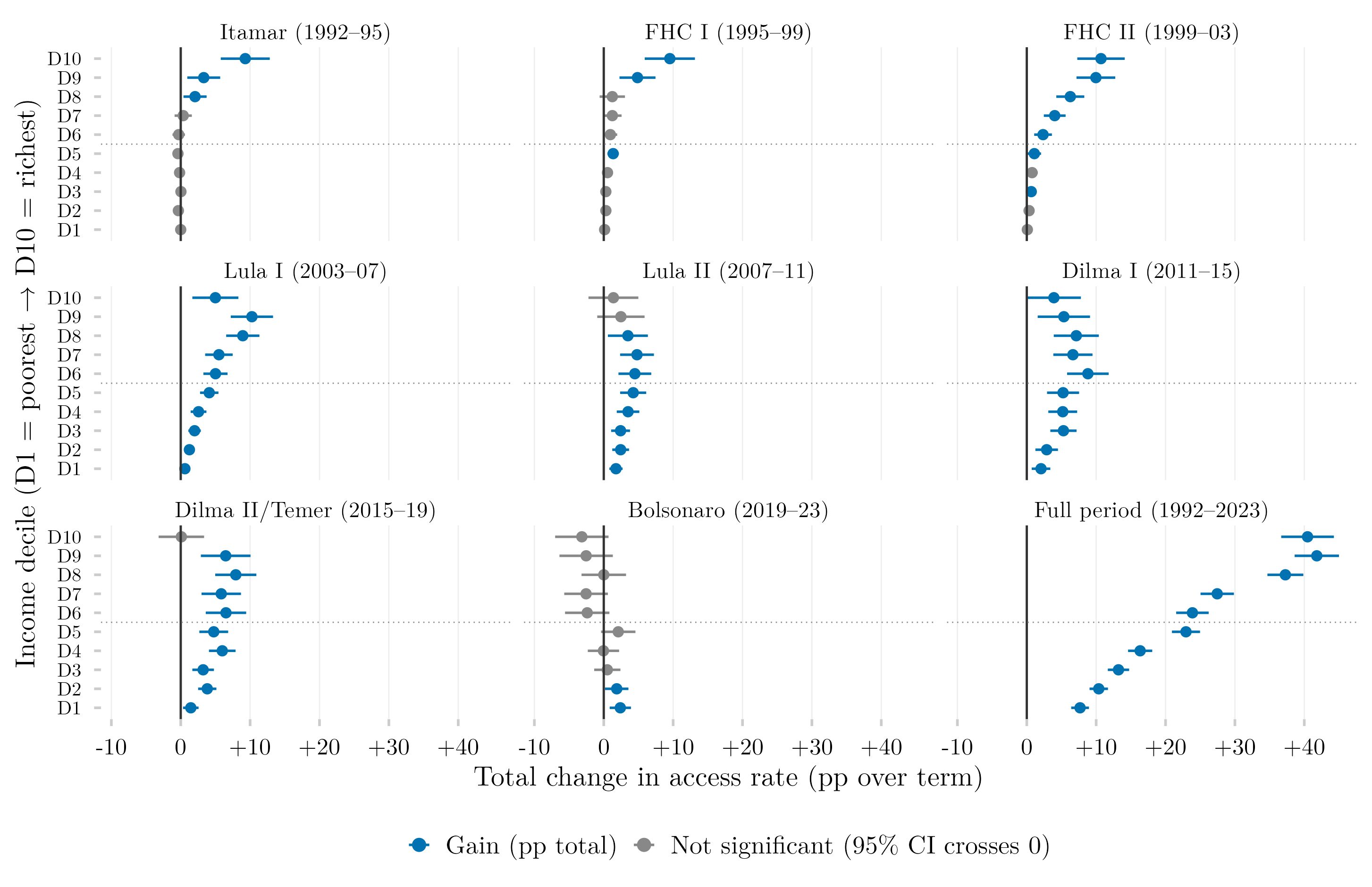
That common expansion masks a more consequential and non-linear trajectory. Observed directly in household-survey data rather than inferred from policy, access inequality did not decline simply because the system grew. Under the center-right Partido da Social Democracia Brasileira (PSDB) coalition led by FHC, enrollment gains accrued overwhelmingly to the top income deciles, with gains at the bottom approaching zero. Inequality of access fell sharply in the late 2000s and mid-2010s under the PT governments, stagnated after the PT left office in 2016, and resumed its decline after 2021 — a pattern that challenges the central mechanisms of the enrollment-threshold theories that remain influential in the literature. This trajectory raises a central unresolved question: how, and through what political processes, was access to Brazilian tertiary education redistributed between 1994 and 2024?

This article explains that trajectory and, in doing so, revisits how the leading theories account for it. Using inference to the best explanation (IBE) process tracing (Fairfield & Charman, 2022) — drawing on income-composition data from national surveys, legislative records, and journalistic sources to trace the political processes from the 1990s to the present — the article adjudicates among three inter-related debates raised by the puzzle. The first concerns the relevant partisan cleavage in tertiary education policy: one account holds that the central axis runs through enrollment expansion, with right-wing governments in elite-phase systems supporting access through private provision and left-wing governments subsequently de-commodifying it (Ansell, 2008; Gomes, 2024); an alternative holds that the decisive cleavage runs instead through de-commodification itself — targeted subsidies, affirmative action, and tuition regulation that reduce the income dependence of access — while enrollment expands broadly across governing orientations (Garritzmann, 2016; Garritzmann & Seng, 2026). The second concerns political actors: one line of argument treats parties as the primary determinants of redistributive content, with business actors and social movements operating only within the space that partisan choices create (Ansell, 2008; Garritzmann, 2016; Gomes, 2024); another contends that private education providers, especially for-profit conglomerates, and grassroots social movements — particularly the Black movement and student organizations — shaped the design, timing, and distributive targeting of key policies with causal autonomy that partisan mediation cannot absorb (Busemeyer & Thelen, 2020; Fairfield & Garay, 2017; Pereira, 2021; Tarlau, 2019). The third concerns the structure of provision: one account attributes the persistent dominance of the private sector to the ideological preferences of center-right governments (Carvalho, 2011; Cunha, 2003); another maintains that institutional inheritance and binding fiscal constraints make structural reversal prohibitively costly regardless of governing-party preferences, a claim most directly testable under left-wing administrations that declared preferences for public expansion but presided over continued private-sector dominance (Arretche, 2019; Pierson, 2004).

Adjudicating among these competing explanations, the paper finds that the central partisan cleavage in tertiary-education policy is de-commodification, not enrollment expansion: administrations across the ideological spectrum pursued policies that continuously expanded tertiary enrollment, so the decisive axis of partisan contestation ran instead through targeted subsidies, affirmative action, and tuition regulation that reduce the income dependence of access — a more genuinely redistributive cleavage than enrollment-threshold theories allow. Second, partisan politics matters, but it does not act alone: social movements and for-profit educational actors, systematically under-theorized in the comparative political economy of education, shaped the distributive content of reform in opposing directions with causal autonomy. Third, path dependence and fiscal constraints offer a better explanation for the persistent dominance of the private sector across all administrations — including those that declared preferences for public expansion — than accounts that attribute this structural feature to the ideological preference of center-right governments for market-based provision. Together, these findings support a revised account of the redistributive politics of education that centers de-commodification as the relevant axis of partisan competition, distributes causal agency across partisan and non-partisan actors, and attributes private-sector persistence to path dependence and fiscal constraints rather than to partisan preference.

Resolving these competing accounts requires evidence that directly observes the political processes through which the policies were produced and their consequences for access inequality — who set the policy agenda, who designed the redistributive instruments, what effects they had on access inequality, against what resistance they were implemented, and in what sequence — rather than inferring causal architecture from correlations between party labels and aggregate outcomes. The inferential logic of inference to the best explanation (IBE) process tracing developed by Fairfield & Charman (2022) is therefore appropriate here. It requires that rival explanations drawn from the existing literature be stated as mutually exclusive hypotheses and confronted, on equal terms, with the same body of evidence, so that none is excluded by assumption and each is retained or discounted according to how well it accounts for the observed record. Understood in this way, the exercise adjudicates among standing theoretical claims defended in the current literature. We make available the full database of qualitative and quantitative evidence on which the inference rests — with each item registered together with its source and its hypothesis-relative assessment — so that every inferential step can be scrutinized, contested, and built upon.

The paper develops these arguments in four steps. Section Literature Review — Redistributive Politics in Brazilian Tertiary Education: Partisan Actors, Enrollment, and De-commodification situates the argument in the relevant literature, explaining why de-commodification rather than enrollment expansion constitutes the relevant partisan cleavage and introducing easy/hard redistribution and the role of non-partisan actors as the analytical tools of the alternative account, while showing why macro-level evidence cannot adjudicate among rival causal stories. Section Research Design then justifies the IBE process-tracing design (Fairfield & Charman, 2022), operationalizes these theoretical tensions into three pairs of mutually exclusive hypotheses, and specifies the evidentiary base and inferential logic. Section Reforming Tertiary Education traces the political processes behind the major reforms from the mid-1990s to the present, integrating direct income-composition evidence with the process-tracing narrative to show how fiscal constraints and path dependence, non-partisan actors operating in opposing directions, and post-enactment reshaping of redistributive targeting produced outcomes whose causal architecture the rival hypotheses specify differently. Section Discussion and Implications draws out the implications for the relevant theories and for the study of welfare-state and education policy in Latin America.

Literature Review — Redistributive Politics in Brazilian Tertiary Education: Partisan Actors, Enrollment, and De-commodification

In the late 1980s, when Brazil democratized, the country was a major laggard in educational access, even by Latin American standards (Kang et al., 2021). The tertiary sector carried a legacy of extreme restriction and elitism, with public funding disproportionately concentrated among elites (Kang & Menetrier, 2024; Lichand et al., 2026). From the mid-1990s to the present, tertiary education underwent massive expansion: enrollment rose from 1.6 million to more than 10 million students between 1994 and 2024, driven overwhelmingly by the private sector, which had already become dominant by the late 1960s. This process became known as the second great expansion cycle of Brazilian tertiary education (Senkevics, 2021). Yet expansion was not necessarily equalizing. Although much of the literature treats massification as a turning point in the redistributive character of higher education, access inequality in Brazil followed a non-linear trajectory: it increased at the beginning of the period, declined substantially between 2005 and 2015 — a decade marked by economic growth, broader reductions in income inequality, and the height of policies designed to reduce the income dependence of access under left-wing governments (Gomes, 2024) — and has declined more slowly since (Salata et al., 2025). This pattern rules out accounts that straightforwardly treat expansion itself as the main explanation for gains in equality (see Jackson, 2021 for a review). More importantly, it suggests that the central mechanism is not expansion itself but the de-commodification of access, and it poses two linked questions: how was access to tertiary education redistributed, and through what political processes were the relevant policies produced in Brazil during this period?

The political-economy literature on education attributes such distributive trajectories to political struggle, power relations, and state action (Carnoy, 1985), framing tertiary-education policy as a political problem with major redistributive consequences (Ansell, 2010; Busemeyer, 2014; Busemeyer & Nikolai, 2021; Busemeyer & Trampusch, 2011; Garritzmann, 2016; Garritzmann & Seng, 2026; Gomes, 2024). But how well does partisan politics explain the distributive politics of educational access?

Challenging traditional partisan and welfare-state theories (Boix, 1998; Huber & Stephens, 2001) that assume left-wing parties universally advocate higher public spending, Ansell (2008) proposes that partisan preferences regarding higher education are conditional on existing enrollment levels. He models this through a trilemma of institutional design, arguing that governments must trade off mass enrollment, public subsidization, and overall public cost. Because access to tertiary education is heavily income-dependent, financing an elite system through general taxation is fiscally regressive. Consequently, when enrollment is low, right-wing governments champion expansion and high subsidization because the marginal beneficiaries belong to their wealthier electorate. Left-wing parties, by contrast, are reluctant to tax the poor to subsidize the rich and therefore resist expansion or prefer partially private models. Once massification shifts the income profile of the student body, however, partisan preferences reverse: the left becomes the primary defender of mass public expansion and full subsidization, while the right attempts to halt further growth to limit tax burdens and protect the scarcity rents of an exclusive diploma. By contrast, Garritzmann (2016) identifies a blind spot in this framework, arguing that enrollment levels are largely endogenous to policy choices — specifically, to the provision of student aid. He therefore distinguishes institutional expenditure from student subsidies and argues that left-wing parties seek to expand the latter in order to foster equality of opportunity and reduce income bias in access (de-commodification), whereas right-wing parties oppose them and favor tuition fees to preserve higher education’s exclusivity.

These theories were developed primarily from evidence drawn from advanced OECD democracies. Applied to Brazil, Gomes (2024) argues that Ansell (2008)’s framework fits the broad trajectory: center-right governments expanded the system in its elitist phase, whereas left-wing governments coupled expansion with redistributive criteria and rapidly advanced social and racial inclusion. Yet both theories generate expectations about the relevant actors, instruments, and sectoral composition of expansion that are inconsistent with what the Brazilian evidence reveals: the enrollment threshold on which Ansell (2008)’s partisan predictions hinge is not consistently observable, and the expectations about which sector should expand, and under what tuition-fee regime, are not borne out. The issue, then, is not simply whether a macro-pattern can be made to resemble the theory, but whether the rival explanations generate observable implications that survive mechanism-level scrutiny. The Brazilian record also brings into view problems these theories underemphasize but that are central to explanation here: the causal role of non-partisan actors, and the intersection between the private sector’s political influence, its weight in educational provision, and the fiscal constraints highlighted by Ansell (2008)’s trilemma. These limitations motivate a systematic evaluation of competing hypotheses capable of explaining what strictly partisan accounts leave unexplained.

Expansion and de-commodification in tertiary education politics

Enrollment expansion and de-commodification are distinct mechanisms with different implications for inequality in tertiary education. The political-economy tradition has long treated education as a field of distributive conflict rather than as a purely technical domain, emphasizing political struggle, power relations, and state action as central explanatory forces (Carnoy, 1985). This perspective is analytically consequential because it rejects deterministic accounts in which educational outcomes are defined by structural or functional logics outside political agency 1. Within that tradition, Ansell (2008) and Ansell (2010) provide the most explicit formulation of the distributive logic of tertiary education policy, arguing that partisan competition over higher-education spending cannot be understood without attention to who actually benefits from access under specific institutional conditions.

This subsection adjudicates between two mutually exclusive hypotheses about the redistributive politics of tertiary education that emerge from this literature. H1a, the conditional partisan-expansion hypothesis, holds that the central cleavage concerns enrollment growth under specific access conditions: when systems remain elite and access is strongly income-stratified, right parties support expansion because their constituencies are the main beneficiaries, whereas left parties become more expansionary only after massification alters the expected beneficiary profile. H1b, the de-commodification hypothesis, holds instead that gross enrollment expansion is not the main political cleavage, because the decisive divide concerns whether access is de-commodified through means-tested subsidies, affirmative action, tuition regulation, and related instruments that reduce income dependence in participation. The two hypotheses generate contrasting observable implications: under H1a, partisan turnover and movement across elite-to-mass thresholds should explain major changes in the expansion policy and inequality of access; under H1b, distributive change should track policy designs that alter who can actually enter and remain in tertiary education. The remainder of this subsection reconstructs the theoretical debate that produces these competing expectations, beginning with Ansell’s foundational formulation and ending with recent evidence that favors H1b.

Ansell formulates this dynamic as a higher-education policy trilemma: governments cannot simultaneously maximize mass enrollment, full subsidization, and low fiscal cost, so systems tend to stabilize in one of three configurations (elite, partially private, or mass public) (Ansell, 2008, 2010). The causal core is that, when access is low and strongly income-dependent, expansion distributes benefits regressively: lower-income taxpayers finance institutions from which high-income and upper-middle-income groups disproportionately benefit; partisan preferences therefore do not map onto the standard welfare-state intuition associated with Boix (1998) and Huber & Stephens (2001). In this framework, expansion becomes progressively redistributive only when enrollment reaches mass levels or when policy instruments reduce the income dependence of access through targeted student support and institutional reforms that weaken early stratification. Until those thresholds are crossed, expansion tends to incorporate groups immediately below the elite rather than those at the bottom of the income distribution.

The theoretical architecture of this argument combines sociological evidence on stratified access with political-economy models of redistribution. On the sociological side, the logic is consistent with the literature on Maximally Maintained Inequality (Raftery & Hout, 1993; Shavit et al., 2007) and with class-biased models of educational transitions (Breen & Goldthorpe, 1997; Breen & Jonsson, 2005), which imply that expansion does not automatically reduce inequality until advantaged groups approach saturation. In its strongest formulation, the MMI hypothesis holds that educational transition rates and class inequality remain stable across generations unless enrollment growth forces them to change — that is, policy reforms do not equalize opportunity on their own; what matters are macro-demographic shifts and the saturation of enrollment at each level. This underpins Ansell’s claim that early expansion in elite systems tends to benefit groups immediately below the elite, since privileged classes fill new places first to preserve relative advantage. It is also, ironically, an uncomfortable foundation for Ansell’s own partisan account, because in much of the social-stratification literature MMI implies that redistributive politics matter little for educational inequality (Beller & Hout, 2006), which remains stable until saturation thresholds are reached.

Raftery & Hout (1993) derive this conclusion from the expansion of secondary education in Ireland (1921-1975), including the abolition of school fees in 1967. As the system expanded, upper classes filled new places first to preserve advantage. Inequality declined only when upper-class demand for that level was nearly exhausted — that is, when almost 100 percent of youth from that class were already enrolled. Only once that ceiling was reached did the surplus of expansion begin to benefit lower classes, forcing a statistical reduction in inequality. They explain why the 1967 reform did not eliminate class barriers under a rational-choice logic: working-class families were constrained less by direct school fees than by opportunity costs — the wages foregone — in a buoyant labor market. Fee abolition therefore operated partly as a windfall for middle-class households, whereas targeted subsistence support for low-income students (which can be read as de-commodification) would likely have been more equalizing.

The same framework resolves a key paradox: gross class differences in schooling can decline even when class advantage at each selection stage remains stable. This occurs when system growth reduces selectivity at the first bottleneck, allowing many working-class students to enter without displacing class-graded advantages later in the trajectory. Politically, this implies that generalized seat expansion is typically easier than reforming selection rules, because it can broaden inclusion while avoiding direct confrontation with elite interests.

On the political-economy side, Ansell adapts median-voter redistribution logic (Meltzer & Richard, 1981): the standard expectation that lower-income groups always demand more public spending weakens when the incidence of benefits is highly unequal, because spending can remain fiscally regressive while access is strongly income-biased.

This move also clarifies Ansell’s relationship to Martin Trow’s classic typology of higher-education development (Trow, 1973, 2006), which has shaped much of the comparative literature on expansion. Trow distinguishes elite (below 15 percent of the relevant age cohort), mass (15-50 percent), and universal (above 50 percent) phases of participation, and uses these thresholds to describe how systems transform institutionally as enrollment grows: from selective gatekeeping to mass credentialing to near-universal participation. Whereas Trow’s framework characterizes the consequences of expansion for institutional form, Ansell shifts the explanatory center toward political conflict over who enters, who pays, and which institutional trade-offs are chosen (Ansell, 2008). In this sense, Ansell’s critique is that functionalist accounts of expansion are insufficiently political: they describe the consequences of growth more effectively than the distributive and partisan mechanisms that generate divergent national trajectories in the first place.

Ansell’s position is also explicitly framed against the classic partisan argument associated with Boix and Power Resources Theory, according to which social-democratic parties should systematically support educational expansion as a redistributive strategy (Boix, 1998, 2003). The higher-education case qualifies that expectation. When access is concentrated among high-income groups, left parties face incentives to restrain broad public subsidies unless they can first alter access rules, whereas right parties may support expansion because their core constituencies capture most of the benefits. In this sense, education policy is not a functional by-product of development but a distributive arena in which the incidence of taxation and benefits determines partisan incentives, so partisan preferences are conditional on the access structure of the system rather than fixed by ideology alone (Ansell, 2008, 2010).

This framework generates a threshold-based account of partisan reversal. In elite systems (roughly below 30-35 percent gross enrollment), right parties are expected to support higher relative spending, subsidies, and quality improvements because expansion at this stage disproportionately benefits upper-income groups. Left parties, by contrast, are expected to resist generalized expansion in these conditions, since using broad taxation to finance a highly elitized system produces fiscally regressive redistribution. As systems approach and then surpass massification levels, however, expected beneficiaries change: once enrollment rises above approximately 50 percent of the relevant age cohort, left parties become the stronger defenders of expanded public financing and de-commodified access, whereas right parties become more likely to favor cost containment, tuition, and privatized provision (Ansell, 2008, 2010).

Income inequality further conditions the timing of these reversals. In more unequal countries, where access remains strongly income-dependent for longer, right parties can continue supporting publicly backed expansion for a longer period, while the left’s pro-expansion turn is delayed toward the upper end of the threshold interval, often near 50 percent enrollment. In more equal countries, where access becomes less income-stratified earlier, the partisan crossover can occur at lower participation levels, and left parties support expansion and public financing sooner (Ansell, 2008, 2010). Therefore, the politics of tertiary expansion cannot be read from party labels alone, because partisan preferences over spending are structurally conditional on who gains access.

Another strand in the comparative political economy of education brings educational provision into direct dialogue with welfare-state theory and seeks to explain cross-national variation in educational regimes (Busemeyer, 2014). In this perspective, education is not an external policy domain but a constitutive component of welfare capitalism, and it is best analyzed through the framework inaugurated by Esping-Andersen (1990), where stratification, de-commodification, and the distribution of responsibilities among family, state, and labor market are central dimensions for explaining and measuring inequality. Busemeyer (2014) argues that post-secondary development is an outcome of partisan and institutional conflict rather than a natural or functional by-product of modernization. He identifies three analytical links connecting education to welfare-state development, beginning with political origins that produced distinct worlds of human-capital formation (liberal, statist, and collective), whose institutional legacies continue to shape contemporary patterns of income and wealth inequality.

Garritzmann (2016) extends this debate to explain tertiary-education financing regimes, arguing that contradictions in the empirical literature on whether left or right parties expand higher education are largely resolved once one distinguishes public expenditure on institutions from public expenditure on student subsidies. On the subsidy dimension, left parties are expected to expand direct aid across enrollment contexts because targeted support reduces income bias in access, whereas right parties are expected to resist generous subsidy schemes in favor of market provision or intra-family redistribution. Garritzmann also argues that partisan sequencing over time shapes which of four regime types emerges (low or high tuition combined with low or high subsidies), with feedback effects that reinforce path dependency.

Taken together, these frameworks identify a central tension: expansion primarily changes the size of the system, often through saturation dynamics that eventually incorporate lower-income groups, whereas de-commodification changes the social distribution of effective access by reducing the link between family income and participation.

What these recent advances converge on, and what subsequent evidence has increasingly confirmed, is that the most consequential partisan differences in tertiary-education policy concern less whether the system expands and more how redistributive the system is, as measured by the income bias in access. Recent findings by Garritzmann & Seng (2026) suggest that parties across the ideological spectrum are broadly favorable to enrollment growth, with conservative parties in Europe sometimes showing positive effects on tertiary expansion while left governments show no robust net effect on enrollment volume. The sharper cleavage appears in the degree of de-commodification: means-tested subsidies, scholarships, tuition regulation, and affirmative action that reduce income bias in access. This reading is consistent with Ansell’s income-dependence hypotheses and Garritzmann’s subsidy-centered argument, although it weakens a strict threshold interpretation of partisan reversal — a proposition that, as Garritzmann & Seng (2026) themselves note, has not been tested quantitatively against the original Ansell (2008) specification.

At the same time, education cannot be reduced to redistribution alone. As Busemeyer & Nikolai (2021) argue, educational policy is also driven by motives linked to human-capital returns, norm diffusion, and state-building projects, all of which can sustain expansion without necessarily reducing inequality (Levine, 2021; Paglayan, 2024). Enrollment growth should therefore be treated as an analytically distinct outcome from redistributive change in access.

The most systematic application of this literature to Brazil is provided by Gomes (2019; 2024), who uses Ansell (2008) to explain policy choices from Collor to Temer. Gomes argues that macro-level trajectories fit the partisan account: both right and left expanded access, but through different instruments, with the left more likely to adopt income-dependence-reducing policies before full massification. This is an important contribution, but some elements of the theoretical mapping require clarification.

First, Ansell (2008, pp. 206–207) is explicit that from an elite baseline the right is more likely to move toward a mass public system, whereas the left tolerates expansion under tighter fiscal burdens and therefore tends toward a more partially private configuration. Interpreting private expansion as intrinsically right-wing behavior in elite systems reverses this specific and counterintuitive prediction. In the Brazilian case, this matters because the large private expansion under FHC occurred in a system already structurally private due to prior institutional legacies from the right-wing authoritarian regime (Schwartzman, 2026), while federal public expansion and subsidy choices followed a more complex pattern than a simple public-right/private-left coding allows.

Second, Gomes (2024) treats income-independence instruments (affirmative action, ProUni, free federal expansion) as mechanisms that allow the left to anticipate expansion. This is partially consistent with Ansell, but Ansell also claims that there is no clear partisan pattern for enrollment under greater income independence, because both rich and poor groups then favor higher enrollment. The sharper cleavage remains in subsidization and quality, not in enrollment volume per se.

Third, we depart from Ansell on the way income inequality conditions the timing of partisan reversal. In Ansell’s own empirical interpretation, higher inequality shifts the partisan reversal point upward, often closer to 50 percent, because income inequality is taken to sustain access inequality for longer; on this reading, the 33 percent threshold Gomes applies to Brazil would actually be too generous, and the left’s pro-expansion turn should arrive later rather than earlier. We argue the opposite. In a country as unequal as Brazil, the elite is small and concentrated, while the bulk of the population sits at the bottom of a tightly compressed distribution (Medeiros, 2023), so that the great majority of the 80 percent poorest are themselves eligible for means-tested subsidies. Under this configuration, the median voter and the median tertiary aspirant fall well below the income range Ansell associates with regressive expansion, and the partisan reversal point should be expected earlier rather than later. The Brazilian case therefore strains Ansell’s inequality-conditioning corollary rather than confirming it, and macro-level alignment between partisan turnover and policy choice cannot be read as evidence in its favor.

These clarifications do not invalidate macro-level alignment, but they do narrow the set of mechanisms, such as partisan preferences for specific redistributive policies, that alignment can plausibly confirm, being insufficient to evaluate competing causal stories. A theory that generates accurate aggregate predictions because those predictions are too coarse to discriminate among rival pathways does not confirm a mechanism; it merely survives falsification by under-specifying disconfirmation conditions and by failing to test rival hypotheses (Fairfield & Charman, 2015). A key inferential weakness of macro-comparative accounts is precisely this slippage from outcome alignment to mechanism confirmation without sufficiently discriminating evidence.

Who are the relevant actors? Partisan vs. non-partisan actors in redistributive politics

The second theoretical puzzle addressed here concerns whether partisan actors are sufficient to explain redistributive outcomes in tertiary education, or whether the explanation must be expanded to include non-partisan actors. In this matter, two literatures generate oposing expetations. A core assumption of Garritzmann (2016) is that focusing primarily on partisan actors is adequate to account for the political economy of tertiary-education policy. Garritzmann assigns analytical primacy to parties by treating government partisan composition, sequencing, and duration in office as the key drivers of financing-regime development. In that framework, parties translate social and ideological cleavages into institutional design, whereas interest groups appear mainly as secondary actors operating within trajectories already structured by partisan and institutional choices. Even Garritzmann’s own exception, the U.S. banking sector’s influence on student lending, is presented as powerful but still embedded in a field whose strategic direction remains heavily conditioned by partisan control (Garritzmann, 2016). However, the comparative political economy luterature focused on expainig the diference in educational regimes between contruis, such as Busemeyer (2014) and Garritzmann (2016) as well as Ansell (2010), put much more emphasis on parties than in other political actors. A major strand of the Latin American redistribution literature, however, has argued, in contrast, that business actors (Schneider, 2004) and social movements have a long tradition of influence on the institutionalization of social policies with distributive consequences in Brazil (Lavalle et al., 2018). A different emphasis appears in the Latin American literature on redistribution, which shows that non-electoral actors often shape policy outputs with substantial causal autonomy (Fairfield & Garay, 2017).

In Paschel (2016), the central argument is that Black movements in Brazil and Colombia achieved major ethnic-racial policy gains not because they possessed the organizational scale or elite allies presupposed by classical social-movement theory, but because they acted strategically within what she calls political field alignments: moments in which openings in the domestic political field converged with a global ethnic-racial field structured by international organizations, transnational advocacy networks, and emerging human-rights norms. The mechanisms identified by Paschel are directly relevant to redistributive educational policy: transnational leverage and boomerang effects, institutional lobbying, the vernacularization of global norms, alliances with academic experts, and the partial occupation of state institutions by activists. These mechanisms suggest that policy change can be produced by organized societal actors even when party incentives alone would not predict it.

The Brazilian social-movement literature pushes this argument further. Tarlau (2019) shows that institutional engagement need not imply cooptation: movements can expand organizational capacity through contentious co-governance, combining insider access with disruptive pressure, building technical expertise, and using insider-outsider strategies to convert social mobilization into durable policy influence. In the specific case of affirmative action, Pereira (2021) argues that the approval of the quota law was the outcome of an ideational struggle in which non-partisan actors such as the Black movement, NGOs, university associations, intellectuals, and the media formed advocacy coalitions, deployed symbolic framing, learned strategically through public debate, and used external shocks such as Durban and the STF’s validation of quotas to raise the political cost of opposition. This reading is reinforced by Custódio (2022), who likewise shows that the racial dimension of quota policy cannot be derived from partisan preference alone.

The implication for this paper is a broader theoretical mismatch. Whereas the Latin American literature places business actors and social movements at the center of redistributive politics (Fairfield & Garay, 2017), the dominant comparative political economy of education, developed largely with OECD cases in mind, tends to subordinate those actors analytically, even when it acknowledges particular exceptions (Garritzmann, 2016). In the Brazilian case we will find that organized business interests and social movements affected the design, timing, and targeting of de-commodifying reforms in ways that cannot be reduced to party strategy alone, favorecendo a ideia de que, No brasil assim como eu outros países das américas é necessário ampliar esse framework de atores relevamtes para construir teorias que sobrevivam ao process tracing. Mesmo que na analise macro vemos os partidos com efeitos importantes, com os partidos de esquerda de fato avançando subsídios que diminuem a desigualdades de acesso como propõe Garritzmann (2016).

The argument here is not historical narrative but causal: the Black movement operated as an autonomous political actor whose organizational capacity and policy expertise were causally necessary for the emergence of racial affirmative action in Brazilian tertiary education. The standard partisan account has no mechanism for predicting the racial dimension of quota policy — it can predict that left-wing governments will adopt redistributive instruments, but it cannot explain why those instruments took the specific form of combined racial and socioeconomic criteria rather than purely income-based targeting, which would have been the design most consistent with the PT’s declared programmatic preferences. The evidence shows that the racial design was produced by sustained mobilization from below: from the first university-level experiments with racial quotas in the early 2000s (notably at UERJ and UnB) through the decade-long legislative process that culminated in Law 12.711/2012, the Black movement set the agenda, generated the policy proposals, built legislative coalitions, and overcame resistance from both the political right and from within the governing coalition itself. This trajectory is consistent with the findings of Paschel (2016) on Afro-descendant movements across Latin America, Tarlau (2019) on social movements and educational policy in Brazil, and Custódio (2022) and Pereira (2021) on the specific role of the Black movement in producing the quota system. The analytical implication is direct: if the racial dimension of affirmative action is causally attributable to an autonomous societal actor rather than to partisan preferences, then the partisan-primacy hypothesis (H2a) is insufficient and the plural-actor hypothesis (H2b) is favored.

Busemeyer & Thelen (2020) theorize the concept of institutional business power, arguing that firms shape policy not merely through direct lobbying but through their structural position within existing institutional arrangements, a form of influence that operates even when it is not actively mobilized and that existing partisan frameworks do not systematically theorize. Applied to education, the for-profit tertiary sector constitutes a plausible instance of such institutional power, given its dependence on regulatory decisions, tax exemptions, and student-finance instruments whose design the sector has strong incentives to influence. On the other side of the actor spectrum, an extensive literature on social movements in Latin America and Brazil has documented the autonomous causal role of grassroots organizations in producing redistributive policy outcomes that no partisan coalition would have generated on its own.

More on that on the section bellow

This reorientation toward non-partisan actors and de-commodification as the relevant cleavage carries a further analytical consequence: if the redistributive content of expansion is what matters, then the mechanisms through which de-commodification is achieved become central, and the distinction between what Holland & Schneider (2017) call easy redistribution and hard redistribution becomes essential for understanding why some redistributive instruments emerge quickly while others require years of political struggle. Easy redistribution involves policies with low fiscal costs, no identifiable losers, and broad coalition support, while hard redistribution entails higher fiscal costs, creates clear losers, and demands sustained coalition-building against organized resistance. This framework, developed for Latin American social policy, has not yet been systematically applied to tertiary education, although the trajectory of Brazilian higher education reform (as the empirical sections will demonstrate) suggests it is directly applicable. A separate but related analytical tension concerns the causal status of private-sector dominance in Brazilian tertiary education. A prominent strand of Brazilian scholarship interprets the expansion of the private sector under the Cardoso administrations (1995–2002) as a deliberate neoliberal project of privatization, driven by ideological affinity with market-based provision and aligned with international prescriptions (Carvalho, 2015; Cunha, 2003; Sguissardi, 2008). An alternative reading, grounded in historical institutionalism, attributes private-sector dominance to path dependence (the institutional architecture inherited from the 1960s military-era reform, which had already made the private sector dominant well before the 1990s) and to binding fiscal constraints that limited public-sector expansion irrespective of the governing party’s preferences (Arretche, 2019; Balbachevsky et al., 2019; Pierson, 2004). These competing accounts constitute the terms of the third hypothesis pair evaluated in this paper. The research design section that follows operationalizes the tensions identified in this review (between enrollment expansion and de-commodification, between partisan primacy and plural-actor accounts, and between ideological privatization and path-dependent fiscal constraint) into three pairs of mutually exclusive competing hypotheses evaluated through mechanism-level evidence.

Furthermore, recent work on the political economy of education in Latin America has shown that the causal architecture behind redistributive educational reforms may be more complex than partisan theories imply: Alves (2024) finds that the massive expansion of basic education financing through FUNDEB, one of the most consequential redistributive educational reforms of the period, is better explained by electoral competition than by strict partisan preference, suggesting that the mechanism through which parties produce redistributive outcomes is not necessarily the one partisan theories specify.

Policy Preferences vs. Path dependence and Fiscal constrains

Por fim a terceira

Research Design

The research design adopts the inference to the best explanation process-tracing approach of Fairfield and Charman (Fairfield & Charman, 2026; Fairfield & Charman, 2022), grounded in logical Bayesianism.

To solve our research puzzle we evaluare theories thet hold mutually excludent expectations on how policies that affect tertiary education inequality carrying divergent implications for when and how redistribution should occur. The first explanation is H1a — the conditional-enrollment-expansion hypothesis (Ansell, 2008; Gomes, 2024) — holds that the central partisan cleavage concerns expansion poloicy depending on enrollment volume: in elite-phase systems, right-wing governments support expansion and spending on tertiary education because the marginal beneficiaries belong to their electorate, while left parties are favorable to expansion of enrollment only after massification or if they can target ther constituency through decommodification to reverse the income profile of new entrants and ennact redistributive policies. H1b — the de-commodification hypothesis (Ansell, 2008; Garritzmann, 2016; Garritzmann & Seng, 2026; Jackson, 2021) — counters that gross enrollment expansion is not the relevant partisan cleavage; the decisive cleavage runs through means-tested subsidies, affirmative action that reduce the income dependence of access somewhat independently of enrollment volume but can have relevant fiscal and redistributive consequences. The right is not against enrollment per se, but with the fiscal consequences of de-commodifying policies. The second debate concerns the political actors that determine the redistributive content of policy. H2a (the partisan-primacy hypothesis, Ansell (2008); Garritzmann (2016); Gomes (2024)) posits that political parties are sufficient political actors to explain tertiary education policies; social movements and business actors operate only within the space that partisan choices create, and their influence is mediated by or conditional on partisan preferences. H2b — the plural-actor hypothesis (Busemeyer & Thelen, 2020; Custódio, 2022; Fairfield, 2015; Fairfield & Garay, 2017; Pereira, 2021; Tarlau, 2019; Tarlau & Moeller, 2020) contends that the private educational conglomerates and grassroots social movements — particularly the Black movement and student organizations — where consequential to the design, timing, and redistributive targeting of policies with causal autonomy, independent of partisan mediation. The third debate concerns the structure of provision—specifically, what explains the relative dominance of the private sector across the full period under study. H3a — the ideological-preference hypothesis (Carvalho, 2015; Carvalho, 2011; Cunha, 2003) argues that the sectoral balance reflects governing party ideology: right-wing governments actively favor private expansion, left-wing governments promote public expansion, so the private sector’s relative weight should shift systematically with partisan turnover. H3b — the path-dependence and fiscal-constraint hypothesis (Arretche, 2019; Pierson, 2004; and partly Garritzmann, 2016) — maintains that the private sector maintains or expands its enrollment share across administrations of all partisan orientations because the institutional inheritance of the 1968 reform and binding fiscal constraints make structural reversal prohibitively costly regardless of governing party preferences—a claim testable precisely during left-wing administrations that declared explicit preferences for public expansion but presided over continued private-sector dominance.

Two bodies of literature converge on the Brazilian case and reach incompatible conclusions about its causal architecture. The first is the comparative political economy of education reviewed in Literature Review — Redistributive Politics in Brazilian Tertiary Education: Partisan Actors, Enrollment, and De-commodification, which attributes the observed distributive trajectory to partisan turnover operating through specific mechanisms — expansion thresholds, subsidy preferences, and the agency of governing parties (Ansell, 2008; Garritzmann, 2016; Gomes, 2024). The second is the critical Brazilian literature, which reads the same period as a neoliberal restructuring driven by ideological preference for the market and the active facilitation of private capital accumulation (Carvalho, 2015; Cunha, 2003; Sguissardi, 2008). Both literatures rest their causal claims on the alignment between political orientation and aggregate policy outcomes — a form of evidence that, as Fairfield & Charman (2022) argue, chronically underdetermines the inference, since the same surface pattern is typically compatible with several causal stories that differ at the level of actors, instruments, and conditions. The puzzle therefore requires mechanism-level evidence evaluated through the question Fairfield and Charman place at the centre of inference: how likely would each piece of evidence be in the world of each rival hypothesis? The analysis proceeds as an iterative dialogue between empirical material and theoretical accounts, with the goal of arriving at an Inference to the Best Explanation rather than rendering a verdict on any single theory.

The Brazilian case is substantively consequential on its own terms. Over the three decades covered by this paper, enrollment grew from 1.6 to more than 10 million students, the income composition of new entrants underwent a non-linear but historically unprecedented redistribution, and the central instruments of reform — large-scale tuition subsidies, federal expansion of public institutions, and racial and socioeconomic affirmative action — became reference points for educational policy across Latin America. The case is also poorly aligned with the empirical universe on which the comparative political economy of education was built: the theoretical frameworks reviewed in Literature Review — Redistributive Politics in Brazilian Tertiary Education: Partisan Actors, Enrollment, and De-commodification were developed primarily on OECD democracies, and even within the Latin American literature evidence has accumulated mostly for less restricted tertiary systems than the Brazilian one. The paper does not argue that Brazil is exceptional. As the introduction makes explicit, the conditions that shaped the trajectory traced here — binding fiscal constraints, organized interests with strong access to administrative veto points, and societal actors with autonomous mobilizational capacity — are not country-specific. The analytical purpose is to recover the actual causal architecture behind a much-cited empirical record and, in doing so, to examine whether the premises and expectations encoded in existing theories hold up when subjected to mechanism-level scrutiny. The temporal scope covers the extensive expansion and reforms in tertiary education across this expansion cycle, spanning the Cardoso (1995–2002), Lula (2003–2010), Dilma (2011–2016), Temer (2016–2018), Bolsonaro (2019–2022), and Lula III (2023–) administrations.

Following Fairfield & Charman (2022), the analysis is organised around mutually exclusive pairs of concrete competing hypotheses. Testing a single hypothesis against its logical negation is methodologically inadequate, since the negation is a residual category with no empirical content; substantive inference requires comparing specific rival explanations of equal structural status. Three pairs structure the empirical sections, derived from the theoretical debates of Literature Review — Redistributive Politics in Brazilian Tertiary Education: Partisan Actors, Enrollment, and De-commodification. The first concerns the mechanism of redistributive politics. H1a, the conditional partisan-expansion hypothesis derived from Ansell (2008), holds that in elite-stage systems right-wing parties drive expansion because the marginal beneficiaries are their own constituents, while left-wing parties prefer expansion only after massification reverses the income profile of new entrants. H1b, the de-commodification hypothesis, holds that gross enrollment expansion is a weak proxy for redistribution; the partisan cleavage runs through the de-commodification of access — means-tested subsidies, affirmative action, tuition-fee policy — and expansion without de-commodification might not be redistributive. Nesse caso, tiramos o foco da expansão e da saturação da oferta como mecanismos e passamos a mostrar o que acontece quando a expansão é mais capturavel a depender da renda da pessoa versus quando é menos dependente dessa renda. The empirical implications diverge: under H1a, expansion magnitudes track partisan turnover and the elite-to-mass threshold; under H1b, expansion is broadly partisan-invariant while the income composition of entrants shifts with de-commodifying instruments.

The second pair concerns who determines the redistributive content of policy. H2a, the strict partisan-primacy hypothesis, holds that parties are sufficient actors; social movements and the educational business sector operate only within the political space parties create. H2b, the plural-actor hypothesis extending Fairfield & Garay (2017) and Busemeyer & Thelen (2020), holds that grassroots movements — particularly the Black movement and student organisations — and for-profit educational conglomerates affect policy with causal autonomy: they set agendas, veto proposals, and create faits accomplis that constrain subsequent governments. The third pair concerns the causal status of private-sector dominance. H3a, the ideological-privatisation hypothesis prominent in the Brazilian critical literature (Carvalho, 2015; Cunha, 2003), attributes private dominance to active right-wing preference for market-based provision. H3b, the path-dependence and fiscal-constraint hypothesis, attributes it to historical inheritance, costly reversal of legacy arrangements, and binding fiscal limits that constrain public expansion irrespective of governing party. Each pair generates distinct evidentiary signatures that the empirical sections then evaluate against the historical record.

The evidentiary base spans four registers, drawn together in a structured database in which each item is registered with its source, date, content, and the conditioning context — administration in office, regime stage, and prior evidence on which the current entry is logically dependent. Primary documentary sources include legislation, decrees, normative acts, parliamentary records, and administrative regulations from the Ministry of Education and the Council of Education. Press coverage, primarily Folha de São Paulo over the period 1994–2024, supplies contemporaneous accounts of policy negotiation and conflict. Memoirs and testimony of policy-makers — notably Souza (2005) and Almeida (2012) — and secondary historiography supply elite reconstructions of decision-making. Following Fairfield & Charman (2022), testimonial evidence is evaluated in light of the institutional position and incentive structure of each source: a former Minister of Education, an activist of the Black movement, and a representative of a for-profit conglomerate report on the same event with systematically different motivations, and the weight of their testimony is hypothesis-relative rather than fixed. The database also tracks logical dependence between evidentiary items, since two sources that drew on a common informational origin do not contribute independently to the inference even when their institutional positions differ.

The income composition of tertiary students, drawn from the nationally representative PNAD household survey conducted by IBGE, enters the analysis as direct empirical evidence about the outcome the paper seeks to explain. Rather than inferring distributional consequences from policy design, as much of the existing literature does, the PNAD series directly observes the income profile of the student population over time, establishing the explanandum with a level of precision rarely mobilised in the comparative political economy of education. Within the Bayesian framework adopted here, the observed trajectory of that income composition functions as a high-weight piece of evidence about each hypothesis pair: a non-linear pattern of stagnation, substantial compression between 2005 and 2015, and renewed stagnation thereafter would be highly expected under the de-commodification hypothesis and considerably less expected under the conditional partisan-expansion hypothesis, providing a strong likelihood ratio in favour of the former before any process-tracing evidence is brought to bear. The process-tracing narrative then turns to the political processes that produced that trajectory — which actors, mechanisms, and configurations of constraint generated the reforms behind each shift. The full database of evidence and hypothesis-relative assessments is documented in a companion methodological repository,2 making the inferential reasoning auditable at the level of each individual evidentiary claim.

The distributive trajectory

Figure 3.1: Wagstaff concentration index (W) of socioeconomic inequality in tertiary education access in Brazil, 1992–2022, by age group. W = CI / (1 − μ): normalises the standard concentration index for the bounded nature of the outcome variable, removing the mechanical decline in measured inequality that accompanies rising access rates. Shaded bands: 95% CI via simple bootstrap (B = 200 replicates per year and group). Dashed vertical lines mark major redistributive policy events. Source: author’s elaboration based on Salata et al. (2025).3

Figure 3.1 documents the trajectory of the Wagstaff (W) concentration index of socioeconomic inequality in tertiary education access in Brazil over the three decades from 1992 to 2022, calculated separately for the 18–24 age group — the traditional college-entry cohort — and for the full adult population aged 18 and over. The choice of the Wagstaff normalisation over the standard concentration index reflects a structural feature of the data: as overall access rates rise substantially over the period, the mathematical upper bound of the concentration index contracts, so a flat or declining CI could reflect nothing more than the mechanics of prevalence growth rather than any genuine shift in the relative access probabilities of different income groups. The W correction — CI / (1 − μ) — removes this artifact, making cross-year comparisons valid even when mean access rates differ widely.4 For the 18–24 group, the series exhibits a pattern of three analytically distinct phases. From 1992 to approximately 2005, W fluctuates between 0.69 and 0.74 without a statistically distinguishable downward trend (bootstrap confidence intervals across adjacent years substantially overlap), indicating that the substantial enrollment growth of the Cardoso years — which roughly doubled the gross enrollment rate in this cohort — left the relative income composition of the student population largely unchanged. This stagnation in the face of aggregate expansion provides, within the Bayesian framework adopted here, a piece of evidence with a high likelihood ratio in favour of H1b over H1a: the conditional partisan-expansion hypothesis (H1a) predicts distributional compression to accompany the enrollment threshold, whereas the de-commodification hypothesis (H1b) holds that expansion without targeted redistributive instruments leaves the income profile of entrants intact. From approximately 2006 to 2015, W falls sharply — from 0.69 to roughly 0.53, a compression of sixteen percentage points concentrated primarily between 2007 and 2011 — a period that coincides with the full rollout of ProUni across all eligible institutions, the launch and expansion of REUNI beginning in 2007, and the near-tripling of FIES contracts between 2010 and 2014. The third phase, beginning after 2015, is one of renewed stagnation: W stabilises at 0.49–0.55 and does not resume a clear downward trajectory, consistent with the fiscal retrenchment and programmatic restructuring discussed in Corporate attitudes and redistribution in tertiary education.

The 18+ series provides two additional analytical observations that are not recoverable from the college-entry cohort alone. The first concerns an important methodological feature of the data: the variable capturing tertiary education attendance in the Salata harmonised dataset combines currently enrolled students (ens_sup, available continuously from the 2007 PNADC onwards) with individuals who report having attended higher education at some point in their lives (ens_sup_a, available from the 1990s PNAD waves), so that the 18+ series is measuring, in effect, a stock of educational attainment across the adult population rather than a flow of current enrolment. The practical implication is that, for adults substantially older than 18–24, the income gradient recorded in the 18+ series reflects access decisions taken years or decades earlier, and compositional change over time is partly a function of cohort replacement rather than of contemporaneous policy. With this caveat registered, the divergence observable between 2001 and 2006 — when 18+ W falls from approximately 0.72 to 0.61 while the 18–24 series remains flat — is nonetheless analytically interesting rather than artifactual. It is consistent with two mechanisms that, unlike cohort replacement, would represent genuine contemporaneous redistribution in the adult working-age population: the expansion of the nocturnal private sector under the Cardoso regulatory framework, which offered part-time pathways at lower tuition levels than the full-time daytime model historically associated with public universities, absorbing a segment of working adults who had remained outside tertiary education despite rising demand; and the early operational phase of FIES, whose contractual structure from 2001 onwards was specifically suited to students financing their studies from labour income and who could not access public university slots through the vestibular. That these mechanisms preceded the ProUni and the cotas does not challenge the paper’s core argument about those instruments; it reinforces instead the H3b reading that the institutional changes of the 1990s, shaped by fiscal constraint and path-dependent regulatory inheritance, produced redistributive side-effects independently of the governing party that introduced them.

The second observation concerns the post-2015 period, where the two series diverge in a direction that is directly informative for the argument developed in Corporate attitudes and redistribution in tertiary education. From 2015 to 2016, the 18+ W rises from 0.584 to 0.612 before stabilising at approximately 0.58 through 2022, while the 18–24 series continues on its plateau or continues to compress slowly toward 0.49. This divergence is consistent with the hypothesis that the retraction of FIES — which reduced new contracts from 733,000 in 2014 to approximately 200,000 in 2016 — re-concentrated access within the adult population in a way that the college-entry cohort did not experience to the same degree, because the latter had access to ProUni scholarship places and to the expanded federal university system with socioeconomic quotas as substitute instruments. The working-age adult pursuing part-time or distance education in the private sector, by contrast, depended disproportionately on the student loan programme and had fewer alternative de-commodified pathways. The divergence between the two series thus provides quantitative grounding for what would otherwise remain a purely qualitative claim about the distributive consequences of FIES retrenchment.5

Reforming Tertiary Education

The evidence presented in this section traces the political processes behind the major tertiary education reforms from the mid-1990s to the present, organized around three analytical dimensions that the comparative political economy of education has not systematically examined: the role of fiscal constraint as a cross-cutting variable that shaped the available policy instruments independently of partisan preferences; the decisive intervention of non-partisan actors (for-profit conglomerates and grassroots social movements) in shaping the redistributive content of policies that partisan theory attributes to governing parties; and the consequential gap between policy design at enactment and redistributive targeting during implementation, through which organized interests reshaped the distributive content of reforms via administrative and legislative channels that bypassed the partisan system. The income-composition evidence from administrative microdata is integrated throughout, connecting the process-tracing narrative to the observable distributional consequences of each reform.

This is the paper’s main section, presenting results organized across several subsections that trace different episodes of reform.

The political origins of the second expansion cycle and its regulatory architecture: the Cardoso-era

Controle de qualidade Decisão por expansão (mais privada) Regulação das mensalidades

When Fernando Henrique Cardoso assumed the presidency in 1995, his administration inherited a tertiary education system at the onset of what the Brazilian literature designates the “second expansion cycle” — a resumption of enrollment growth that had begun in the mid 1990s, following more than a decade of stagnation during the 1980s and early 1990s (Senkevics, 2021). The first expansion cycle, the name given to the explosion of tertiary-sector enrollments in the late 1960s and the 1970s driven by the military reform of 1968 (Brasil, 1968), had multiplied the sector from roughly 100,000 enrollments in the early 1960s to approximately 1.4 million by 1980, predominantly in private, non-university establishments that proliferated well beyond what reformers had originally anticipated. The model they envisioned was the United States research-university model, not the mass-teaching, non-university isolated institutions that eventually dominated (Schwartzman, 2026).

At the baseline of the second cycle, in 1993, the net enrollment rate for 18-to-24 year-olds stood at only 5.8%; the system was thus still extremely restricted, with roughly 75% of students originating from the wealthiest quintile of the population (Senkevics, 2021). The 1968 reform had also locked public institutions into a research-university model centered on teaching, research, and extension, with high operating costs and a highly credentialed faculty (Balbachevsky et al., 2019). Discussions about higher education reform never ceased altogether (Carlotto, 2014)6; proposals remained a constant feature of the policy landscape. Yet legislative reform remained largely incremental for most of the period. Regulatory activity centered on accrediting institutions and authorizing new courses and seats or blocking it, including explicit restrictions on expansion under both the military regime and the democratic transition (Brasil, 1979, 1981, 1982, 1986; Souza, 2005).

The literature is emphatic in identifying the economic crisis of the 1980s as a central explanation for enrollment stagnation in that decade (Durham, 2005; Sampaio, 2000), but it has sometimes underemphasized the simultaneous role of regulatory intervention in constraining expansion, as noted by Souza (2005, p. 147) and Almeida (2012, pp. 47–48). From the 1980s through the mid-1990s, a succession of decrees restricted the expansion of higher education, particularly in non-university institutions, imposing a protracted authorization bureaucracy for the opening of new seats that functioned, in practice, as an anti-expansion policy confining growth legally to the universities. Perhaps the most dramatic of the measures that restrained expansion was Decree 86.000 of 1981 (Brasil, 1981), which may account for the surprising drop of nearly 200,000 enrollments in Brazil between 1981 and 1982 by prohibiting the creation of new higher-education courses. The creation of new seats was strictly regulated by the education councils and the ministry through procedures recorded in an extensive sequence of decrees that progressively accumulated into the regulatory framework governing expansion; the non-exhaustive list of successive decrees on the recognition, creation, and regulation of higher-education courses below illustrates a trajectory of regulation through council accreditation that extended over more than fifteen years (Brasil, 1979, 1981, 1982, 1986, 1987a, 1987b, 1988, 1989, 1991b, 1991c, 1994c, 1996, 1997a).

In the public sector, fiscal contraction also curtailed institutional growth, while in the private sector declining household income reduced demand for tertiary education, limiting both the pipeline of secondary-school graduates prepared to continue and the number of families able to pay 7. As Kang (2023) shows, the crisis severely depressed financing for secondary education, which fell below world-regional averages before recovering, as documented by Lee & Lee (2016). At the same time, the successive decrees previously cited explicitly restricted seat creation and repeatedly reassigned authorization authority8, at different moments centralizing decisions either in the Ministry of Education or in the presidency after consultation with the Federal Council of Education.

Accordingly, during the Itamar Franco administration, which preceded FHC, the Federal Council of Education was widely accused of capture by private interests, influence peddling, corruption, and favoritism, especially in decisions over course authorization, where thousands of applications accumulated and were rarely processed in a timely manner. Allegations included both selective facilitation of approvals and partiality linked to conflicts of interest, as universities that nominated council members were said to block potential competitors in their own regions. The crisis reached the point that the Federal Council of Education was extinguished, its functions were temporarily delegated to state education councils, and it was later reconstituted as the National Education Council (Brasil, 1994b; Folha de S.Paulo, 1994; Secco, 1995; Souza, 2005).

The FHC administration is often portrayed in Brazilian scholarship as systematically pro-private and neoliberal, with explicit preferences for private-sector service provision (Carvalho, 2015; Cunha, 2003; Sguissardi, 2008). This expectation also resembles that of more traditional partisan theory (Boix, 1998; Huber & Stephens, 2012), which, as Ansell (2008) and Gomes (2024) note in an important review of the literature, generates the expectation that the right will prefer market-based solutions for educational provision. In this interpretation, an ideological preference for private provision would have led the government to intentionally favor private-sector expansion. The political-economy theories discussed here, however, generate a different set of expectations. In Ansell’s framework (2008, 2010), a right-wing government in an elite system (defined here as one with enrollment rates below 33%) should expand tertiary education because the marginal beneficiaries are expected to belong to its electorate. Expansion should also occur through subsidization patterns with distributive effects favorable to higher-income groups, who are presumed to constitute that electorate. Yet these accounts are either based on premises that are inconsistent with the empirical record or contradicted by the observed policy outcomes of the period.

According to this first line of interpretation, one would expect a broadly accommodating stance toward private providers, with policies designed to actively benefit and accelerate their expansion. That is not, however, what the evidence shows. The government engaged in repeated conflict with the private sector, initially in disputes over course authorization, and later to regulate quality, tuition fees, and tax exemptions. Lasting legacies of the period include standardized assessment and course-level evaluation, and the administration also attempted, with limited success, to close poorly performing programs. These patterns support an alternative explanation. The government did adopt measures that facilitated private-course authorization and expanded market competition (often against resistance from already consolidated institutions), but this was less a matter of ideological preference for privatization than of policy choice under fiscal constraint and path dependence. In a context of tight public finances, expansion through lower-cost instruments became more viable. The broader economic context was one of fiscal austerity. As Arretche (2019) documents for Brazilian social policy more broadly, the overarching priority of the Cardoso administrations was fiscal adjustment, and tertiary education policy was not insulated from that constraint (Gomes et al., 2019). The administration also pressured the public sector to expand without proportional expenditure growth while simultaneously expanding federal tertiary provision. A further piece of evidence often mobilized in favor of the neoliberal-privatization thesis is that the Cardoso administration enabled private higher education institutions to operate on a for-profit basis by modifying core provisions of the LDB. Yet the available evidence suggests that this move can hardly be interpreted that way: non-profit private institutions had enjoyed tax exemptions, and both the literature and government sources had long recognized that many already operated as profit-oriented educational firms in practice. The key difference was tax status. In this sense, the reform is more consistent with an alternative account centered on fiscal constraints and institutional path dependence than with a straightforward ideological preference for private provision.

Regarding the second body of literature, we also find tensions in both its initial premises and its empirical expectations. Ansell’s argument (inspired by median-voter logic) links partisan politics to distributive outcomes in tertiary education (2008, 2010), but some assumptions are difficult to sustain in the Brazilian case. First, the premise that expansion under a center-right government would primarily benefit a richer electorate is not straightforward, as shown by Araújo & Flores (2019). In a highly unequal country such as Brazil, where the high-income stratum is relatively small and lower-income groups represent a large share of the electorate, social policy cannot simply bypass poorer voters (Arretche, 2018). Consistent with this, the PSDB electorate during its years in office was not richer than the left electorate; according to available evidence, it was in some periods poorer (Araújo & Flores, 2019), with stronger income polarization emerging only after the post-2002 realignment.

Second, the expectation that right-wing governments would expand an elite sector through higher public spending per student does not fit the observed policy dynamics: expansion occurred more strongly through the private sector and the public sector was under persistent expenditure constraints during most of the administration. For these reasons, Ansell’s account appears insufficient to explain the redistributive dynamics of PSDB-era tertiary policy. On one hand, the PSDB marked a break with late-authoritarian and early-transition governments (such as Sarney and Collor), which had largely constrained tertiary expansion through decrees and provisional measures that restricted new-course authorization in non-university institutions. On the other hand, as the subsequent sections show, the central cleavage with the PT concerned de-commodifying policies, which were substantially expanded under PT governments that, despite criticizing several FHC-era measures while in opposition, broadly maintained the expansion trajectory. During the FHC era, access to tertiary education stayed highly income-dependent as competition for seats was intense after more than a decade of stagnation in enrollments and provision remained heavily commodified in the private sector. This stands in clear contrast to the de-commodifying measures adopted under PT administrations. The period also shows that non-partisan private actors were politically consequential, and that party-centered theories alone cannot fully account for the observed outcomes.

Whether the FHC government was regressive in tertiary education admits a qualified answer. The system expanded predominantly (though not only) through the private sector, where tuition fees were prohibitively expensive for most Brazilian families, so the distributional effect was predictable. Yet the government actively fought to cap tuition fees and pursued several redistributive policies in the provision of public services (Arretche, 2019). In terms of education more broadly, Alves (2024) shows that the massive expansion of basic education financing through FUNDEB was a major redistributive measure, one that the author concludes was driven by electoral competition rather than strict partisan preference, consistent with the framework of Fairfield & Garay (2017).

Forging the quality control, tuition fees and expansion regulation.

The transformation of tertiary education regulation in the mid-1990s and early 2000s was profoundly contentious, pitting the federal government directly against various partisan and non-partisan actors. After more than a decade of enrollment stagnation, the Cardoso administration inherited a large backlog of pending applications for new courses and university conversions left unprocessed under the restrictive regulatory policies of its predecessors, which had systematically constrained institutional growth, especially in private non-university tertiary education institutions.

Upon taking office, the Minister of Education, Paulo Renato de Souza, recounts in his account of the period (Souza, 2005) that he was immediately approached by deputies, senators, and private actors requesting support for course approvals and the conversion of institutions into universities, a status that conferred autonomous authority to open new courses and expand enrollment in the institution’s home municipality without case-by-case ministerial authorization (and therefore a decisive regulatory advantage in a context where standard authorization processes could take years) (Souza, 2005, pp. 147, 171–173). The main legal barrier to expanding tertiary enrollment had been the required authorization from the Federal Council of Education, a system widely denounced as highly susceptible to lobbying and political pressure from the private sector (Bergamaschi, 1994; Carlos Silva, 1994; Folha de S.Paulo, 1994; Pinto & Dimenstein, 1997), both as pressure to expand course offerings and, conversely, as pressure from established actors to block the entry of potential competitors (Souza, 2005).

Quality control

The new administration adopted an explicitly expansionist regulatory posture, aimed at changing the procedures that had constrained institutional growth through restrictive decrees justified on quality grounds. The ministry operated under the premise that demand for tertiary education was rising and that suppressing institutional growth would only preserve an exclusionary, elitist system (Souza, 2005). Souza’s declared intention was to reverse the logic: instead of blocking creation ex ante, the new approach facilitated the conditions for opening new courses and institutions while simultaneously constructing a post-hoc quality-control apparatus designed to discipline the system from the output side (Souza, 2005). This instrument, administered at the end of undergraduate training, became known as the Provão (formally the ENC, Exame Nacional de Cursos, known today as ENADE, the National Exam of Student Performance, in the Portuguese acronym), anchoring a regulatory shift that sought to evaluate expansion ex post rather than restrict it.

The administration preceding FHC’s had abolished the Federal Council of Education (CFE) in late 1994, a measure taken in the wake of a corruption scandal that had exposed the organ as a marketplace for institutionalized dealings between college lobbyists and council members. With the expectation of better insulating policy from the conflicts of interest that had led to the CFE’s dismantlement, the CNE (National Council of Education) was initially granted less authority than its predecessor; the direct power to inspect and accredit universities was instead shifted to bureaucratic analyses within the Ministry, with the council deciding on authorizations only after reviewing the Ministry’s technical assessments (Brasil, 1994b; Folha de S.Paulo, 1995).

To contain corporate lobbying and improve educational quality, the minister anchored the administration’s strategy on the National Examination to establish quality control via centralized evaluations (Souza, 2005, pp. 148, 150–151). By basing accreditation on objective performance indicators, the Ministry aimed to limit the margin for political favors; the National Council of Education would decide on authorizations based on the technocratic indicators produced within the Ministry’s evaluation procedures (Souza, 1995). A first step was therefore to institutionalize the exam, which proved contentious even within the ministry. In one of the re-editions of the provisional measure that had abolished the Federal Council of Education and created the National Council of Education (Brasil, 1995b) — which would later be converted into Law 9.131/1995 (Brasil, 1995c) — the government introduced a provision creating the Provão. Both the private sector and the left-wing-controlled student union attempted to sabotage the exam: in 1995, an organized, cross-partisan effort in Congress saw eight legislators from six different parties introduce identical amendments to mandate secrecy for the test results, exposing a coordinated legislative interest group dedicated to protecting institutions that stood to suffer from public disclosure of the exam results (Dimenstein, n.d.).

In Congress, the Provisional Measure faced fierce obstruction. The opposition, led by leftist parties and the National Student Union (UNE, in the Portuguese acronym), systematically emptied joint sessions to prevent a quorum, forcing the government to reissue the MP monthly (Souza, 2005, pp. 151, 157). To break this deadlock, the MEC executed a complex political maneuver. With the extinction of the CFE, the Ministry had inherited a massive backlog of approximately 5,000 pending applications for new institutions and courses, alongside over 100 requests for the conversion of colleges into universities — the ultimate ambition, as university status granted autonomy to expand without constant bureaucratic approval (Souza, 2005, p. 148). The Minister deliberately paralyzed the analysis of these thousands of processes within the MEC’s provisional council, publicly announcing that the government would only resume authorizations after Congress approved the Provão (Souza, 2005, p. 157). According to the minister of education, that strategy worked: desperate to unlock their processes, the owners of private institutions activated their congressional lobby, aggressively pressuring parliamentarians to pass the measure. Thanks to this private-sector pressure, combined with a procedural maneuver by the congressional vice-president that guaranteed a quorum, the contentious bill went to a vote and was sanctioned in November 1995, following a last-minute concession that the Provão score would not appear on students’ official transcripts (Souza, 2005, pp. 157–158).

Following the law’s passage, private universities avoided public confrontation over a measure aimed at educational quality, while leaving public universities and students to conduct the visible protests against the exam (Souza, 2005, p. 151). Finally implemented in 1996 (Rossetti, 1996a), the Provão continued to face a wall of opposition: rectors published open letters questioning its methodological validity (Rossetti, 1996b), while the student movement organized boycotts and lawsuits attempting to block its first application (de Brasília & do Rio, 1996; Rossetti & Silva Pinto, 1996). Nevertheless, it survived these attepts of vetoing it though legal ways. The minister’s expectation was that, over the long run, it would reshape the market dynamics of private education by leading students to demand higher-quality programs; the better-evaluated courses would grow while the rest stagnated, gradually shifting expansion toward higher-quality provision (Souza, 2005, pp. 165–168, 173). Over time, the government calibrated the tool, transforming the Provão from a diagnostic exam into the backbone of tertiary-education expansion policy, where scores began to determine institutional closures — which, however, were frequently overturned by the courts, while institutions often found ways to remain open — as well as funding allocation and access to student credit, mechanisms that would later penalize poorly evaluated institutions (Souza, 1999).

Expansion regulation

The ministry still had to confront the massive backlog of course requests on which the private sector lobbied heavily. Predatory practices multiplied to evade ministerial inspections, including fraudulent maneuvers such as physically transporting entire libraries between campuses on evaluation days (Freitas, 1997; Romano, 1997). Como vimos, a posição do ministro era que a acreditação de cursos deveria ser facilitada, ao invés do controle caso a caso do ministério. Ao invés de lidar com a burocriacia na criação, os cursos deveriam ser autorizados e avaliados para poderem emitir o diploma

Tuittion Fee regulation

Tuition-fee regulation also became one of the most politically contentious fronts in the Cardoso administration’s relationship with the private sector — a domain of state intervention that was not an administrative novelty but rather the continuation of a long-standing trajectory of price controls. Private school tuition had been subject to state oversight since the 1960s (Brasil, 1969); and the hyperinflationary stabilization plans of the 1980s period reproduced this interventionism through macroeconomic price freezes that wielded police power to audit and fine non-compliant institutions. The dispute was essentially structured around a coalition that included the parents of private-school students — who broadly favored state regulation of tuition increases — alongside both private basic-education and tertiary institutions.

The Collor administration also regulated that with Law 8.039/1990 (Brasil, 1990) and then Law 8.170/1991 (Brasil, 1991a). Lei 8.170 was itself immediately subjected to further executive modification, however: Provisional Measure 295/1991 and Law 8.178/1991 altered its Art. 2 even before the Collor government fell; and under the Itamar Franco administration a new family of provisional measures governed tuition readjustments for the second semester of 1993, before the Real Plan was launched in July 1994 (Brasil, 1993).

Executive price regulation through MPs was therefore already an established instrument when Itamar issued Provisional Measure 550 in July 1994 to govern the conversion of tuition values to the new Real currency (Brasil, 1994a); that measure was re-edited six times before the end of 1994 and once more on January 5, 1995, only four days into Cardoso’s first term, before Provisional Measure 887 of January 30, 1995 revoked it and re-established the chain under a new originating instrument (Brasil, 1995a). MP 887 was carried forward by the chain of re-editions that would govern school tuition for the next five years.

Rather than maintaining a hands-off neoliberal posture, as parts of the literature had led one to expect from a center-right administration, the Cardoso government inherited and institutionalized this long-established executive instrument, converting what had been a series of reactive price interventions by its predecessors into a sustained, politically consequential price-control regime. Over the five years that followed, it issued sixty-two consecutive editions of MP 550, each introducing incremental changes. The first fourteen editions had regulated the conversion of tuition values from cruzeiros and URV into reais — a monetary operation technically continuous with Itamar’s original MP 550 (Brasil, 1994a). The private sector, organized under the National Confederation of Educational Establishments (CONFENEN), recured to the Supreme Federal Court (STF) challenging the constitutionality of monthly re-editions and the price ceiling as violations of free enterprise and educational freedom under the 1988 Constitution.

The STF granted a partial injunction suspending provisions that conditioned federal funding on compliance with the ceiling, but upheld the core of the state’s regulatory authority over tuition levels, forcing a protracted legal standoff that would persist until the legislative conversion of the measure in November 1999. Running alongside and reinforcing the MP-based control was the student-as-consumer enforcement framework formalized by Decree 2.207/1997 — discussed in the preceding subsection — under which the Ministry of Education operated in partnership with the Secretary of Economic Law (SDE/MJ) and state consumer-protection agencies (PROCONs) to sanction institutions that raised prices without presenting publicly disclosed, mathematically justified cost spreadsheets (França, 1997b, 1997a).

This adversarial relationship, which contradicts the partisan expectation of a neoliberal coalition, escalated into what became known as the “war on tuition fees”. To protect the newly implemented currency against the Asian and Russian financial crises, the Central Bank aggressively raised interest rates; the resulting economic downturn squeezed middle-class incomes, and by mid-1998 private educational institutions faced a massive wave of defaults. Reports at the time indicated a 126% increase in unpaid tuitions, with over 230,000 students and parents blacklisted by credit agencies (Avancini, 1998). To offset these losses, institutions retaliated by imposing abusive tuition hikes on paying students for the following academic year and barring defaulting students from attending classes — precisely the conduct the MP-based ceiling had sought to prevent and the judiciary had been only partially capable of suppressing.

The escalation forced the administration to act decisively. In late 1999, Minister Paulo Renato Souza introduced the final legislative intervention on tuition pricing (Gaspari, 1999); the 68th and final edition of the MP 550/1994 family was converted by Congress into Law nº 9.870 of November 23, 1999 (Brasil, 1999). The law prohibited arbitrary tuition increases, mandated that any adjustment be mathematically justified by a publicly disclosed cost spreadsheet submitted forty-five days in advance, and explicitly banned “pedagogical sanctions” — institutions were legally forbidden from preventing indebted students from attending classes, taking exams, or receiving academic transcripts during the school year, with debt collection strictly relegated to judicial channels. Signed by President Cardoso alongside the Ministers of Education (Paulo Renato Souza), Finance (Pedro Malan), and Justice (José Carlos Dias), it functioned as a negotiated settlement under constraint: the state banned immediate pedagogical coercion while allowing institutions to deny enrollment renewal for the subsequent academic term. Analytically, however, Law 9.870 represents a qualitative shift away from the MP-based price-control model and toward a consumer-protection one. Under the MP regime, the state had imposed a direct ceiling on annual tuition. Law 9.870 replaced this with a disclosure-based reference value that institutions could exceed provided they published a detailed cost justification in advance, transferring the enforcement burden from the state to the consumer and the judiciary. Cardoso reinforced this liberalizing direction through partial vetoes, eliminating the provision that would have imposed additional restrictions on the permissible percentage of increase and removing more detailed disclosure requirements — delivering the private sector a partial legislative victory within the same act that introduced consumer protection against the most predatory practices. That the final instrument combined student protection with a liberalization of the pricing regime, and that it was signed by the Finance Minister as much as the Education Minister, captures the dual character of the Cardoso administration’s regulatory stance: interventionist enough to be condemned by private providers as statist, market-oriented enough to be condemned by the academic left as neoliberal, and adequately explained by neither label in isolation.

This intervention was part of a broader strategy to discipline the market by empowering students as active consumers. The Cardoso administration transformed the legal understanding of private education, subjecting it to the rigors of consumer law. Decree 2.207/1997 (Brasil, 1997a) had already operationalized this relationship by mandating that all institutions publicly disclose their teaching conditions (including faculty qualifications and physical infrastructure) prior to enrollment. This enabled students to invoke the Consumer Defense Code (CDC), mobilizing consumer protection agencies (Procon) and the courts if the actual service delivered fell short of the advertised conditions (França, 1997b, 1997a).

Rather than acting as a passive partner of the state, the private sector actively resisted this consumer-protection framework and the associated tuition controls, frequently resorting to the judiciary to block enforcement.

The judicial system thus emerged as a critical veto point that limited the government’s regulatory capacity, providing early evidence of the autonomous business power that would become increasingly consequential in subsequent administrations.

The second major regulatory front targeted the fiscal architecture of the sector.

Decree 2.207/1997 (Brasil, 1997a)formally permitted strictly private institutions to operate on a for-profit basis, a regulatory change that the critical literature has frequently treated as a hallmark of neoliberal policy design (Carvalho, 2015; Cunha, 1997, 2003).

The available evidence, however, supports a more nuanced reading. The distinction between non-profit and for-profit institutions was primarily a matter of tax status: confessional and philanthropic institutions retained significant fiscal exemptions by virtue of their non-profit legal status, while strictly private (“particular em sentido estrito”) institutions were permitted to distribute profits but were not entitled to the same exemptions. The government’s rationale was not to favor the private sector, but to clarify a regulatory fiction and combat widespread tax exemptions decorrente de supor que todas as instituições não teriam fins lucrativos.

Many nominally non-profit institutions had long operated as profit-oriented firms in practice, utilizing loopholes—such as renting properties to themselves at inflated rates, paying massive salaries to their owners, and contracting private services from affiliated companies—to indirectly distribute profits while maintaining complete tax exemption (Sampaio, 2000). Indeed, Minister Paulo Renato Souza justified the change by calling the existing ban on profits a “farce” since “these entities use every subterfuge to bypass the law,” asserting that “if they want to make a profit, they should start paying taxes” (França, 1997a). By formalizing for-profit status, the government demanded that institutions choose: either prove genuine philanthropic operations to retain their tax exemptions, or formally operate as for-profit businesses and pay taxes. The reform thus combined fiscal transparency with a reduction in tax expenditures.

Yet Decreto 2.207 left a structural problem unresolved that its successor, Decreto 2.306 of August 1997, was designed to address.

Non-university institutions — faculdades integradas, faculdades isoladas, and technological institutes — remained subject to the case-by-case ministerial authorization that had been the object of lobbying and regulatory capture under the old CFE: every new course and increment of enrollment slots required a separate administrative process with no guarantee of timely review.

Universities, by contrast, enjoyed full administrative autonomy to expand course offerings and enrollment within their accredited geographic remit without ongoing bureaucratic dependency. This categorical asymmetry created a structural incentive for every private institution to pursue university designation above all else, since the label was, in practice, the most valuable regulatory asset the system offered.

The resulting race had been underway for a decade: Paulo Renato noted publicly that the number of private universities had grown by 130 percent in ten years, driven not by any substantive expansion of research capacity but by the premium attached to the designation (Rossetti & Simões, 1997). The CNE, created as a normative body designed to insulate accreditation decisions from the pressures that had corrupted the CFE, became the new site of that pressure: converting to university required CNE authorization, and private actors worked systematically to secure favorable decisions (Barros e Silva, 1997). The institutional perverse incentive was structurally the same as under the predecessor regime: the authorization bottleneck had migrated from one organ to another, not disappeared. The crisis that exposed this vulnerability broke on August 21, 1997, when the CNE voted six to five to authorize the conversion of the Faculdades Anhembi-Morumbi into a university. The council’s president, philosopher José Arthur Giannotti, resigned in protest, publicly denouncing the decision as technically ungrounded: Anhembi lacked the institutionalized research activity the constitution required of universities, and in his assessment the deliberation had been politically rather than academically driven (Barros e Silva, 1997).

The government responded through both personnel and institutional architecture. Paulo Renato appointed anthropologist Eunice Durham to replace Giannotti and used the episode to announce a reorientation of the ministry’s regulatory posture, declaring: “I want MEC to play a role more tied to evaluation than to credentialing” (author’s translation) (do Rio, 1997). Decreto 2.306 (Brasil, 1997b), signed four days before the Giannotti vote became a public crisis, had already operationalized that reorientation at the level of institutional design. It established the comprehensive post-LDB typology of higher education institutions — universidades, centros universitários, faculdades integradas, estabelecimentos isolados, and institutos tecnológicos — specifying their distinct obligations regarding faculty qualifications, research requirements, and administrative autonomy.

The most consequential innovation was the formalization of centros universitários as an intermediate category: institutions meeting defined quality benchmarks could obtain the autonomy to create and close courses without prior ministerial authorization without satisfying the full research requirements of a university (Rossetti, 1997; Rossetti & Simões, 1997). Paulo Renato was explicit that the fixation on the university designation had become a structural deformation: “A myth has been created around the name ‘university’ in Brazil” (author’s translation), adding that the country needed a differentiated institutional system in which quality could take multiple forms rather than being identified with a single model (Rossetti, 1997). The outgoing council president supplied the clearest retrospective diagnosis: “This crisis provoked the need for a finer instrument to distinguish what is a university and what is a centro universitário” (author’s translation) (Bernardes, 1997a).

The CNE subsequently froze all pending university credentialing processes until November, pending the establishment of the criteria governing the institutional boundary D2.306 had introduced (Bernardes, 1997b). The private sector’s immediate response was at best ambivalent: leading private actors continued to press for maximum regulatory freedom, and institutions that had sought full university status expressed public disappointment at the prospect of being designated centros universitários instead (Rossetti & Simões, 1997).

The logic of this regulatory sequence is more consistent with the path-dependence and fiscal-constraint hypothesis (H3b) than with the ideological-privatization hypothesis (H3a): the transition from D2.207 to D2.306 was not a concession to the private sector’s demand for deregulation but a structural response to the regulatory failure that D2.207’s institutional design had inadvertently reproduced — the authorization bottleneck and its capture dynamics having migrated from the MEC’s backlog to the CNE’s credentialing process.

This fiscal transparency effort provoked intense pushback, exacerbating the conflict between the different institutional models. While explicitly commercial entities began paying taxes, the institutions that opted to retain their “non-profit” status mobilized heavy congressional lobbying to dilute the social counterparts required of them. In September 1999, Minister Paulo Renato de Souza was forced to publicly intervene against a Provisional Measure advancing in the Chamber of Deputies; parliamentarians were maneuvering to exempt philanthropic institutions from the legal obligation to spend at least 60% of their revenues on faculty salaries—a blatant attempt to inflate the financial surplus of these entities without requiring them to migrate to the taxable corporate model (de S.Paulo, 1999).

Ultimately, the government’s pragmatic reliance on the private sector to expand enrollments under fiscal constraints exacted a heavy political toll, alienating its own academic base. By 2001, prominent figures who had initially helped formulate the administration’s educational policy began to openly defect. Most notably, Eunice Durham—a prominent anthropologist and key architect of the MEC’s original strategy—resigned from the National Education Council. Upon her departure, she harshly criticized the Minister, accusing the government of having structurally “favored private education” to the detriment of the public university system (Gois, 2001a, 2001b). This internal rupture powerfully illustrates that the expansion of the private sector was not universally embraced as a coherent partisan project within the PSDB, but was rather a contested, path-dependent outcome driven by fiscal limitations and the entrenched power of corporate lobbying.

If the early years of the Cardoso administration were defined by regulatory tension, the turn of the decade was marked by the ethical collapse of the CNE itself. In early 2000 another corruption scandal emerged: an internal Ministry investigation revealed that a forged authorization for a private college in Guarulhos had been drafted on a CNE computer — in other words, ministry staff themselves had been collaborating with operators attempting to circumvent the authorization bureaucracy for new courses. The council became the stage for a judicial war between private education competitors, who actively fought to control council members and secure favorable decisions (Falcão, 2000; Garcia, 2000). The scandal peaked in the first half of 2001 when the press exposed extensive influence peddling by prominent CNE figures, reaching the upper echelons of the Ministry and forcing the resignation of the Minister’s chief of staff over accusations of facilitating the approval of an institution owned by his wife. Left-wing legislators summoned the Minister to explain the deep penetration of lobbying around authorization for private institutions within the government (Folha de S.Paulo, 2001a). Under immense public pressure, the government retaliated: in June 2001, the MEC suspended the authorization of all new courses nationwide, an explicit move to halt the flow of approvals and sever the lobby’s access (Falcão, 2001a; Paraguassú, 2001). Days later, the administration issued decrees centralizing and simplifying the closure of poor-quality courses as measured by the Provão, intentionally bypassing council members seen as susceptible to political pressure (Falcão, 2001b; Folha de S.Paulo, 2001b, 2001c, 2001d). The ensuing crackdown produced severe practical effects, culminating in late 2001 with the MEC publicly suspending university entrance exams at private institutions as an exemplary punishment for irregularities (Folha de S.Paulo, 2001f, 2001e).

The reform attempt of the public sector

The Cardoso administration did not simply neglect the public sector in favor of private expansion. Federal universities were pressured to increase enrollment without proportional growth in expenditure, a policy that generated sustained conflict with the academic community and university leadership, and the administration also created new federal institutions, including vocational and technological education centers (CEFETs) that would later be expanded into the Federal Institutes network under PT governments. Nevertheless, the inherited cost structure of federal universities — locked into the research-university model established by the 1968 reform, with high per-student expenditure, mandatory full-time faculty, and constitutionally mandated autonomy — made public-sector expansion far more expensive per marginal student than private-sector growth. This structural asymmetry, rather than ideological preference, explains why the balance of expansion tilted toward the private sector during the period, a pattern consistent with the path-dependence hypothesis (H3b). The administration’s attempts to reform public-university governance and financing met with significant political resistance and produced limited results, further illustrating the constraints that fiscal and institutional inheritance imposed on the menu of available policy instruments.

The redistributive politics of tertiary education

The preceding subsections demonstrate that business actors in the tertiary education sector were politically consequential — and not marginally so — during a period that partisan theory attributes exclusively to the strategic calculations of the governing party. The private sector was not a passive vehicle for a partisan expansion strategy; it was an actor with autonomous interests, organizational capacity, and access to administrative and legislative veto points that enabled it to resist government regulation (in the case of tuition controls) and to reshape the terms of market competition (in the case of for-profit authorization and quality evaluation). This evidence favors the plural-actor hypothesis (H2b) over the strict partisan-primacy hypothesis (H2a) for the FHC period. The Holland & Schneider (2017) framework for understanding redistribution in Latin America provides a useful lens for interpreting the transition to the PT period: the instruments available to the Cardoso government were constrained by fiscal austerity and institutional inheritance, limiting redistribution to regulatory measures with low fiscal cost (what Holland and Schneider would characterize as institutional reforms rather than direct transfers). The PT administrations, operating under more favorable fiscal conditions after 2003, faced a different menu of instruments — but as the following sections show, the distinction between easy and hard redistribution structured the sequence and character of their reforms in ways that partisan theory alone cannot explain.

Easy and hard redistribution under the PT governments: ProUni and the quota system

The PT administrations that took office in 2003 and remained in power for three full terms and part of Dilma’s second — cut short by her 2016 impeachment — are conventionally credited with the de-commodifying turn in Brazilian tertiary education, and the macro-level record supports that association: it was under Lula and Dilma that means-tested subsidies, subsidized credit, federal expansion, and affirmative action reduced the income and racial bias of access. Yet the two instruments most often cited as evidence of a partisan redistributive strategy — the ProUni scholarship program and the racial and socioeconomic quota system — followed sharply opposed political logics, and that contrast is precisely what the partisan account cannot capture. The distinction between easy and hard redistribution (Holland & Schneider, 2017) explains why one was enacted within two years of the first PT government while the other required nearly a decade of struggle under continuous center-left rule, and why the decisive agency behind each was differently located.

ProUni, created by provisional measure in 2004 and converted into law in 2005, was a case of easy redistribution. It did not expand the public sector at high fiscal cost; it exchanged tax exemptions for tuition waivers, channeling low-income students from public secondary schools into idle capacity at private institutions that were in any case already largely tax-exempt. The arrangement produced redistribution without new public expenditure and without identifiable losers — it benefited the very private sector it ostensibly disciplined — and could therefore be enacted quickly and sustained by a broad coalition. As Gomes (2024, p. 10) observes, the program used the tax exemption of some non-profit private institutions to expand places without increasing public spending or taxation while privileging a potential PT electorate, although she does not register that this breaks the very Ansell mechanism it is taken to confirm. ProUni is consistent with a PT preference for redistribution, but its operative mechanism is not the electoral targeting of an enrollment threshold; it is opportunistic institutionalism under fiscal constraint, combined with the coalition-building that low-cost instruments make possible (Alves, 2025). That organized business was able to dilute the program’s counterparts during its passage through Congress — reducing the share of scholarships institutions were obliged to grant, admitting partial scholarships and former private-school students into the eligible pool — already indicates that the distributive content of even this flagship instrument was co-produced with the private sector rather than dictated by the governing party.

The quota system was the opposite case. Reserving half of the places in federal universities for public-school students, with sub-quotas for low-income, Black, mixed-race, and Indigenous applicants, it redistributed a scarce and highly valued good — admission to tuition-free, high-prestige public institutions historically occupied by top-decile families — and so created clearly identifiable losers, imposed real fiscal and institutional costs, and provoked sustained contestation. It was hard redistribution, and its trajectory reflects that status: from the first university-level experiments at UERJ and UnB in the early 2000s to the federal Lei de Cotas (Law 12.711) in 2012, the policy required nearly a decade to clear the political system despite continuous center-left government throughout. Its most distinctive feature — the racial dimension that sets the Brazilian case apart internationally — was not a partisan priority. It was placed on the agenda and sustained by the autonomous organizational capacity of the Black movement and student associations, against resistance both from the right and from within the governing coalition itself (Custódio, 2022; Paschel, 2016; Pereira, 2021), with the legislative compromise that cleared a central veto point brokered from the opposition benches by Paulo Renato de Souza. No partisan mechanism, in either its Ansell or its Garritzmann variant, predicts that a left-wing government would adopt race-based rather than purely income-based targeting, which would have been the design most consistent with the PT’s declared programmatic preferences; the racial design is irreducible to partisan preference and points directly to the plural-actor hypothesis (H2b).

The analytical point is that the partisan account predicts the outcome — a left-wing government presiding over de-commodification — while missing the political process that produced it. It has no mechanism for distinguishing easy from hard redistribution, and therefore none for explaining the most conspicuous feature of the PT period: that two redistributive instruments adopted by the same governments, toward broadly the same electorate, followed timelines an order of magnitude apart. Nor can it explain why the more transformative of the two acquired the specific design it did. The income composition of those who actually entered through each channel — ProUni scholars in the private sector against quota entrants in the public sector — makes the distributive stakes concrete and can be observed directly in household-survey microdata rather than inferred from the instruments themselves. Read together, the two instruments favor the de-commodification hypothesis (H1b) over the conditional partisan-expansion hypothesis (H1a), and the quota trajectory favors the plural-actor hypothesis (H2b) over strict partisan primacy (H2a).

Reshaping of redistributive targeting: the unforeseen actors of redistribution

Plural actors and the design of affirmative action

The most consequential redistributive instrument of the period owed its decisive feature — the racial criterion that distinguishes the Brazilian case internationally — to an actor that the partisan frameworks do not theorize. The design that reserved half of the places in federal universities for public-school students and then calibrated sub-quotas to the state-level Black and Indigenous population was not drawn from any party’s programme; it was formulated and carried by autonomous organisations of the Black movement and student associations, principally the Movimento dos Sem Universidade and Educafro, whose negotiations with legislators were repeatedly conducted without partisan mediation (Custódio, 2022; Paschel, 2016; Pereira, 2021; Tarlau, 2019). That the racial cut emerged from below rather than from the governing party is underscored by two facts that the partisan account cannot easily absorb: the PT’s own programmatic inclination ran toward income-based rather than race-based reservation, and one of the most categorical opponents of racial quotas in the legislative debate was himself a PT senator.9 The party that presided over the reform did not author its central redistributive content and was, on the racial dimension, internally divided — direct evidence against the strict partisan-primacy hypothesis (H2a).

The trajectory of the policy bears the signature of hard redistribution, and the mechanism that carried it was not partisan arithmetic but a shifting correlation of forces. Where ProUni created no identifiable losers and was enacted within two years, the quota law redistributed admission to the tuition-free, high-prestige public institutions historically occupied by top-decile families, and it accordingly required more than a decade and survived a long sequence of vetoes before it passed. The movement prevailed not by commanding a parliamentary majority but by raising the political cost of opposition until active resistance became reputationally untenable: the vocabulary of historical reparation came to saturate the debate, the decisive vote was ultimately taken on the Day of Black Consciousness, and a supra-partisan list of nearly three hundred signatures, spanning the religious and the agrarian benches, was assembled by the movement itself rather than by the government (Custódio, 2022; Pereira, 2021). The reconstruction offered here does not adopt the advocacy-coalition and ideational frameworks through which this process has been analysed; ideas mattered, but what requires explanation is why these ideas won the vote and retained popular support instead of being vetoed, and the answer lies in the configuration of forces that made opposing them progressively costlier, not in the persuasive force of the ideas alone.

The configuration that produced the law cut across the partisan divide in ways that compound the difficulty for the partisan account. The bill itself originated with a centre-right deputy; the agreement that finally unblocked it in the Chamber in 2008 was brokered from the opposition benches by Paulo Renato de Souza, by then the PSDB’s leading authority on education, who conditioned his party’s assent on inserting an income sub-quota into a text that already contained the racial criterion — removing a veto-point rather than authoring the design (Custódio, 2022). Conversely, the most consequential early obstruction came not from the opposition but from within the governing coalition itself, when the government’s own leader in the Senate blocked the urgency motion that would have advanced the law.10 These crossings are not anomalies to be explained away; they are the expected traces of a politics in which electoral competition in a deeply unequal country pulls actors across the ideological divide toward redistributive positions their party labels would not predict (Arretche, 2018; Fairfield & Garay, 2017), and in which the governing party is neither a unified agent nor the author of the redistributive content attributed to it.

Taken together, the autonomy of the racial design, the decade-long sequence of vetoes and unblockings that the easy/hard distinction anticipates, and the spectacle of a governing party obstructing its own redistributive law converge on a single inference: the distributive content of affirmative action in Brazilian tertiary education was co-produced by non-partisan actors with causal autonomy, operating through and against the parties rather than as instruments of them. The plural-actor hypothesis (H2b) accounts for this record; the partisan-primacy hypothesis (H2a) does not.

Corporate attitudes and redistribution in tertiary education

If the Black movement illustrates redistributive co-production from below, the for-profit tertiary sector illustrates its mirror image: the dilution of redistribution by an organised interest whose power the partisan frameworks likewise fail to register. That power is best understood through the typology of Busemeyer & Thelen (2020), who distinguish the structural power of capital and the instrumental power of lobbying from a third, institutional source that arises when the state delegates the provision of a public good to private actors and, through feedback and lock-in, becomes asymmetrically dependent on their continued commitment. The Brazilian case is a strong instance of this dynamic, though it arrived at it less by deliberate delegation than by accretion: because the public sector was locked into the costly research-university model inherited from the 1968 reform and could not, under binding fiscal constraints, provide mass access, private institutions moved into the space the state left open and the state subsequently legitimated and came to rely on them (Sampaio, 2024; Schwartzman, 2026). By the time access became a salient political objective, no government could pursue massification without the private sector, and that indispensability — not a partisan affinity for the market — is the structural source of the sector’s leverage. This is the point at which the path-dependence account of private dominance (H3b) and the plural-actor account of business power (H2b) meet.

The sector’s influence was exercised long before, and independently of, the financialisation that later reorganised it. Its instrumental power was direct and documented: during the congressional passage of ProUni, organised private interests succeeded in softening the programme’s counterparts, reducing the share of scholarships institutions were obliged to grant, admitting partial scholarships and former private-school students into the eligible pool, and thereby converting a redistributive instrument into a more profitable one (Carvalho, 2015). This capacity to act in concert was institutionalised in a standing front — the Forum of Representative Entities of Private Higher Education, formed in 2009 — through which associations with otherwise irreconcilable commercial interests coordinated to press for larger public transfers under the banner of the National Education Plan’s enrolment targets. Alongside the commercial providers, the older confessional sector exercised a quieter institutional power, drawing on the prestige of the Church to place representatives on the National Education Council and to defend the subsidies and exemptions on which it depended while resisting the faculty-credentialing and full-time-employment requirements that the research-university template imposed. None of these channels required the partisan system as an intermediary, and all of them predate the entry of financial capital.

The most consequential exercise of this power was the progressive dilution of FIES under left-wing governments. Conceived as a subsidised-credit instrument for students who could not otherwise afford private tuition, the programme had its income-eligibility thresholds raised step by step in response to sustained pressure from the providers that were its principal beneficiaries, until eligibility extended to the large majority of Brazilian families and the programme’s redistributive targeting had been substantially hollowed out. By the peak of disbursements in 2013–2014, FIES had become a very large fiscal transfer to the private sector whose beneficiary profile had shifted from low-income students toward middle-income families at for-profit institutions — an outcome that a partisan account attributing redistributive policy to left-wing preference cannot explain without granting organised business an autonomous causal role. The wave of private-equity- and market-financed mergers that consolidated the sector into a handful of listed conglomerates (Kroton/Cogna, Estácio, Ânima, among others) deepened this leverage and is rightly emphasised by a critical literature on the financialisation of Brazilian higher education (Alvim, 2022; Oliveira, 2019; Wood Junior & Trivelli, 2022); but financialisation is better read as an amplifier of a business power that was already consequential than as its origin, and the post-2015 retrenchment of FIES, together with the deregulation of distance education that partly compensated the sector for it, shows the same actors reshaping policy through administrative channels that bypassed partisan mediation across governments of opposing orientation.

The two moments of this account describe a single architecture. Under fiscal constraint, the inherited institutional structure delegated mass provision to the private sector and produced its dominance (H3b); once that dominance was established, the structural, institutional, and instrumental power it conferred allowed organised providers to reshape the redistributive content of policy — diluting ProUni’s counterparts and FIES’s targeting — even under governments whose declared preferences ran the other way and even after the fiscal constraints of the earlier period had eased. Private-sector dominance is thus better explained by historical inheritance and the dependence it created than by any party’s ideological preference for the market, and the redistributive content of the major subsidy programmes becomes intelligible only once the autonomous agency of business is admitted into the account.

Discussion and Implications

The empirical analysis yields three sets of findings. First, the Cardoso administrations — often characterized as an ideologically pro-market neoliberal government (Carvalho, 2015; Cunha, 2003; Sguissardi, 2008) — were neither merely favorable regulators for private providers nor did they substantially increase spending that would benefit the overwhelmingly elite students accessing tertiary education during that period, as Ansell (2008)‘s framework would predict. Rather, the center-right government’s relationship with the private tertiary sector was marked by sustained conflict over tuition-fee regulation, quality standards, and the terms of tax exemptions, including the removal of fiscal exemptions that private institutions had previously held. The expansion of tertiary education happened through two channels: it reformed private-sector regulation in ways that facilitated market competition and the expansion of private provision previously constrained by state control on the opening of new institutions accused of regulatory capture; and it expanded public (subsidized) tertiary education under significant fiscal constraints. This expansion, however, did not produce redistributive gains in access, as national survey evidence indicates [^introduction-1]. These findings complicate the claim that partisan preference for expansion in either the public or private sector is the core cleavage (Ansell, 2008). Left-wing governments — whose electoral programs advanced markedly more pro-public (tuition-free) expansion platforms (Carvalho, 2011) — nonetheless accommodated for-profit business interests in the design of student-finance programs, a pattern consistent with the institutional business power framework (Busemeyer & Thelen, 2020). Conversely, affirmative action in public universities required more than a decade of legislative struggle sustained by the autonomous organizational capacity of a broad cross-party coalition that included the Black movement and student organizations, whose pressure produced a redistributive design that no single partisan coalition would have generated on its own. This pattern — whereby policies with significant redistributive consequences are shaped by non-partisan actors — is extensively documented by the literature on social movements and business actors in Latin America (Custódio, 2022; Fairfield & Garay, 2017; Lavalle et al., 2018; Lavalle & Szwako, 2023; Paschel, 2016; Pereira, 2021; Tarlau, 2019; Tarlau & Moeller, 2020). As Holland & Schneider (2017) describe, redistribution in Latin America can be understood as divided between “easy” and “hard” forms, education policy is not an exception. Easy redistribution is less fiscally costly, institutionally simpler, and easier to enact since it requires narrower coalitions, making it more likely to be adopted. It can be layered onto existing programs and sustained by broad coalitions with relatively diffuse stakes. Hard redistribution, by contrast, entails higher fiscal costs and is politically contentious because it creates clearer losers and requires deeper coalition-building. We argue that this distinction helps explain the trajectory of policies with clear distributive consequences in tertiary education. The contrast between the means-tested scholarship program (PROUNI) and the racial and socioeconomic reservations in public tertiary education illustrates this dynamic: while PROUNI was implemented within approximately two years of the first PT government, quota policies required nearly a decade to be approved, despite continuous center-left governments during the period. Organized for-profit conglomerates meanwhile reshaped the redistributive targeting of student-loan programs through administrative and legislative channels during left-wing governments, progressively raising income-eligibility thresholds and diluting the programs’ redistributive content. The need for broader coalitions and pressure from business actors were central in that political process.

The analysis has evaluated three pairs of mutually exclusive competing hypotheses against a body of evidence spanning direct income-composition data, legislative history, administrative records, contemporaneous press documentation, and reconstructed testimony. Across all three pairs, the evidence points in a consistent direction. Against the conditional partisan-expansion hypothesis (H1a), the Wagstaff concentration series documents that the substantial enrollment growth of the Cardoso years — roughly doubling the gross enrollment rate among 18–24-year-olds — left the income composition of the student population statistically unchanged, while the distributional compression observable between approximately 2007 and 2011 coincides with the rollout of specifically targeted de-commodifying instruments rather than with any enrollment threshold reversal; the de-commodification hypothesis (H1b) accounts for this record with considerably greater likelihood, since expansion without de-commodification does not redistribute, as the flat first decade of the series confirms. Against the strict partisan-primacy hypothesis (H2a), the legislative reconstruction of affirmative action shows that the racial criterion defining the Brazilian quota system internationally was formulated and carried by autonomous organisations of the Black movement rather than derived from any party programme, that the decisive parliamentary breakthrough in 2008 was brokered from the opposition benches by a PSDB legislator, and that the most consequential early obstruction was exercised from within the governing coalition; these traces are precisely what the plural-actor hypothesis (H2b) anticipates and what H2a cannot accommodate without evacuating its own explanatory content. Against the ideological-privatisation hypothesis (H3a), the record of the Cardoso administration reveals not passive facilitation of market provision but sustained regulatory conflict with the private sector over tuition levels, quality standards, and fiscal exemptions, while the structural dominance of private institutions is traced by the path-dependence account (H3b) to the costly inheritance of the research-university model and to fiscal constraints that prevented public expansion from meeting mass demand irrespective of partisan preference. The three results are mutually reinforcing and converge on a single interpretive claim: the distributive trajectory in Brazilian tertiary education between 1992 and 2022 was produced through a causal architecture that partisan theories predict at the macro level but do not theorize and, in critical respects, actively misspecify.

The implication of this convergence is that partisan theories of educational redistribution predictions are underdetermined in a specific and consequential way. The broad strokes of Ansell (2008)’s income-dependence hypothesis and Garritzmann (2016)’s four-worlds framework are confirmed at the aggregate level: a center-left government did advance de-commodifying instruments, access inequality did compress substantially during its tenure, and the subsequent trajectory under governments of varying partisan orientations is broadly consistent with the expectation that left parties maintain redistributive arrangements while the center-right proves less committed to their integrity. The problem is that these macro-level predictions are equally consistent with the plural-actor causal story advanced here, in which social movements design the redistributive content of affirmative action and constrain parties across the partisan divide, for-profit providers reshape the redistributive targeting of subsidy programmes through administrative channels that bypass partisan mediation, and the governing party is neither the author of the most consequential redistributive design nor capable of preventing its subsequent dilution. A party-centered account and a plural-actor account generate indistinguishable first-order predictions as long as the analysis remains at the level of aggregate enrollment and expenditure correlations; they diverge only at the level of mechanisms, actors, and the specific conditions under which redistribution of a given design is possible. This is the underdetermination that Fairfield & Charman (2022) identify as the core inferential problem for small-N comparative analysis, and it is why mechanism-level evidence is necessary rather than merely complementary to macro-level covariation: not to disconfirm the aggregate correlation but to adjudicate among the causal stories that correlation leaves open. The field’s reliance on cross-national covariational evidence between party labels and aggregate outcomes is insufficient for the causal claims it routinely makes — claims about mechanisms and actors, not merely about correlations — and Brazil illustrates this insufficiency with particular clarity precisely because it is a case where the macro predictions hold.

Identifying this underdetermination opens a comparative question of broader scope: under what conditions is the party-centered simplification a useful approximation, and under what conditions does it become a substantive misspecification? The analysis suggests that three structural features, present in combination in the Brazilian case, produce a configuration in which the partisan label of the governing coalition is an incomplete guide to what redistribution occurs, with what design, and at whose cost. Binding fiscal constraints that precede the redistribution cycle push demand toward private providers before targeted subsidies are available, creating institutional dependences whose scope and character are determined by historical inheritance rather than by the preferences of the governing party. Organized interest groups with reliable administrative access to the veto points where redistributive content is determined — in normative acts, ministerial portarias, council appointments, and the technical drafting of legislation — exercise an influence that is structurally prior to, and partially independent of, the legislative arena where partisan alignments are most legible. And societal actors with sufficient autonomous mobilizational capacity to sustain redistributive demands across multiple electoral cycles and against the resistance of coalition partners, including their nominal allies, produce institutional designs that no party coalition would have generated through its own deliberation. None of these features is an idiosyncratic property of the Brazilian case. Fiscal constraint has been a near-universal condition for tertiary policy in Latin America and in many OECD democracies since at least the early 1990s. Organized educational business interests with systematic administrative access characterize any tertiary system in which private enrollment is significant, regardless of whether they are mediated by financial conglomerates or by confessional institutions. Autonomous movements with the capacity to sustain educational redistribution agendas across party cycles were similarly decisive in the affirmative action politics of Colombia and South Africa and in the student mobilizations against privatised student finance in Chile after 2011. The conditions that generate plural-actor configurations in educational redistribution are, in other words, not the signature of a non-OECD outlier but structural consequences of how mass tertiary systems develop under democratic conditions with private provision, ethnic heterogeneity, and organized civil societies — conditions that describe a growing share of the field’s empirical universe. The scope conditions of party-centered theories are accordingly more restrictive than the literature has typically acknowledged: they may hold as a useful approximation in the small universe of coordinated market economies with strong programmatic party systems, negligible private tertiary sectors, and weak societal mobilization around educational access — precisely the cases from which the dominant frameworks were initially constructed — but are likely to misspecify causal architecture wherever those conditions relax, which is an increasingly large portion of the cases the field studies (Fairfield & Garay, 2017).

This diagnostic case analysis carries a methodological implication that is independent of the specific findings reported here. The comparative political economy of education has accumulated its evidence primarily through cross-national covariation between party control, expenditure patterns, and aggregate enrollment or access indicators, with case studies typically mobilized to illustrate or contextualize patterns already established in the cross-national record. That evidence is consistent with the broad strokes of partisan theories, and the Brazilian case is no exception: the aggregate alignment between left governments and de-commodification episodes holds. It is, however, insufficient for the theoretical claims the field routinely makes, because those claims concern the causal role of parties — their preferences, their agency, the mechanisms through which electoral incentives translate into policy design — not merely the correlation between party labels and outcomes. Demonstrating that left governments are associated with higher subsidies does not establish that those subsidies were designed by parties without constraint, that their redistributive content reflects partisan preference rather than conflict with organized interests, or that the same outcomes would have been produced absent the pressure of societal actors with autonomous capacity. Macro-level covariation cannot distinguish these scenarios, and the causal claims the field makes require evidence that can. Whether that evidence is obtained through the formal Bayesian process-tracing approach used here, through natural experiments at policy thresholds (Estevan et al., 2019; Mello, 2023), or through structured within-case comparisons of specific reform episodes is an important secondary question; the prior point — less frequently acknowledged — is that covariation does not establish mechanism, and theories that make mechanistic claims require mechanism-level evidence to sustain them. Brazil examined at that level of resolution does not merely extend the existing theories to a new geographical context; it demonstrates that the causal architecture generating their predicted outcomes differs enough from what they specify that the theories require extension before they can claim to explain even the cases they already predict correctly, and that building that extension requires the kind of evidence this field has rarely mobilized at scale.


Final Remarks


Evidence presented in this paper through an inference to the best exlanation design (Fairfield & Charman, 2022) offers three principal findings that complicate the comparative political economy frameworks reviewed above.

We find that de-commodification policy — means-tested subsidies, affirmative action, and tuition regulation — constitutes the most consequential dimension along which left- and right-wing governments diverge in Brazil, even in a context where enrollment was still expanding. Enrollment growth itself proceeded broadly across all administrations. This result is consistent with the income-dependence hypotheses advanced by Ansell (2008) and Garritzmann (2016), and corroborates the progressive shift in the literature away from enrollment expansion as the relevant axis of contestation (Garritzmann & Seng, 2026). It does not, however, support the conditional enrollment-threshold logic proposed for partisan preference reversals (Ansell, 2008, 2010; Gomes, 2024): redistributive policy choices operated independently of that threshold condition. The choice between public and private sector expansion, meanwhile, is better understood as a function of path dependence and political-institutional constraints — including fiscal costs and the tractability of reform given inherited institutional arrangements — rather than of strict partisan preference.

In the Brazilian case, the expansion of both sectors is more convincingly explained by path-dependent institutional dynamics (Balbachevsky et al., 2019; Garritzmann, 2016; Pierson, 2004).

The dynamics of electoral competition itself further pulled actors across the partisan divide toward positions their strict ideological preferences would not predict, since democratic competition with a strong center-left alternative, such as PT, places strong pressures on all governments in a deeply unequal country to engage in redistribution that no electoral coalition can ignore (Arretche, 2018), in another case of redistribution under the right in Latin America (Alves, 2024; Fairfield & Garay, 2017), a pattern that many current theories on the comparative political economy of educatio cannot accommodate. The alternative explanations that complexify theories centered in parties — such as binding fiscal constraints, organized interests, and social movements with autonomous mobilizational capacity — are not country-specific; they are likely to operate wherever mass tertiary systems expanded under tight fiscal limits and powerful private providers, as the politics of higher-education financing in Chile after the 2011 student mobilizations, or in other highly unequal Latin American democracies with large private sectors, suggests. Whether parties are the relevant decision-makers in the redistributive politics of education is not a premise to be assumed but an empirical question to be answered.


  1. Many theories treat educational inequalities as structurally determined phenomena governed by broad regularities that politics does not influence, reducing inequality at times to a merely demographic or apolitical economic question and therefore starting from premises that differ fundamentally from the one advanced here. The theoretical traditions most clearly at odds with a political economy approach are human capital theory (Becker, 1964) in economics, the Bourdieuian structuralist-constructivist account of the functions of education (Bourdieu & Passeron, 1982), strands of social stratification research (including deterministic readings of Maximally Maintained Inequality (Raftery & Hout, 1993) as popularized by Shavit & Blossfeld (1993) and expanded in Shavit et al. (2007), and the Effectively Maintained Inequality theory (Lucas, 2001)), Brazilian examples such as Brito (2017), and the world-society institutionalism of Meyer et al. (1992) and Boli et al. (1985), which explains educational expansion as a process of global diffusion rather than domestic political choice. What these perspectives share is a tendency to treat the distributive character of education as structurally or functionally determined, thereby marginalizing the politically contingent dimension of how educational systems come to reproduce or reduce inequality.↩︎

  2. The companion repository — Reforming-TE-PT — documents the database schema and the operationalisation of Fairfield & Charman (2022)’s framework, including the verbal probability scale used to evaluate each piece of evidence against the competing hypothesis pairs and the sensitivity analyses applied to test the robustness of the posterior conclusions to alternative prior specifications.↩︎

  3. The dataset is the harmonised PNAD and PNADC microdata produced by Salata et al. (2025), which constructs consistent variable definitions and weighting schemes across the two survey instruments to produce a continuous series from 1992 to 2022. No PNAD was conducted in 1994, 2000, or 2010 (replaced by the population census). The income variable used for the concentration index ranking is per capita household income within the reference age group in each year. Bootstrap confidence intervals are computed by simple resampling with replacement (B = 200 replicates per year and group); the absence of strata and primary sampling unit identifiers in the harmonised dataset precludes design-based variance estimation and yields confidence intervals that may be modestly anti-conservative, but for the purposes of the descriptive trend analysis presented here the approximation is adequate. Two notes on measurement: first, the outcome variable is the ens_sup indicator from the Salata harmonisation, labelled “Ingressou no Ensino Superior” — capturing everyone who has ever entered tertiary education, whether currently enrolled or already graduated or withdrawn, as opposed to ens_sup_a (“Frequenta agora”), which captures only individuals currently enrolled at the survey date. The analysis uses ens_sup throughout, producing a cumulative stock-of-access measure rather than a point-in-time enrollment snapshot; this is a feature of household survey data and means the series reflects the accumulated income composition of those who have ever accessed tertiary education, not the income composition of each year’s entering cohort. Second, the PNADC’s continuous geographic coverage extended to northern rural areas not surveyed by the original PNAD; because the Salata harmonisation addresses compositional consistency across survey instruments, the full-population series in this figure incorporates those areas, unlike an earlier version of this analysis restricted to urban areas for longitudinal comparability (script 4-DA-Code/2026-02_SALATA_PNAD/242_Indices_Concentracao_Adultos_Urbanos.R). The R code producing this figure is documented in script 4-DA-Code/2026-02_SALATA_PNAD/241_Wagstaff_18_24_vs_Adultos.R.↩︎

  4. The 2020 and 2021 observations should be interpreted with particular caution. The COVID-19 pandemic generated a severe and compound exogenous shock to both the enrollment structure and the household income distribution simultaneously, operating through several difficult-to-disentangle mechanisms: the rapid acceleration of distance education by for-profit private institutions — which temporarily lowered access barriers for lower-income students who could not otherwise afford face-to-face tuition — contributed to a sharp compression of W for the 18–24 cohort (falling to 0.46 in 2020); the pandemic-induced income shock reduced labour earnings across the distribution but disproportionately affected informal workers at lower income levels, mechanically compressing the income ranking used to compute the index; job displacement pushed some individuals into education as an alternative to unemployment; and some previously employed students who had been financing their studies through labour income lost that income, appearing as full-time students at lower effective household incomes. Because these mechanisms operate simultaneously and in partially offsetting directions, and because no administrative microdata permitting their isolation is available in the harmonised series, the 2020–2022 observations are reported descriptively but excluded from the causal inference developed in the subsequent sections.↩︎

  5. The present analysis does not seek to identify the causal effect of individual programs on educational attainment or earnings. A growing microeconometric literature does precisely that, using quasi-experimental designs to estimate local average treatment effects at eligibility thresholds: Estevan et al. (2019) and Estevan & Santos (2025) for affirmative action quotas in federal universities; Barahona et al. (2023) for centralized admissions; Mello (2023) for the effect of affirmative action on school choice; and Dobbin et al. (n.d.) for the equilibrium effects of subsidized student loans. These estimates are locally informative and complement the aggregate trajectory analysis developed here; they establish that specific instruments had real effects on specific margins, but they do not speak to the macro-level distributional trend or to the political processes that determined which instruments were enacted with which redistributive content — the questions this paper addresses.↩︎

  6. Several reform proposals had already diagnosed the inadequacy of the existing framework — most notably the report produced by the National Commission for the Reformulation of Higher Education (CNRES, 1985), “Uma nova política para a educação superior” — which articulated the need for a new legal framework combined with a national evaluation system, anticipating the direction the Cardoso government would eventually take.↩︎

  7. This alternative explanation is often underemphasized in the comparative political economy of education literature. The mechanism is straightforward: during periods of accelerated economic growth, especially when growth is driven by higher-skilled jobs, more people are both able and willing to pursue further education. During economic crises, by contrast, incentives to remain in school weaken while constraints intensify. As household income falls, the opportunity cost of continued study rises, and both the direct and indirect costs of education become more burdensome. This account helps explain episodes of tertiary education contraction associated with economic downturns rather than party politics alone, as in Sweden in the 1980s (Ansell, 2010).↩︎

  8. A comprehensive list of relevant legislation, including the decrees discussed here, is provided in the appendix (legislation tab), where these normative acts are organized and documented.↩︎

  9. The senator was Aloizio Mercadante (PT), classified in the legislative debate within the meritocratic coalition opposed to any reserved-seat policy (Pereira, 2021); his position illustrates that the governing party did not hold a unified preference on the racial dimension of the reform.↩︎

  10. The episode — the silent veto of the urgency motion by the government’s Senate leader (PMDB) in December 2008 — is documented in Custódio (2022). The broader cast that the same source reconstructs reinforces the heterogeneity of the right: a PFL senator in opposition served as rapporteur and expanded ProUni’s scholarship counterparts; the DEM leader from Bahia declined to obstruct the quota law and redirected the movement’s negotiators to Paulo Renato; and the law’s most determined Senate blocker opposed not reserved seats as such but their racial criterion, favouring socioeconomic quotas instead — a stance that, far from contradicting the argument, reinforces that the cleavage ran through the design of de-commodification rather than through expansion versus containment. The full actor-by-actor record is documented in the companion process-tracing database.↩︎