The Distance-Education Undercount and Reconstructed Tertiary Enrollment Totals
Overview
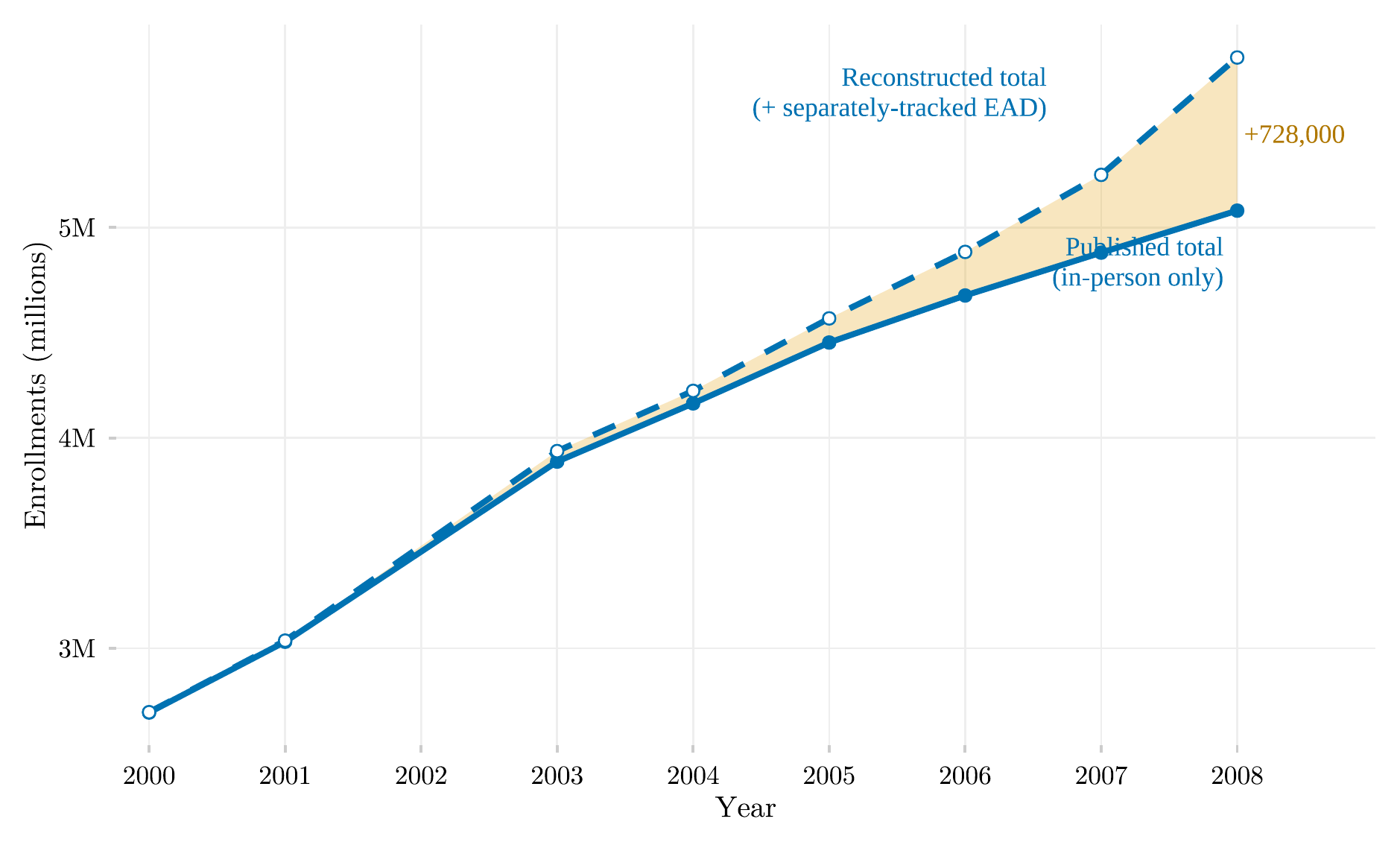
This figure documents a gap in Brazil’s official higher-education statistics between 2000 and 2008: distance-learning enrollment was tracked separately by INEP but left out of the headline published totals. It shows both the officially published (in-person only) total and a reconstructed total that adds the separately tracked distance-learning enrollment back in, revealing how much bigger the true tertiary system already was.
Methodology
Between 2000 and 2008, INEP tracked distance enrollment (EAD) in a separate table and excluded it from published headline totals. The shaded band is the resulting undercount, which grows to roughly 700 thousand students by 2008; the dashed line shows the educabr2 package’s reconstructed totals (is_derived = TRUE), which add the separately tracked distance-learning figures back into the published in-person total.
How to Cite
If you use this figure or the pipeline behind it, please cite both the dissertation and this specific analysis. References follow APA 7th edition.
Dissertation (in preparation; the entry will be updated after the defense):
Mançano, T. (2026). Inequality in access to tertiary education in Brazil: Household incomes, reforming policies, and the politics of who gets in (1990s–2020s) [Unpublished master’s thesis]. University of São Paulo.
This figure and pipeline:
Mançano, T. (2026, July 12). The distance-education undercount and reconstructed tertiary enrollment totals [Figure and reproducible pipeline]. Open Data Analysis. https://mancano-tales.github.io/open-data-analysis/posts/educabr2-enrollment-reconstructed/
In text: (Mançano, 2026) — when citing several analyses from this catalog in the same work, APA distinguishes them as 2026a, 2026b, … in the order they appear in the reference list.
BibTeX:
@mastersthesis{Mancano2026Thesis,
  author = {Man\c{c}ano, Tales},
  title  = {Inequality in Access to Tertiary Education in Brazil: Household
            Incomes, Reforming Policies, and the Politics of Who Gets In
            (1990s--2020s)},
  school = {University of S\~{a}o Paulo},
  year   = {2026},
  type   = {Master's thesis},
  note   = {Unpublished; Graduate Program in Political Science}
}

@misc{Mancano2026_educabr2_enrollment_reconstructed,
  author       = {Man\c{c}ano, Tales},
  title        = {The distance-education undercount and reconstructed tertiary enrollment totals},
  year         = {2026},
  month        = jul,
  howpublished = {Open Data Analysis, \url{https://mancano-tales.github.io/open-data-analysis/posts/educabr2-enrollment-reconstructed/}},
  note         = {Figure and reproducible pipeline. Source code: \url{https://github.com/mancano-tales/open-data-analysis}, folder posts/educabr2-enrollment-reconstructed/. Accessed YYYY-MM-DD}
}
A permanent version (Git tag + Zenodo DOI) will be linked here once the dissertation is defended; until then, cite the page URL above and add the date you accessed it (source code: https://github.com/mancano-tales/open-data-analysis, folder posts/educabr2-enrollment-reconstructed/).
Pipeline
Scripts for this analysis:
Reproducibility
Tier: A (cross-repo)
This pipeline depends on the public R package educabr2 (remotes::install_github("mancano-tales/educabr2")), which already embeds the necessary data.