Distance Learning and the Reach of Student Aid Policies
Overview
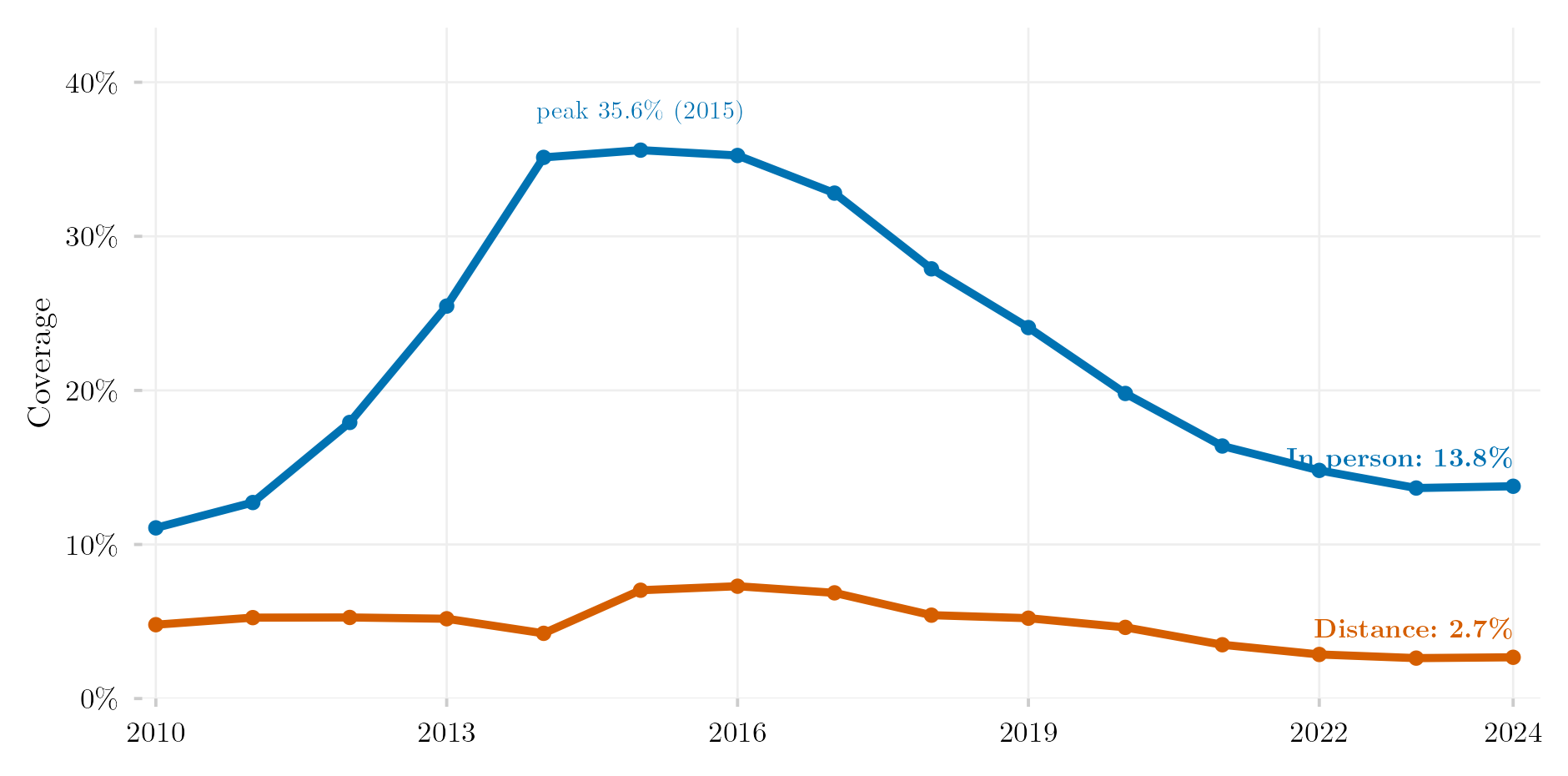
This figure asks whether Brazil’s main private-sector student aid programs (ProUni scholarships and FIES loans) kept pace with the explosive growth of distance-learning (EaD) enrollment. Rather than looking at the raw number of students covered by aid, it looks at what fraction of private enrollment, within each mode of delivery, is covered — a more policy-relevant way of asking whether aid reached where the system actually grew.
Methodology
Drawn from the same SEDAP+ extraction as the enrollment-by-sector-and-route figure. The quantity plotted is a ratio within each mode of delivery (distance vs. in-person): enrollment holding a ProUni scholarship or a FIES loan, over all private enrollment in that mode. Public-sector enrollment is excluded, since a seat that carries no price cannot be described as covered or uncovered by aid. In absolute terms, ProUni coverage in distance learning looks stable — but the ratio shown here reveals that the same absolute count covered a shrinking fraction of a modality that more than doubled in size, which is the more policy-relevant reading of whether the aid instruments reached where the system actually grew.
How to Cite
If you use this figure or the pipeline behind it, please cite both the dissertation and this specific analysis. References follow APA 7th edition.
Dissertation (in preparation; the entry will be updated after the defense):
Mançano, T. (2026). Inequality in access to tertiary education in Brazil: Household incomes, reforming policies, and the politics of who gets in (1990s–2020s) [Unpublished master’s thesis]. University of São Paulo.
This figure and pipeline:
Mançano, T. (2026, August 6). Distance learning and the reach of student aid policies [Figure and reproducible pipeline]. Open Data Analysis. https://mancano-tales.github.io/open-data-analysis/posts/descolamento-ead-politicas/
In text: (Mançano, 2026) — when citing several analyses from this catalog in the same work, APA distinguishes them as 2026a, 2026b, … in the order they appear in the reference list.
BibTeX:
@mastersthesis{Mancano2026Thesis,
  author = {Man\c{c}ano, Tales},
  title  = {Inequality in Access to Tertiary Education in Brazil: Household
            Incomes, Reforming Policies, and the Politics of Who Gets In
            (1990s--2020s)},
  school = {University of S\~{a}o Paulo},
  year   = {2026},
  type   = {Master's thesis},
  note   = {Unpublished; Graduate Program in Political Science}
}

@misc{Mancano2026_descolamento_ead_politicas,
  author       = {Man\c{c}ano, Tales},
  title        = {Distance learning and the reach of student aid policies},
  year         = {2026},
  month        = aug,
  howpublished = {Open Data Analysis, \url{https://mancano-tales.github.io/open-data-analysis/posts/descolamento-ead-politicas/}},
  note         = {Figure and reproducible pipeline. Source code: \url{https://github.com/mancano-tales/open-data-analysis}, folder posts/descolamento-ead-politicas/. Accessed YYYY-MM-DD}
}
A permanent version (Git tag + Zenodo DOI) will be linked here once the dissertation is defended; until then, cite the page URL above and add the date you accessed it (source code: https://github.com/mancano-tales/open-data-analysis, folder posts/descolamento-ead-politicas/).
Pipeline
Run these scripts in this order, from the project root (each one writes to data-raw/, which the next one reads):
shared-pipeline/sedap/010_SEDAP_Cliente.R— SEDAP+ API client, sourced by the script below — requires theSEDAP_TOKENenvironment variableshared-pipeline/sedap/020_Extrair_Nicho_2020_2024.R— extracts enrollment by sector × access route × shift/modality from the SUP_ALUNO tables 2010–2024 via SEDAP+ and writesdata-raw/INEP/derived/nicho_agregado_sedap_2010_2024.csvplot.R— readsdata-raw/INEP/derived/nicho_agregado_sedap_2010_2024.csv; writes the figure tooutput/figures/descolamento-ead-politicas/— compare it with this post’sthumbnail.png
The SEDAP+ steps only run with an approved INEP credential exported as SEDAP_TOKEN (see Reproducibility below); the extracted CSV is not redistributed here.
Reproducibility
Tier: B
This pipeline depends on restricted INEP data accessible via SEDAP+ credentials (SEDAP_TOKEN environment variable). Without an approved credential, the scripts in shared-pipeline/sedap/ will not run — the logic remains available for audit, but full reproduction requires requesting access.